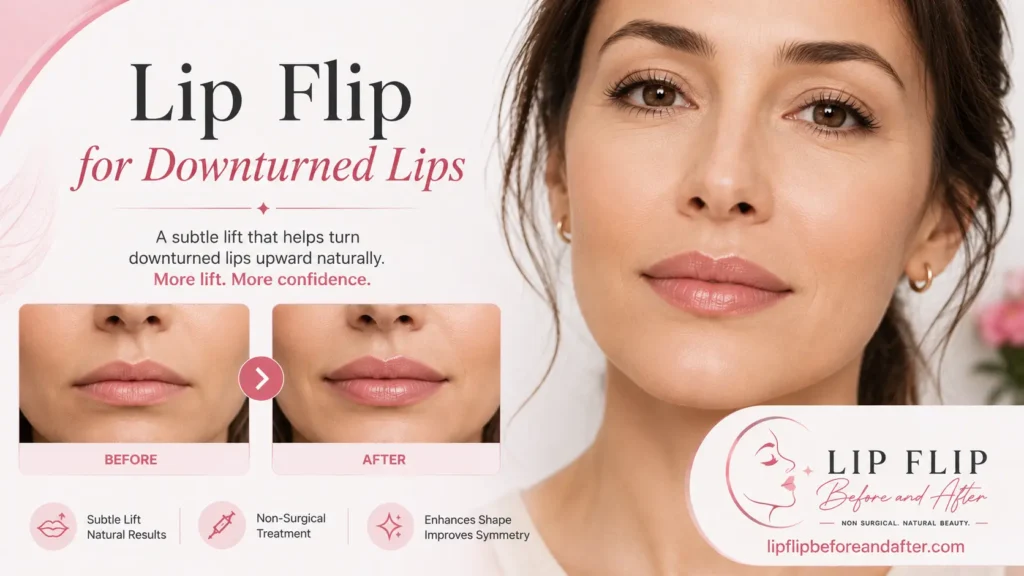
If the corners of your mouth naturally point down, even when you’re not frowning, you’ve probably wondered whether a lip flip for downturned lips can help. It’s a fair question — a lot of people are told a “lip flip” is the answer to almost any lip concern, but downturned corners are a slightly different problem than thin lips or a gummy smile. The good news is that there is a Botox-based option that can soften a downturned mouth, but it isn’t always the same injection pattern as a classic lip flip. This guide breaks down exactly what works, what a real lip flip can and can’t do for drooping mouth corners, and how to talk to your injector about it so you get a result that actually matches what you’re picturing.
A lip flip for downturned lips uses botulinum toxin (Botox, Dysport, or Xeomin) to relax specific muscles around the mouth so the upper lip rolls outward and the corners look less pulled down. A traditional lip flip targets the orbicularis oris muscle, but true correction of downturned corners usually needs botox placed in the depressor anguli oris (DAO) muscle, sometimes combined with a standard lip flip for a fuller, more balanced result.
Table of Contents
Key Takeaways
- A downturned mouth is mainly caused by the depressor anguli oris (DAO) muscle, not the muscle a classic lip flip targets.
- A standard lip flip for downturned lips softens the upper lip and can create a subtle lift, but DAO Botox is the more targeted fix for the corners themselves.
- Many injectors combine both treatments for a natural, balanced improvement.
- Results typically appear within 3–7 days and last about 3–4 months.
- A lip flip does not add volume — if you also want fuller lips, filler is a separate, complementary option.
- Downturned corners caused by loose skin, bone loss, or deep folds may respond better to a lip corner lift (surgical) than to Botox alone.
What Causes a Downturned Mouth?
Before deciding whether a lip flip for downturned lips is right for you, it helps to understand why your mouth corners point down in the first place. A few things are usually at play:
- An overactive depressor anguli oris (DAO) muscle. This small muscle runs from the jawline up to each corner of the mouth. Its job is literally to pull the corners down — it’s the muscle you use to frown. In some people, it’s naturally strong or dominant, creating a resting “sad” expression even when they feel perfectly happy.
- Age-related volume loss. As collagen and fat pads in the lower face shrink, the corners of the mouth can droop and marionette lines deepen.
- Loss of skin elasticity. Sun damage and natural aging reduce skin’s ability to bounce back, adding to the downward pull.
- Genetics and bone structure. Some people are simply born with a mouth shape where the corners sit lower relative to the rest of the lip line.
This matters because a downturned mouth isn’t always one problem — it can be muscular, volumetric, or structural, and often a mix of all three. That’s why the right treatment depends on which factor is doing most of the work in your case.
How a Lip Flip for Downturned Lips Actually Works
A classic lip flip relaxes the orbicularis oris, the circular muscle that wraps around the mouth. When this muscle softens near the upper lip border, the lip rolls slightly outward and upward, making it look fuller and giving the illusion of a gentle lift at the center of the smile.
For downturned corners specifically, injectors often extend or adjust this approach to include the depressor anguli oris. Weakening the DAO stops it from pulling the corners down as forcefully, which allows the naturally opposing muscles to hold the corners in a more neutral, slightly upturned position. In practice, this is sometimes called “DAO Botox” or “downturned mouth Botox,” and it’s frequently paired with a traditional lip flip so the upper lip and the corners improve together.
If you want to see what this combination can look like in practice, it helps to browse real lip flip before and after results, especially ones showing the mouth at rest rather than smiling, since that’s where a downturned mouth is most visible.
Step-by-Step: What Happens During Treatment
- Consultation and muscle assessment. Your injector examines your resting expression and asks you to purse and relax your lips to map exactly how your DAO and orbicularis oris behave.
- Marking injection points. Points are marked near the corners of the mouth (for the DAO) and along the upper lip border (for the flip effect).
- Injecting the toxin. Using a very fine needle, small amounts of botulinum toxin are placed at each marked point. Most patients describe this as a quick pinch rather than significant pain.
- Observation. You’ll be watched briefly for any immediate swelling or asymmetry before you leave.
- Aftercare instructions. You’ll be told to avoid rubbing the area, strenuous exercise, and lying flat for a few hours.
For a broader look at how the underlying technique works, see this explainer on how does a lip flip work.
Lip Flip vs. Lip Corner Lift: Which One Actually Fixes Downturned Corners?
This is one of the most common points of confusion, and it’s worth being direct about it: a lip flip and a lip corner lift are not interchangeable treatments. One is temporary and non-surgical; the other is a permanent surgical procedure.
| Factor | Lip Flip (Botox) | Lip Corner Lift (Surgical) |
| What it treats | Muscle overactivity (DAO and/or orbicularis oris) | Excess skin, deep folds, structural droop |
| Downtime | None to minimal | 1–2 weeks |
| Results last | 3–4 months | Permanent (with normal aging after) |
| Cost | $$ (lower) | $$$$ (higher, surgical fees apply) |
| Best for | Mild to moderate downturn from muscle pull | Significant, long-standing droop or excess skin |
| Reversibility | Fully reversible as it wears off | Permanent |
| Anesthesia | None | Local, sometimes with sedation |
If your downturn is mild and mostly happens because your DAO muscle is strong, a lip flip for downturned lips or DAO Botox is usually the smarter first step — it’s low-risk and lets you “test drive” a lifted look before committing to anything permanent. If skin laxity or bone loss is the main driver, Botox alone will underdeliver, and a corner lift or combination approach may be worth discussing. For a deeper side-by-side, see lip lift vs lip flip and lip flip vs corner lip lift.
Botox vs. Dysport vs. Xeomin for a Downturned Mouth
All three are botulinum toxin type A products, and any of them can be used for this treatment. The differences are mostly in onset speed and diffusion, not in whether they “work.”
| Brand | Onset | Typical Duration | Notes |
| Botox | 3–7 days | 3–4 months | Most commonly requested by name |
| Dysport | 2–5 days | 3–4 months | May spread slightly more, useful for larger areas |
| Xeomin | 3–7 days | 3–4 months | “Naked” formula with no accessory proteins |
Your injector’s product preference matters less than their experience with lower-face anatomy. Getting downturned mouth injections wrong can affect your smile and speech, so this is not the treatment to shop for based on price alone. You can compare specific formulations in more detail on dysport lip flip and xeomin vs botox lip flip.
How Many Units Do You Need?
Dosing for a lip flip for downturned lips is small compared to areas like the forehead. Most injectors use approximately 2–4 units per DAO muscle (4–8 units total for both corners), plus another 4–8 units if a traditional lip flip is added to the upper lip. Your exact dose depends on muscle strength, lip anatomy, and how much movement you want to preserve. For a full breakdown, check how many units of botox for lip flip.
Featured snippet answer: Most patients need 2–4 units of Botox per side for DAO correction, plus 4–8 units for a standard lip flip if combined, totaling roughly 8–16 units depending on individual anatomy and injector technique.
Timeline: When Will You See Results?
- Day 1–2: Minor swelling or pinpoint redness at injection sites; muscle is not yet affected.
- Day 3–5: The DAO and/or orbicularis oris begin to relax; corners start looking less pulled down.
- Day 7–10: Full effect is visible — this is when most people notice the biggest change.
- Week 6–8: Results are stable and at their peak.
- Month 3–4: Effect gradually fades as muscle activity returns.
If you want to track this stage by stage, lip flip results day by day and lip flip healing stages walk through what’s normal at each point.
Benefits of a Lip Flip for Downturned Lips
- Softens a resting “sad” or “angry” expression without surgery
- No incisions, no downtime for most people
- Can be combined with a standard lip flip for a fuller, more balanced smile
- Fully reversible if you don’t like the outcome
- Relatively affordable compared to surgical correction
- Quick appointment — often done in 15–20 minutes
Limitations and Realistic Expectations
- It won’t remove excess skin or deep folds caused by aging
- It doesn’t add volume — lips won’t look bigger unless combined with filler
- Overcorrection can create asymmetry or a “duck lip” look if too much toxin is placed in the wrong spot
- Results are temporary and require maintenance every 3–4 months
- If the downturn is caused by bone structure rather than muscle, Botox has limited effect
Being upfront about these limits matters — no injectable can permanently reverse structural aging, and a good injector will tell you honestly whether Botox is likely to give you the change you’re hoping for or whether you need something more.
Common Mistakes to Avoid
- Choosing an inexperienced injector. The DAO sits close to the depressor labii inferioris; misplaced injections can cause an uneven smile.
- Going too aggressive on the first try. Start conservative — you can always add more toxin at a touch-up.
- Expecting volume, not just lift. If you want fuller lips too, ask about combining with filler (see lip flip with filler).
- Ignoring your smile mechanics. Tell your injector if you rely heavily on your lower lip for speech or wind instruments — technique may need to adjust.
- Skipping the consultation. Photos of your resting face (not smiling) help the injector see the true extent of the downturn.
Tips for the Best, Most Natural Results
- Bring a photo of yourself from 10–15 years ago if you have one — it helps the injector understand your natural resting expression.
- Ask specifically whether they’re treating the DAO, the orbicularis oris, or both, so you know what to expect.
- Avoid alcohol and blood thinners for 24–48 hours before your appointment to reduce bruising risk.
- Plan your appointment 1–2 weeks before any big event, since full results take about a week to show.
- If you’re nervous about looking “overdone,” ask for a conservative starting dose — you can always add more at a follow-up.
Cost of a Lip Flip for Downturned Lips
Pricing varies by provider, geography, and whether DAO treatment is combined with a standard lip flip. In the U.S., a lip flip alone typically runs $100–$400, while adding DAO correction may add $50–$150 depending on units used. Surgical corner lifts cost significantly more, often $2,500–$6,000, since they involve an operating fee, anesthesia, and aftercare. For current pricing breakdowns, see lip flip cost and how much does a lip flip cost.
Aftercare: What to Do (and Avoid) After Treatment
- Avoid touching, massaging, or applying pressure to the treated area for at least 4 hours
- Stay upright for 3–4 hours after injection
- Skip strenuous exercise for the rest of the day
- Avoid extreme heat (saunas, hot yoga) for 24 hours
- Wait to drink through a straw until your injector confirms it’s safe
You can find more detail on daily do’s and don’ts at lip flip aftercare and can you eat after a lip flip.
Who Is a Good Candidate?
A lip flip for downturned lips tends to work best for people who:
- Notice their mouth corners droop even when relaxed or neutral
- Have mostly muscular (not structural) causes of downturn
- Want a low-commitment way to trial a lifted look
- Are in good general health with no known allergy to botulinum toxin
- Have realistic expectations about subtlety and duration
It may be less suitable for people with significant skin laxity, prior lip surgery affecting muscle function, or neuromuscular conditions — always disclose your full medical history during consultation.
Frequently Asked Questions
Can a lip flip really fix downturned lips? A lip flip can soften the appearance of downturned corners when the cause is muscular, but it works best when it specifically targets the depressor anguli oris rather than just the upper lip border.
Is DAO Botox the same as a lip flip? No. A traditional lip flip targets the orbicularis oris around the upper lip, while DAO Botox targets the muscle that pulls the mouth corners down. They’re often combined but are technically different treatments.
How long does a lip flip for downturned lips last? Most people see results for 3–4 months before the effect gradually fades and the treatment needs to be repeated. See how long does a lip flip last for more detail.
Does treating downturned lips with Botox hurt? Most people describe it as a brief pinch at each injection site rather than significant pain. Numbing cream is sometimes offered for extra comfort.
Will my smile look different afterward? A well-placed treatment shouldn’t restrict your smile — the goal is to soften the resting droop, not limit natural movement. Ask your injector how they plan to preserve smile symmetry.
Can I combine a lip flip with lip filler? Yes. Many patients combine the two — the flip softens the corner droop and defines the border, while filler adds volume. Botox is typically done first, with filler added once swelling settles.
What if my downturn comes back quickly? If results fade faster than expected, it may be due to muscle strength, metabolism, or dosage. Talk to your injector about adjusting the unit count at your next visit.
Is a lip flip better than a lip corner lift for downturned mouths? It depends on the cause. Botox-based approaches work well for muscle-driven droop, while a surgical corner lift is better for excess skin or long-standing structural sagging.
Can men get a lip flip for downturned lips? Yes, and it’s increasingly common for men who want a less severe or “tired” resting expression without changing their overall lip shape dramatically.
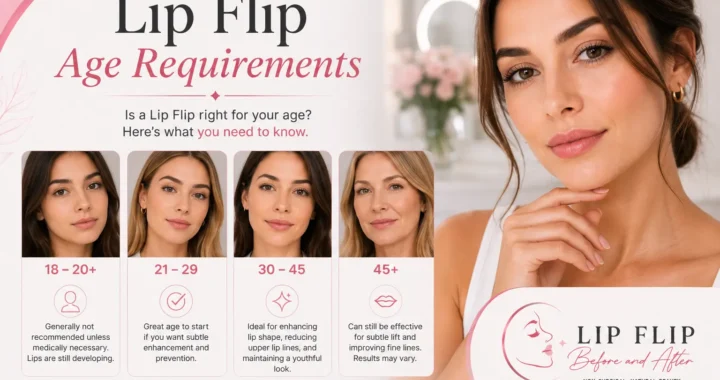
Does age affect how well this treatment works? Younger patients with mostly muscular causes tend to see cleaner results. Older patients with more skin laxity may need to combine Botox with volume or a surgical approach for full correction.
How soon can I get a touch-up? Most injectors recommend waiting the full 3–4 month cycle before repeating treatment, unless correcting an asymmetry from the original session.
Are there any side effects specific to treating downturned corners? Temporary bruising, swelling, or mild asymmetry are the most common side effects. Rarely, an uneven smile can occur if the toxin spreads beyond the intended muscle.
Can this treatment fix a gummy smile too? Not directly — a gummy smile involves different muscles (the levator labii superioris group). It’s a separate treatment, though some patients address both concerns in the same visit.
Summary
A lip flip for downturned lips can be an effective, low-commitment way to soften a resting “sad” or “tired” mouth expression, especially when the droop is caused by an overactive depressor anguli oris muscle. It’s not the same as a standard lip flip, though the two are frequently combined for a fuller and more balanced result. If your downturn comes from skin laxity or bone structure rather than muscle pull, a surgical lip corner lift may give you more lasting correction. Either way, the best results come from a qualified, experienced injector who assesses your specific facial anatomy rather than applying a one-size-fits-all approach — so always start with a proper consultation before deciding which treatment is right for you.
This article is for general educational purposes and is not a substitute for professional medical advice. Always consult a qualified, licensed injector or healthcare provider before undergoing any cosmetic procedure.