If you’re Wondering about a lip flip while breastfeeding? See what current research says, why guidance is cautious, and how to make an informed decision.
and thinking about getting back to your usual beauty routine it’s completely normal to wonder whether a lip flip is safe. Unlike pregnancy where recommendations are more consistent breastfeeding is a little different. The available evidence has improved over the years but the decision is still a personal one that should be made with your healthcare provider.
A lip flip uses a small amount of a neuromodulator usually Botox injected into the muscles above the upper lip. Since breastfeeding women have rarely been included in clinical studies there hasn’t been much direct safety data. However newer research has provided more information about whether Botox reaches breast milk and the findings are more reassuring than they were in the past.
This guide explains what current research says why many providers still recommend caution and what you should discuss with your doctor before making a decision.
Table of Contents
Is a Lip Flip Safe While Breastfeeding
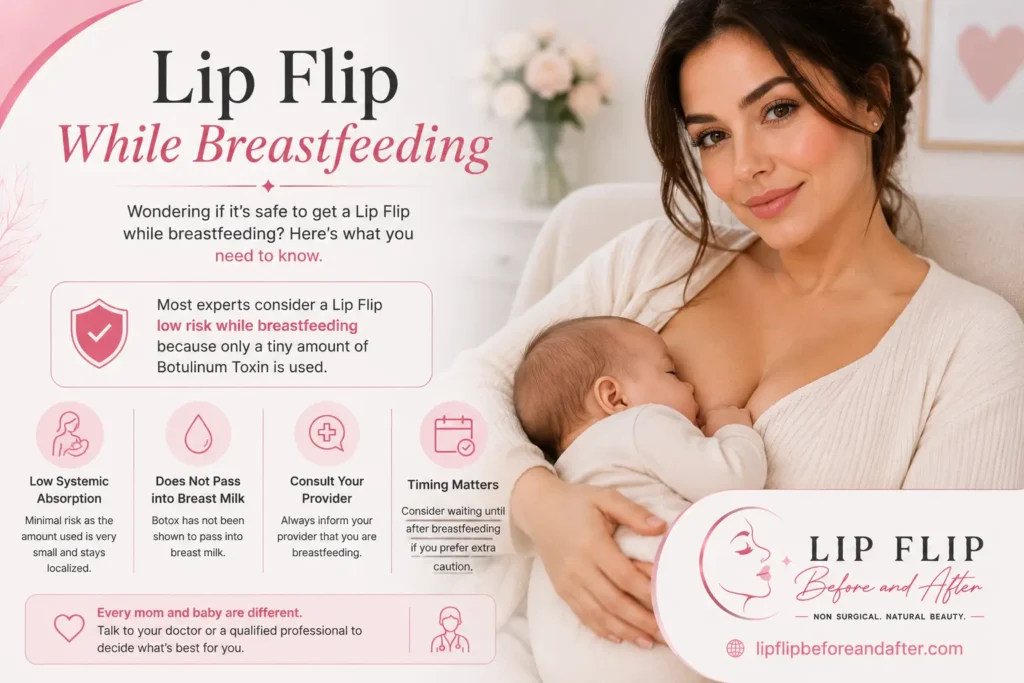
Current evidence suggests that the risk of Botox passing into breast milk in significant amounts is very low. The product usually stays close to the injection site instead of spreading throughout the body. Even so long term safety research is still limited and manufacturers continue to recommend caution. Because of this many providers now treat it as a personal decision rather than giving every patient the same answer.
Key Takeaways
- Recent studies found little or no detectable botulinum toxin in breast milk after cosmetic Botox treatments.
- Large clinical studies in breastfeeding women are still unavailable.
- Many providers now discuss the risks and benefits with each patient instead of automatically refusing treatment.
- Some clinics continue to avoid treating breastfeeding patients as a precaution.
- Non injectable alternatives are available if you prefer to wait.
- Speaking with your OB GYN pediatrician or lactation consultant is the best way to make an informed decision.
Why There Isn’t a Simple Yes or No Answer
Researchers cannot ethically perform controlled studies that expose breastfeeding infants to cosmetic treatments. Because of this most of the available information comes from smaller studies case reports and precautionary recommendations rather than large clinical trials.
In recent years several studies have looked at whether botulinum toxin appears in breast milk after facial Botox injections. Some found no detectable toxin while others found only extremely small trace amounts. This has changed the conversation from a clear no to a more balanced discussion between patients and healthcare providers.
Read More: Lip Flip Before Photoshoot: Ideal Timing and Prep Guide
What Recent Research Suggests
Small studies have generally shown either no detectable botulinum toxin or only tiny trace amounts in breast milk after facial Botox injections. Botox is a large molecule that usually remains near the injection site instead of circulating throughout the body. Because of this researchers believe that meaningful transfer into breast milk is unlikely although it has not been completely ruled out.
It’s important to understand that low risk does not mean proven safe. The evidence is encouraging but still limited which is why healthcare professionals continue to recommend a cautious approach.
Why Manufacturers Still Recommend Caution
Botox manufacturers advise against using the product while breastfeeding because large scale safety studies have not been completed. This recommendation is based on the lack of definitive evidence rather than confirmed evidence of harm. Similar precautionary guidance exists for many medications used during breastfeeding.
How Providers Handle This Today
| Provider Approach | What It Means |
|---|---|
| Standard precaution | Does not treat breastfeeding patients under any circumstances. |
| Individual assessment | Reviews the latest research discusses your situation and helps you make an informed decision. |
| Physician approval | Requests clearance from your OB GYN or pediatrician before treatment. |
Each approach reflects a different level of caution. If you’re considering treatment while breastfeeding ask providers about their policy and the reasons behind it before booking an appointment.
Questions to Ask Your Doctor
- What does the latest research say about Botox and breastfeeding.
- Does my personal health history or my baby’s health change the recommendation.
- Would using a smaller dose reduce any possible risk.
- Is there an ideal time to schedule treatment around breastfeeding sessions.
- Based on my situation what would you personally recommend.
You can also discuss these questions during your lip flip consultation along with advice from your OB GYN pediatrician or lactation consultant.
If You Decide to Wait
Waiting until breastfeeding is finished will not affect your future lip flip results. The effects naturally wear off after about eight to twelve weeks and your lip muscles simply return to their normal state. When you’re ready you can safely restart treatment according to your provider’s recommendations.
Read More: Lip Flip During Pregnancy: What You Need to Know
Non Injectable Alternatives
If you’d rather avoid injections while breastfeeding there are a few temporary alternatives you can consider.
- Lip plumping glosses for short term fullness.
- Lip liner and makeup techniques to enhance the appearance of the lips.
- Surface treatments such as certain chemical peels microneedling or LED therapy after discussing them with your healthcare provider.
Pros
- Current research suggests the overall risk is low.
- You can continue your cosmetic routine without waiting until breastfeeding ends.
- Decisions are based on your personal circumstances rather than a one size fits all approach.
Cons
- Long term safety studies are still lacking.
- Manufacturers continue to recommend caution.
- Some providers will not perform the treatment while you’re breastfeeding.
- You may need additional discussions with your doctor before moving forward.
Common Mistakes to Avoid
- Assuming low risk means completely proven safe.
- Forgetting to tell your injector that you’re breastfeeding.
- Making the decision without medical advice.
- Choosing a provider simply because they agreed to perform the treatment.
- Ignoring your own comfort level if you’d rather wait.
Frequently Asked Questions
Has research changed in recent years
Yes. Recent studies have found little or no detectable botulinum toxin in breast milk after facial Botox injections. Even so more research is still needed.
Why aren’t there larger studies
Researchers cannot ethically expose breastfeeding infants to elective cosmetic treatments which limits the type of research that can be performed.
Does the type of neuromodulator matter
Most available research focuses on Botox. There is less information about Dysport Xeomin and Jeuveau so discuss these options with your provider.
Is a smaller dose safer
There is no strong evidence showing that a smaller dose or a different treatment area changes the risk during breastfeeding.
Why do providers have different policies
Different clinics interpret the available evidence differently. Some prefer maximum caution while others make decisions on a case by case basis.
Should I pump and dump after treatment
Some recent guidance suggests this may not be necessary but you should always follow the advice of your doctor or lactation consultant.
Is there a safer stage of breastfeeding
Current research has not identified a specific stage of breastfeeding that is safer for treatment.
Does breastfeeding change how long a lip flip lasts
There is no evidence that breastfeeding affects how long Botox results last.
Summary Lip Flip While Breastfeeding
Research on lip flips during breastfeeding has become more encouraging over the past few years. Available studies suggest that the amount of Botox reaching breast milk is either extremely small or not detectable. However long term safety research is still limited and manufacturers continue to recommend caution. The best approach is to discuss your situation with your OB GYN pediatrician or lactation consultant and choose a qualified provider who explains both the benefits and the uncertainties. This allows you to make the decision that feels right for you and your baby.
This article is for educational purposes only and should not replace professional medical advice. Always consult a qualified healthcare provider before making decisions about cosmetic treatments while breastfeeding.