If you’ve ever wondered exactly where to inject Botox for lip flip results that look natural instead of frozen, you’re asking the right question. The lip flip has become one of the most requested “starter” injectables, but its success depends almost entirely on precise placement — not on how much product is used.
This guide breaks down the exact injection points, the anatomy behind them, dosing ranges, what happens if placement goes wrong, and how the results compare to fillers. Whether you’re a patient preparing for a consultation or simply researching before you book, you’ll leave knowing exactly what a skilled injector is doing and why. For visual reference points, our lip flip before and after photos gallery shows how correct placement translates into real results.
Table of Contents
Quick Answer: Where Is Botox Injected for a Lip Flip?
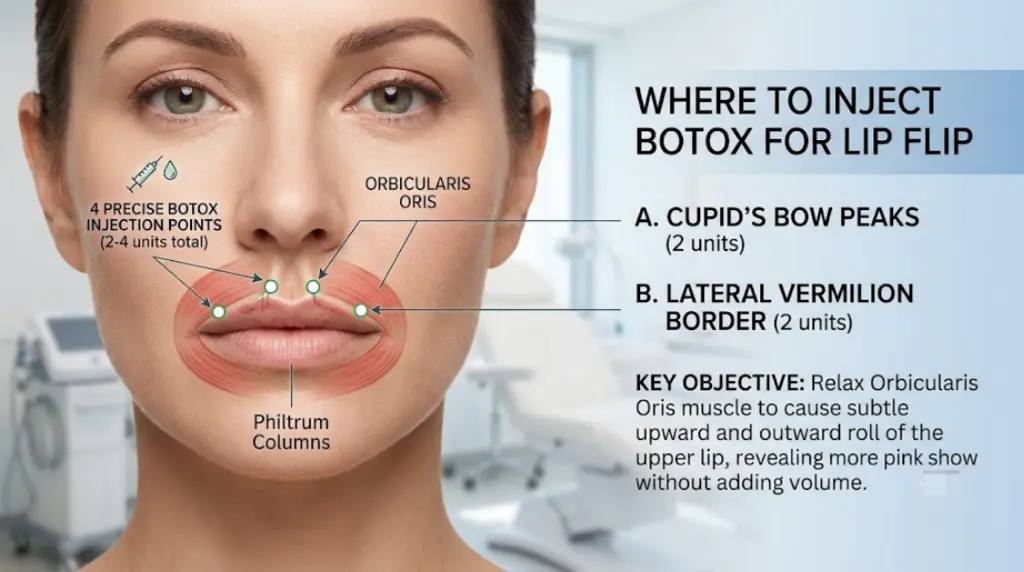
Botox for a lip flip is injected into the orbicularis oris muscle, the ring-shaped muscle circling the mouth — specifically along the outer edge of the upper lip, just above the vermilion border (where the lip color meets the skin). Injectors typically place 4–6 small injection points: 2 central points near the Cupid’s bow and 2–4 lateral points toward the corners, using roughly 4–8 total units.
Key Takeaways
- Where to inject Botox for lip flip results is the upper portion of the orbicularis oris muscle, never the vermilion border itself.
- Typical placement uses 4–6 points spaced evenly across the upper lip.
- Total dosing is usually 4–8 units, far less than Botox used for forehead lines or crow’s feet.
- The lower lip is rarely treated, since over-relaxing both lips can affect speech and lip seal.
- Results appear in 2–7 days, peak by week two, and fade in 6–12 weeks.
- A lip flip is reversible and temporary — unlike filler, it adds no volume, only lift.
What a Lip Flip Actually Does
A lip flip uses small doses of botulinum toxin (Botox, Dysport, or Xeomin) to relax the upper portion of the orbicularis oris muscle. As this muscle loosens, the upper lip rolls slightly outward and upward, exposing more of the pink vermilion tissue. The lip looks fuller and more defined, even though not a single drop of volume has been added.
This is the core difference people miss when comparing treatments: a lip flip changes how the lip behaves, while filler changes how much tissue is there. If you’re deciding between the two, our guide on what is a lip flip breaks down the mechanism in more depth, and botox lip flip covers product-specific differences.
The Anatomy Behind Correct Injection Placement
Understanding where to inject Botox for lip flip treatment starts with the structures involved, not just the injection points themselves.
Orbicularis Oris Muscle
This sphincter-like muscle encircles the entire mouth and controls puckering, speaking, whistling, and lip closure. Only the superficial fibers along the upper lip’s outer edge are targeted for a flip — the deeper fibers responsible for full lip seal are left untouched.
Vermilion Border
This is the sharp line separating the colored lip tissue from the surrounding skin. Injections are placed above this border, never directly into it. Injecting into the vermilion border itself risks an uneven smile and difficulty sealing the lips.
Philtrum and Cupid’s Bow
These central landmarks shape the upper lip’s silhouette. Central injection points are placed carefully around this area to enhance the bow’s definition rather than flatten it.
Labial Arteries
Small blood vessels run just beneath the lip tissue. Superficial injection technique keeps the needle above this vascular layer, which is why lip flips carry a lower bruising risk than deep filler injections.
Standard Injection Points for a Lip Flip
Most injectors follow a consistent point pattern, adjusted slightly for each patient’s lip shape and muscle strength.
| Injection Zone | Location | Typical Dose per Point | Purpose |
| Central points (x2) | Just above the Cupid’s bow, on either side of the philtrum | 1–1.5 units | Creates central lift and definition |
| Lateral points (x2–4) | Along the outer upper lip, toward the corners | 0.5–1 unit | Balances the flip across the full lip width |
| Optional lower lip point | Center of lower lip (rarely used) | 1–2 units | Softens a deep lower lip line (used sparingly) |
Total dosing generally lands between 4 and 8 units, though this varies by product (Botox, Dysport, and Xeomin are dosed differently) and by how strong the patient’s orbicularis oris muscle is. Someone with a very active, strong muscle — often visible as prominent lip lines when smiling — may need slightly more product than someone with a naturally relaxed upper lip.
Where NOT to Inject
Knowing where to avoid is just as important as knowing where to inject Botox for lip flip success.
- Directly into the vermilion border — risks asymmetry and an uneven smile.
- Too close to the mouth corners — can weaken the depressor anguli oris, dragging the smile down on one side.
- Too deep into the muscle body — can affect speech clarity and the ability to purse the lips.
- Both lips heavily — over-treating the lower lip alongside the upper lip increases the risk of difficulty drinking from a straw or whistling.
A well-trained injector marks these points before injecting and reassesses lip symmetry at rest and while smiling.
Lip Flip vs. Lip Filler: Placement and Results Compared
| Factor | Lip Flip (Botox) | Lip Filler (Hyaluronic Acid) |
| Injection target | Orbicularis oris muscle | Lip tissue and mucosa |
| Mechanism | Relaxes muscle to roll lip outward | Adds physical volume |
| Best for | Thin lips that “disappear” when smiling, gummy smiles | Adding size, shape, or symmetry |
| Units/volume | 4–8 units | 0.5–1 mL typically |
| Onset | 3–7 days | Immediate, with settling over 2 weeks |
| Duration | 6–12 weeks | 6–12 months |
| Reversibility | Wears off naturally | Can be dissolved with hyaluronidase |
| Cost (US average) | $75–$300 | $500–$800 per syringe |
Many patients eventually combine both — a small amount of Botox for lift plus a touch of filler for volume, sometimes called a “Russian lip” technique. If you’re weighing this decision, our comparison of lip flip results across different lip shapes can help set realistic expectations before your consultation.
Step-by-Step: What Happens During the Injection
- Consultation and marking — The injector examines your smile, lip shape, and muscle strength, then marks injection points with a skin-safe pen.
- Cleansing — The upper lip area is cleaned with antiseptic.
- Injection — Using a fine needle, small doses are placed at each marked point, just above the vermilion border.
- Symmetry check — You may be asked to smile, purse your lips, and speak so the injector can confirm even placement.
- Aftercare instructions — You’ll be told to avoid rubbing the area, lying flat, or exercising heavily for the rest of the day.
The entire appointment typically takes 10–20 minutes, with no downtime needed afterward.
Timeline: How Long Does a Lip Flip Take to Work and Last?
| Stage | What to Expect |
| Day 0 | Injection performed; lips may look slightly swollen or unchanged |
| Days 2–4 | First subtle signs of lift appear |
| Days 7–14 | Full effect visible; lip sits in its “flipped” position |
| Weeks 6–8 | Effect begins to soften gradually |
| Weeks 10–12 | Muscle activity returns to normal; lip reverts to baseline |
Because it’s temporary, many people repeat the treatment every 8–12 weeks to maintain the look. Some injectors note that repeated treatments can slightly train the muscle to relax more easily over time, though this effect varies by individual.
Who Is a Good Candidate?
A lip flip tends to work best for people who:
- Have a thin upper lip that flattens or disappears when smiling
- Show a gummy smile (excess gum visible when smiling)
- Want subtle enhancement without added volume
- Are hesitant about committing to filler
- Have realistic expectations about a temporary, mild change
It’s less suited for those wanting significantly bigger, more defined lips — filler or a combination approach usually serves that goal better. If you’re unsure which category you fall into, browsing real examples such as lip flip before and after for thin lips, lip flip before and after for full lips, or lip flip before and after gummy smile can help you visualize what’s achievable for your lip type.
Risks and Side Effects Linked to Injection Placement
Most side effects trace directly back to where the product was placed and how much was used.
Common and mild:
- Slight swelling or bruising at injection points
- Temporary difficulty whistling or drinking from a straw
- Mild asymmetry in the first few days
Less common, needs follow-up:
- Noticeable smile asymmetry lasting beyond two weeks
- Difficulty fully closing the lips
- Drooping near the mouth corner if product spreads beyond the intended muscle fibers
Serious complications are uncommon when an experienced, trained injector performs the procedure with correct anatomical placement. Still, it’s worth discussing your full medical history — including any neuromuscular conditions or pregnancy — with a licensed provider before treatment, since Botox is not recommended in those situations.
Cost Factors Tied to Technique
| Factor | Why It Affects Price |
| Number of units used | More units for a stronger muscle mean higher cost |
| Injector’s experience | Specialists in precise perioral anatomy often charge more |
| Product used | Botox, Dysport, and Xeomin are priced differently per unit |
| Geographic location | Urban clinics typically charge more than smaller markets |
Expect to pay anywhere from $75 to $300 in the US, depending on these factors. Choosing based on price alone is risky — precise placement matters more for a lip flip than for almost any other Botox treatment, since the treated area is small and highly visible.
Mistakes to Avoid When Choosing Where to Inject
- Going too low, into the vermilion border — the single most common cause of an unnatural or uneven smile.
- Overdosing the lateral points — can weaken the corners of the mouth.
- Treating the lower lip too aggressively — increases the odds of drinking or speech difficulty.
- Skipping the symmetry check — an injector who doesn’t ask you to smile and speak mid-appointment may miss early signs of imbalance.
- Choosing an inexperienced injector to save money — the margin for error in this small area is slim.
Tips for the Best Results
- Bring reference photos so your injector understands your goals, and check out lip flip before and after smile photos for inspiration on natural-looking outcomes.
- Avoid alcohol and blood thinners for 24 hours before your appointment to reduce bruising risk.
- Stay upright and avoid touching the treated area for several hours after injection.
- Schedule a follow-up around two weeks out so any minor asymmetry can be corrected early.
- Ask your injector directly how many units they plan to use and where — a confident, specific answer is a good sign of experience.
How Lip Flip Placement Differs by Facial Feature
Injection points aren’t identical for everyone. Injectors often adjust based on:
- Side profile balance — For some, subtle adjustments to lateral point placement improve how the lip projects from the side; see lip flip before and after side profile for how this plays out visually.
- Age-related lip thinning — Older patients may need slightly different dosing since lip tissue naturally thins over time; our lip flip before and after older woman gallery shows realistic results for this group.
- Gender-specific goals — Men often prefer a barely-there lift; lip flip before and after men shows how conservative dosing achieves this.
Frequently Asked Questions
How many units of Botox are used for a lip flip? Most lip flips use 4 to 8 total units, split across 4–6 injection points along the upper lip. The exact amount depends on muscle strength and desired subtlety.
Does a lip flip hurt? Discomfort is minimal. Most people describe a brief pinch at each injection point, similar to a quick pinprick, with no need for numbing cream in most cases.
Can Botox be injected into the lower lip for a flip? Occasionally, in very small amounts, but this is used sparingly since over-relaxing both lips raises the risk of drinking and speech difficulty.
Will a lip flip make my lips bigger? No. A lip flip doesn’t add volume — it changes the position of the existing lip tissue so more of it shows. For actual size increase, filler is the appropriate option.
How soon can I see results after the injection? Initial changes often appear within 2–4 days, with full results visible by day 10–14.
Can a lip flip go wrong if the injector places it incorrectly? Yes. Incorrect placement — especially injecting into the vermilion border or too close to the mouth corners — can cause asymmetry, an uneven smile, or difficulty with speech and eating.
Is a lip flip permanent? No. Results typically last 6–12 weeks as the muscle gradually regains normal movement.
Can I combine a lip flip with lip filler? Yes. Many providers combine a small Botox dose for lift with filler for added volume, often for a fuller yet natural-looking result.
Does a lip flip help with a gummy smile? Yes, in many cases. Relaxing the upper lip’s elevator muscles reduces how much gum shows when smiling, which is why gummy smile correction is a common secondary reason people seek this treatment.
Will I be able to drink from a straw after treatment? Some people notice mild, temporary difficulty for the first few days as the muscle adjusts, but this typically resolves on its own.
How do I know if my injector chose the right injection points? Ask them to explain their plan before starting, and check that your smile and lip closure look symmetrical when you test them mid-appointment.
Is a lip flip safe for everyone? It’s not recommended for pregnant or breastfeeding individuals, or those with certain neuromuscular conditions. A licensed provider should review your medical history beforehand.
Summary
Where to inject Botox for lip flip results comes down to precision: the outer edge of the upper lip’s orbicularis oris muscle, just above (never into) the vermilion border, using 4–8 units across 4–6 carefully spaced points. Correct placement is what separates a natural, subtle lift from an uneven smile or functional side effects. Because the margin for error is small, choosing an experienced, licensed injector matters more here than in almost any other cosmetic injectable treatment.
If you’re still deciding whether this treatment fits your goals, reviewing real outcomes — like our full library of lip flip before and after results, or learning more about how does a lip flip work and the lip flip procedure itself — is a good next step before booking a consultation.
This article is for educational purposes only and is not a substitute for professional medical advice. Always consult a licensed, qualified injector to determine whether a lip flip is appropriate for you.