If your smile shows more gum than you’d like, you’ve probably searched for lip flip before and after gummy smile photos to see if this quick Botox treatment can actually help. It can, for many people, and the reason comes down to a very specific muscle that controls how high your upper lip lifts when you smile.
Unlike a standard lip flip aimed purely at fuller lips, a gummy smile lip flip targets the muscle responsible for excess gum exposure. A small amount of Botox relaxes that muscle so your lip doesn’t rise as high, which means your smile results show more lip and less gum. In this guide, you’ll see exactly how it works, what a realistic timeline looks like, what before and after photos typically reveal, and how it compares to other gummy smile treatment options.
Table of Contents
Quick Answer: Can a Lip Flip Fix a Gummy Smile?
A lip flip can improve a gummy smile when the cause is a hyperactive lip-lifting muscle. Botox is injected to relax the levator labii superioris alaeque nasi muscle, reducing how high the upper lip rises when you smile. This lowers gum exposure, though it won’t correct gummy smiles caused by bone structure or excess gum tissue.
Key Takeaways
- Lip flip before and after gummy smile results typically appear within 3 to 5 days and reach full effect around two weeks.
- The treatment works only on muscle-related gummy smiles, not those caused by jaw structure, short teeth, or excess gum tissue.
- Results generally last 3 to 4 months before a touch-up is needed.
- It’s non-surgical, low-downtime, and reversible in the sense that the effect wears off naturally.
- A dentist, periodontist, or licensed injector can determine whether your gummy smile is a good candidate for this gummy smile treatment.
What Causes a Gummy Smile?
Before looking at smile results, it helps to understand why gums show in the first place. A gummy smile can be caused by:
- An overactive upper lip muscle that lifts too high when smiling
- A naturally short upper lip
- Excess gum tissue covering more of the tooth surface than usual
- A jaw or bone structure that positions the upper lip higher
A lip flip only addresses the first cause. This is one of the most important things competitor pages tend to gloss over, so it’s worth repeating: if your gummy smile comes from bone structure or gum tissue, Botox alone won’t fully resolve it, and a dental or surgical consultation may be more appropriate.
How a Gummy Smile Lip Flip Works
- Assessment. A provider evaluates your smile to confirm the gummy smile is muscle-related rather than structural.
- Injection. A small dose of Botox is placed near the base of the nose and corners of the upper lip, targeting the levator labii superioris alaeque nasi muscle.
- Muscle relaxation. Over the following days, the muscle’s ability to pull the lip upward weakens.
- Lower lip line. As the muscle relaxes, the upper lip sits and moves lower when smiling, covering more gum tissue.
- Full results. The final smile results typically settle in around two weeks.
The injection itself takes only a few minutes, with discomfort usually compared to a quick pinch.
Lip Flip Before and After Gummy Smile: Timeline
| Timeframe | What to Expect |
| Day 1–2 | Minimal visible change; possible mild swelling near injection sites |
| Day 3–5 | Early signs of muscle relaxation begin |
| Day 7–10 | Noticeable reduction in gum show when smiling |
| Week 2 | Full results typically visible |
| Month 3–4 | Effects gradually fade as the Botox wears off |
| Month 4+ | Touch-up treatment usually needed to maintain results |
Individual results vary depending on muscle strength, dose, and how your body metabolizes the neuromodulator.
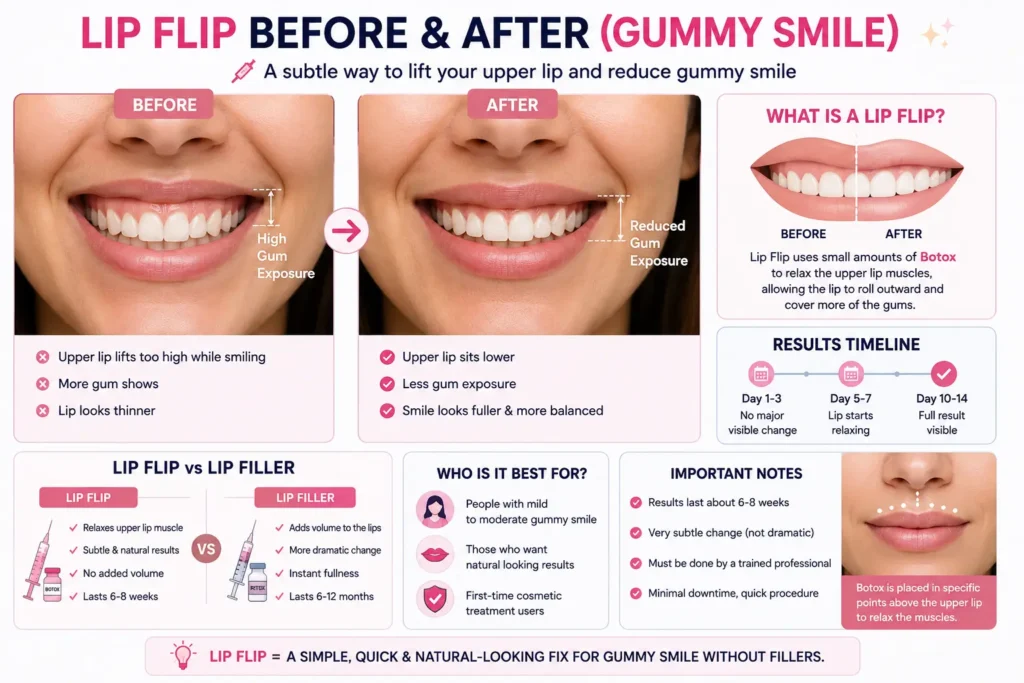
What Before and After Photos Usually Show
When comparing lip flip before and after gummy smile photos, focus on the smiling shot rather than the resting lip position, since that’s where the treatment’s effect is most visible. Common changes include:
- Less visible gum tissue when smiling
- A slightly lower resting position of the upper lip during a full smile
- A softer, more balanced smile line
- Sometimes a subtly fuller-looking upper lip, since the same muscle relaxation can affect lip position at rest
What typically doesn’t change: tooth size, gum tissue volume, or jaw structure, since Botox only relaxes muscle activity.
Gummy Smile Lip Flip vs. Other Gummy Smile Treatments
| Treatment | How It Works | Downtime | Duration | Best For |
| Lip flip (Botox) | Relaxes the lip-lifting muscle | None to minimal | 3–4 months | Muscle-related gummy smiles |
| Gum contouring | Surgically reshapes gum line | Several days | Long-term/permanent | Excess gum tissue |
| Crown lengthening | Removes gum and bone to expose more tooth | 1–2 weeks | Permanent | Short teeth covered by gum |
| Orthognathic surgery | Repositions the jaw | Weeks to months | Permanent | Skeletal causes |
A lip flip is the least invasive option on this list, which is why it’s often the first thing people try before considering surgical gummy smile treatment.
Benefits of Treating a Gummy Smile with a Lip Flip
- Quick, non-surgical procedure with little to no recovery time
- Lower cost compared to surgical gummy smile correction
- Reversible, since the effect naturally wears off
- Can improve confidence in smiling and photos
- Often improves lip fullness as a secondary benefit
Limitations to Keep in Mind
- Doesn’t correct gummy smiles caused by bone structure or excess gum tissue
- Temporary, so results require repeat treatments every few months
- Overcorrection can occasionally make it harder to fully cover the teeth when speaking or smiling widely
- Results depend heavily on accurate muscle assessment and injector experience
Common Mistakes to Avoid
- Assuming every gummy smile is muscle-related. Get an assessment first, since structural causes won’t respond to Botox.
- Choosing price over experience. Precise placement near the nose and upper lip matters for natural-looking smile results.
- Expecting permanent results. This is a temporary treatment, not a one-time fix.
- Skipping follow-up. Missing the 3 to 4 month maintenance window means the gummy smile will gradually return.
- Not communicating your goals. Some patients want a subtle reduction in gum show; others want a fuller lip appearance too. Be specific during your consultation.
Aftercare Tips
- Avoid rubbing, pressing, or massaging the treated area for at least 24 hours.
- Skip strenuous exercise the day of treatment.
- Stay upright for a few hours after your appointment.
- Avoid excessive puckering, straws, or smoking for a couple of days.
- Reach out to your provider if you notice asymmetry, drooping, or difficulty closing your lips fully.
How Much Does It Cost?
Cost depends on the number of units used, your provider’s experience, and your location. Because it uses far less product than a full lip flip or filler treatment, gummy smile correction with Botox is often one of the more affordable smile results treatments available. Ask your provider for a clear, itemized quote during your consultation, since pricing structures vary between clinics.
Lip Flip and Fuller Lips: A Related Benefit
Because the same muscle group influences both gum show and lip position, many patients notice their upper lip also looks slightly fuller after treatment. If a fuller lip appearance is part of your goal, it’s worth reviewing our detailed guide on lip flip before and after full lips, which explains how this dual effect happens and what to expect.
Seeing Results When You Smile
Since a gummy smile is only visible while smiling, it’s especially useful to look at photos taken specifically during a full smile rather than at rest. Our page on lip flip before and after when smiling shows exactly this kind of comparison, which can help you set realistic expectations for your own smile results.
If You Have Naturally Thin Lips Too
Some people dealing with a gummy smile also have thinner upper lips, and both concerns can sometimes be addressed in the same treatment plan. Our guide to lip flip before and after for thin lips covers what realistic change looks like for this lip type.
Browsing Real Before and After Examples
Reviewing a range of real photos, not just the most dramatic ones, gives a more accurate picture of what to expect. You can browse a curated set of comparisons on our lip flip before and after photos page, and for a general overview of the entire treatment, start with our lip flip before and after guide.
A Note on Safety
Treating a gummy smile with Botox is a medical procedure, and results vary based on individual anatomy, muscle strength, and the underlying cause of gum exposure. This article is intended for general information rather than medical advice. Before booking, consult a licensed provider, such as a dentist, periodontist, dermatologist, or experienced injector, who can confirm whether your gummy smile is muscle-related and appropriate for this treatment. Organizations such as the American Academy of Cosmetic Dentistry and the American Society for Dermatologic Surgery offer resources for finding qualified professionals.
Frequently Asked Questions
How long does it take to see lip flip before and after gummy smile results? Initial changes often appear within 3 to 5 days, with full results typically visible around the two-week mark.
How long do gummy smile lip flip results last? Most patients see results last around 3 to 4 months before a touch-up treatment is needed.
Does treating a gummy smile with Botox hurt? Discomfort is usually minimal, often compared to a quick pinch, and numbing is rarely needed.
Will a lip flip work for every type of gummy smile? No. It only helps gummy smiles caused by an overactive lip muscle. Structural causes like bone position or excess gum tissue need different treatments.
Can a lip flip make my lips look fuller too? Often, yes. Since the treatment relaxes the same muscle involved in lip position, many patients notice a subtly fuller upper lip as a secondary effect.
Is gummy smile Botox treatment safe? When performed by an experienced, licensed injector, it’s generally considered a low-risk procedure, though all injectable treatments carry some risk of side effects.
What’s the difference between a lip flip and gummy smile correction? They often use similar techniques and the same general muscle group, but gummy smile correction is specifically dosed and placed to reduce gum exposure, while a standard lip flip focuses more on lip fullness.
Can I combine gummy smile treatment with lip filler? Yes, many patients combine Botox for muscle relaxation with filler for added lip volume and shape.
What happens if too much Botox is used? Overcorrection can occasionally make it harder to fully close the lips or speak normally for a short period, which is why provider experience matters.
Is this treatment permanent? No. Since it relies on a neuromodulator, the effect gradually wears off, and repeat treatments are needed to maintain results.
How do I know if my gummy smile is muscle-related? A dentist, periodontist, or injector can assess this during a consultation, often by observing how your lip moves when you smile.
Can teenagers get this treatment? This is a decision best made with a licensed medical provider, who can evaluate age-appropriate options and any relevant considerations.
Does insurance cover gummy smile treatment? Since it’s typically considered cosmetic, it’s usually not covered by insurance, though it’s worth checking with your provider and insurer directly.
What should I avoid after treatment? Avoid touching or massaging the area, strenuous exercise, and excessive lip puckering for the first day or two.
How soon can I see a provider for a touch-up? Most people schedule a follow-up around the 3 to 4 month mark, once they notice the gummy smile beginning to return.
Summary
Lip flip before and after gummy smile results come down to relaxing one specific muscle that controls how high your upper lip lifts when you smile. For people with a muscle-related gummy smile, this simple, low-downtime gummy smile treatment can noticeably improve smile results, often with a subtly fuller lip as a bonus. It’s not a fix for every type of gummy smile, so an accurate assessment from a qualified provider is the most important first step before booking your treatment.