
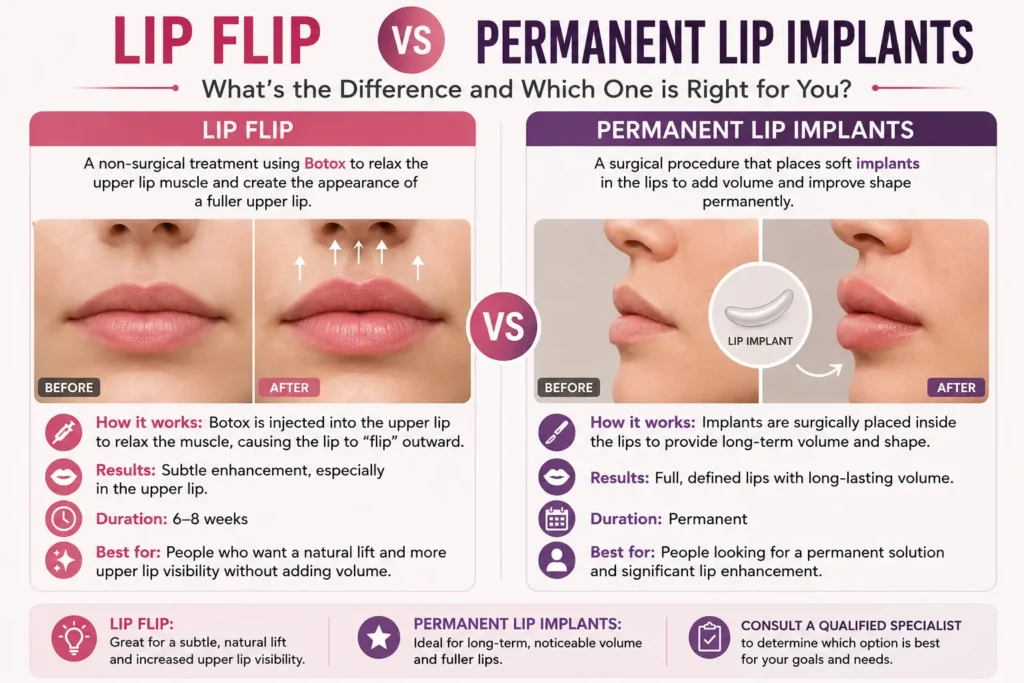
Comparing lip flip vs permanent lip implants really comes down to one honest question: are you looking for a low-commitment trial run, or are you ready for a surgical, long-term change? A lip flip is a quick injection that relaxes your upper lip muscle for a few months. Permanent lip implants are a surgical procedure that places a solid silicone device inside the lip for a result meant to last indefinitely.
These two treatments sit at opposite ends of the lip enhancement spectrum. One is reversible simply by waiting. The other requires surgery to place, and surgery to remove or adjust. Neither is “better” in a general sense — it depends entirely on how confident you are in the look you want and how much risk, downtime, and cost you’re willing to take on.
This guide breaks down exactly how each treatment works, the real risks and recovery involved with implants, how they compare on cost, and how to think through this decision before committing to either one.
A lip flip is a non-surgical Botox injection that temporarily relaxes the upper lip muscle for about 2 to 4 months. Permanent lip implants are a surgical procedure that places a solid silicone device inside the lip for long-term volume. The lip flip is reversible by waiting; implants require another surgery to adjust or remove.
Table of Contents
Key Takeaways
- A lip flip is a non-surgical, reversible neuromodulator treatment that repositions the lip — it adds no volume.
- Permanent lip implants are a surgical procedure using a solid silicone device to add lasting lip volume.
- Lip flip results last 2 to 4 months; implants are designed to last indefinitely, though they can shift, need adjustment, or be removed.
- Implants carry real surgical risks, including infection, asymmetry, and implant migration.
- The branded “PermaLip” device was withdrawn from lip marketing after a 2019 FDA warning; today, surgeons typically use custom, hand-carved silicone off-label for this purpose.
- A lip flip is a reasonable way to “test” a fuller-lip look before considering a permanent, surgical option.
What Is a Lip Flip?
A lip flip is a non-surgical treatment that uses a small dose of neuromodulator, such as Botox, Dysport, Xeomin, or Jeuveau, injected into the orbicularis oris muscle just above the upper lip. Relaxing this muscle allows more of your natural lip to show when you smile or talk. It’s a repositioning treatment only — it doesn’t add volume or physically change the structure of your lip.
You can see the process explained step by step in how does a lip flip work, and browse real results in lip flip before and after. Because it’s temporary, many patients use a lip flip as a low-risk way to get comfortable with a fuller-looking lip before considering longer-term options like filler or implants.
What Are Permanent Lip Implants?
Permanent lip implants are a surgical procedure in which a plastic surgeon places a solid silicone device inside the lip through a small incision, typically at the corners of the mouth. The implant creates a pocket of added structure and volume that’s intended to last indefinitely, unlike injectable fillers, which the body gradually breaks down over time.
There’s an important detail worth understanding here for accuracy. The branded silicone implant known as PermaLip was originally introduced for lip augmentation, but the FDA issued a warning in 2019 after determining the device had been marketed for an indication it wasn’t cleared for. Silicone facial implants remain FDA-cleared for areas like the chin, cheek, and nose, but not specifically for the lip. Today, surgeons who perform this procedure typically use custom, hand-carved sterile silicone implants in what’s considered an off-label, physician-directed use of an approved material. This isn’t necessarily a reason to avoid the procedure, but it’s an important detail to discuss directly with a board-certified surgeon during your consultation.
Lip Flip vs Permanent Lip Implants: Full Comparison
| Feature | Lip Flip | Permanent Lip Implants |
| Type of treatment | Non-surgical neuromodulator injection | Surgical implant placement |
| What it does | Relaxes upper lip muscle | Adds physical volume and structure |
| Adds volume? | No | Yes |
| Typical duration | 2–4 months | Designed to be permanent |
| Anesthesia | None, just numbing if used | Local, sometimes general |
| Recovery time | Little to none | 1–3 weeks, with full healing taking longer |
| Reversibility | Wears off naturally | Requires a second surgery to remove or adjust |
| Typical cost | Lower per session | $2,000–$5,000, often per lip or per procedure |
| Regulatory note | On-label use of an approved product category | Lip-specific device withdrawn from market in 2019; implants used off-label today |
| Risk level | Low, temporary side effects | Surgical risks including infection, asymmetry, migration |
How Long Do Lip Implants Actually Last?
Permanent lip implants are designed to provide long-term, stable volume without needing repeat treatments the way filler does. That said, “permanent” doesn’t mean risk-free or unchangeable. Implants can shift position over time, and some patients eventually choose to have them adjusted, repositioned, or removed if they’re unhappy with the result or experience complications. Unlike a lip flip, which simply wears off on its own, any change to an implant requires another surgical procedure.
Recovery Comparison: Lip Flip vs Permanent Lip Implants
A lip flip involves essentially no downtime. Most people return to normal activities the same day, with final results settling in within about a week. See does a lip flip hurt and lip flip aftercare for more detail.
Lip implant surgery involves a real recovery period. Most patients experience swelling, tenderness, and moderate discomfort for one to two weeks, with full healing sometimes taking several weeks longer. Pain is typically managed with prescribed medication, and patients are usually advised to avoid excessive talking, smiling, or chewing for the first 48 to 72 hours after surgery.
Cost Comparison: Lip Flip vs Permanent Lip Implants
A lip flip is significantly less expensive per session, and pricing details are available at lip flip cost and how much does a lip flip cost. Because it needs to be repeated every few months, the annual cost adds up over time, though it remains far below the cost of surgery.
Permanent lip implants typically range from about $2,000 to $5,000, depending on the surgeon, implant type, and location. Because the result is intended to last, this is generally framed as a one-time investment, though it doesn’t account for the cost of a future removal or revision surgery if one becomes necessary.
Risks Worth Understanding Before Choosing Implants
Because lip implants involve surgery, the risk profile is meaningfully different from a lip flip. Documented risks include infection, implant migration or protrusion, asymmetry, allergic reaction, and the need for revision surgery in some cases. Published outcome data from experienced surgeons has reported complication rates in the range of roughly 8%, most commonly related to the implant sitting slightly off-center, with smaller risks of swelling, infection, or the need for a minor correction.
This is meaningfully different from a lip flip, where side effects are temporary and self-resolving. If you’re weighing this trade-off, it’s worth reading lip flip gone wrong and lip flip side effects for comparison, since even the more serious lip flip complications tend to fade on their own within a few months.
Who Should Consider Each Option?
| Your Situation | Better Fit |
| Want to “test” a fuller lip before committing long-term | Lip flip |
| Comfortable with surgery for a lasting result | Permanent lip implants |
| Prefer something fully reversible | Lip flip |
| Have tried filler repeatedly and want a permanent solution | Permanent lip implants (after discussing with a surgeon) |
| Want the lowest-risk option | Lip flip |
| Willing to accept surgical risk for long-term volume | Permanent lip implants |
| Budget-conscious or want to avoid a large upfront cost | Lip flip |
Common Mistakes to Avoid
- Assuming “permanent” means risk-free. Implants carry real surgical risks and are not simply a one-time, no-maintenance solution for everyone.
- Choosing implants without researching your surgeon’s specific experience with this procedure. Because the lip has no underlying bone to anchor an implant, technique and placement matter enormously.
- Overlooking the reversibility difference. A lip flip fades on its own; correcting or removing an implant requires another surgery.
- Not asking directly about FDA status. Any provider claiming a lip implant device is “FDA-approved specifically for lips” is not being fully accurate, given the regulatory history.
- Jumping straight to implants without trying reversible options first. Many patients start with a lip flip with filler combination to understand their ideal lip shape before considering surgery.
Tips Before Choosing Between the Two
- If you’re unsure about commitment, try a lip flip or filler first to see how a fuller lip actually looks and feels on your face.
- If considering implants, choose a board-certified plastic surgeon with specific, extensive experience in lip implant surgery.
- Ask directly about the implant material, FDA status, and the surgeon’s personal complication rate.
- Budget for the possibility of a future revision or removal procedure, not just the initial surgery.
- Get a clear understanding of the recovery timeline and take the appropriate time off work or social plans.
Warnings and Limitations
A lip flip carries standard neuromodulator risks, including temporary bruising or an uneven smile, all of which resolve on their own within a few months. Permanent lip implants carry the risks inherent to any surgical procedure, including infection, implant migration or protrusion, asymmetry, and the potential need for revision surgery. Because the lip has no underlying bone structure to anchor an implant, this procedure requires significant surgical skill and should only be performed by a board-certified plastic surgeon with specific experience in lip implant surgery.
This article provides general information and is not a substitute for a professional consultation. A licensed provider can assess your anatomy, medical history, and goals, and can speak candidly to the regulatory status of any implant device being discussed, before recommending a treatment path.
Frequently Asked Questions
Is a lip flip the same as a lip implant? No. A lip flip is a temporary, non-surgical injection that relaxes the upper lip muscle, while a lip implant is a surgical device that adds permanent physical volume to the lip.
Are permanent lip implants FDA-approved? Silicone facial implants are FDA-cleared for areas like the chin, cheek, and nose. The branded PermaLip device was withdrawn from lip-specific marketing after a 2019 FDA warning, and lip implants used today are generally a physician-directed, off-label use of an approved material.
Can lip implants be removed? Yes, but removal requires another surgical procedure. This is different from a lip flip, which simply wears off on its own without any additional treatment needed.
How long does recovery take after lip implant surgery? Most patients experience swelling and tenderness for one to two weeks, with full healing sometimes taking several weeks longer, compared to the virtually nonexistent downtime of a lip flip.
Do lip implants look natural? When placed by an experienced surgeon, lip implants can look natural, though results depend heavily on the surgeon’s skill, the implant size chosen, and your existing lip anatomy.
Is a lip flip a good way to “test” a fuller lip before getting implants? It can be a helpful low-risk option to see how a slightly fuller upper lip looks and feels, though a lip flip doesn’t add volume the way an implant does, so it’s not a perfect preview.
What happens if I don’t like my lip implants? You would need a second surgery to adjust, reposition, or remove the implant, unlike a lip flip, which fades away naturally within a few months.
Are lip implants more expensive than a lip flip? Yes, significantly, with implants typically costing $2,000 to $5,000 upfront compared to a much lower per-session cost for a lip flip. However, lip flips require repeat treatments several times a year.
Can lip implants shift or move over time? Yes, implant migration is a documented risk, which is one reason choosing an experienced, board-certified surgeon matters so much for this procedure.
Is a lip flip painful compared to lip implant surgery? A lip flip involves minimal discomfort from a few quick injections. Lip implant surgery involves more significant post-operative pain, typically managed with prescribed medication during the first one to two weeks.
Who is a good candidate for permanent lip implants? Someone with realistic expectations, healthy lip tissue, no conditions that impair healing, and a clear understanding of the surgical risks and lack of full reversibility involved.
Should I try filler before considering lip implants? Many patients try filler or a lip flip first to understand their ideal lip shape and volume before committing to a permanent, surgical option, though this isn’t a strict requirement.
Summary: Lip Flip vs Permanent Lip Implants
The lip flip vs permanent lip implants decision comes down to commitment level, risk tolerance, and how confident you are in the result you want. A lip flip is a temporary, low-risk, non-surgical option that wears off naturally within a few months. Permanent lip implants involve real surgery, meaningful recovery time, and risks that don’t apply to injectable treatments, in exchange for a result designed to last indefinitely.
Because implants require surgery to place, adjust, or remove, this isn’t a decision to make lightly or based on trend appeal alone. A consultation with a board-certified plastic surgeon, alongside an honest look at reversible options like a lip flip or filler, is the best way to figure out which path truly fits your goals.