
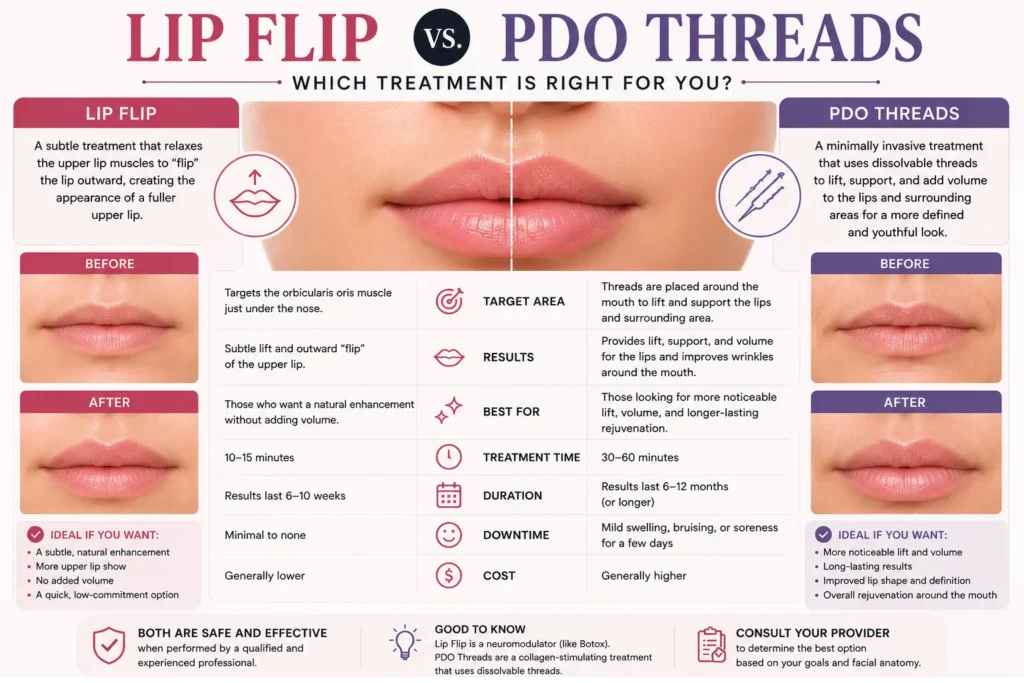
If you’re comparing lip flip vs PDO threads, it’s worth knowing upfront that these two treatments barely have anything in common except the end goal: fuller, more defined-looking lips. A lip flip uses a neuromodulator like Botox to relax the upper lip muscle. A PDO thread lip lift inserts thin, dissolvable threads directly into the lip tissue to physically lift, define, and stimulate collagen. One is muscle-based. The other is structural.
This mix-up is common because both treatments avoid surgery, both skip added filler volume, and both promise a natural-looking result. But the mechanism, the downtime, the pain level, and especially how long results last are all quite different. If you’ve been Googling “PDO thread lip lift vs lip flip” and getting conflicting answers, this guide lays out exactly how each one works, what to expect, and which one actually fits what you’re looking for.
Table of Contents
Quick Answer: What’s the Difference Between a Lip Flip and PDO Threads?
A lip flip uses a neuromodulator injection to relax the upper lip muscle, making more of your natural lip visible for about 2 to 4 months. PDO threads are dissolvable sutures inserted into the lip to physically lift, define the Cupid’s bow, and stimulate collagen, with results generally lasting 6 to 18 months.
Key Takeaways
- A lip flip uses Botox, Dysport, Xeomin, or Jeuveau to relax the upper lip muscle — no threads, no added volume.
- PDO threads are dissolvable polydioxanone sutures inserted into the lip tissue to lift and define its shape.
- Lip flip results last 2 to 4 months; PDO thread results often last 6 to 18 months.
- PDO threads can stimulate collagen production, which may offer subtle benefits even after the threads dissolve.
- A lip flip involves little to no downtime; PDO threads may cause more noticeable swelling and tenderness for several days.
- Some patients combine both, or pair either treatment with filler, for a more customized result.
What Is a Lip Flip?
A lip flip is a non-surgical treatment where a small amount of neuromodulator is injected into the orbicularis oris muscle, just above the upper lip. Once the muscle relaxes, it stops curling the lip inward, so more of your natural lip becomes visible when you smile or talk. It’s purely a repositioning treatment — it doesn’t add tissue, volume, or structure to the lip itself.
You can see the injection process explained step by step in how does a lip flip work, and browse real results in lip flip before and after. If you’re also comparing this to filler, it’s worth reading lip flip vs lip filler to understand that category too.
What Are PDO Threads for Lips?
PDO threads are thin, dissolvable sutures made of polydioxanone, a material that’s been used safely in medicine for decades, including in surgical stitches. For lip enhancement, a practitioner inserts these threads into specific points of the lip, often along the Cupid’s bow and vermillion border, using a fine needle or cannula. The threads physically lift and define the shape of the lip while it’s in place.
Beyond the immediate lifting effect, PDO threads are also known for stimulating collagen production in the surrounding tissue as the body responds to the thread material. This means some patients notice a subtle, gradual improvement in lip texture and firmness even after the threads themselves have fully dissolved, which typically happens over several months.
Lip Flip vs PDO Threads: Full Comparison
| Feature | Lip Flip | PDO Threads |
| Mechanism | Relaxes upper lip muscle | Physically lifts and defines lip structure |
| Adds volume? | No | Minimal, mostly definition rather than bulk |
| Typical duration | 2–4 months | 6–18 months |
| Onset | 3–7 days | Immediate lift, collagen benefits build over weeks |
| Pain level | Minimal, quick pinches | Mild to moderate, some pressure and tugging |
| Downtime | Little to none | Possible swelling, tenderness for a few days |
| Procedure time | 10–15 minutes | 15–45 minutes depending on technique |
| Typical cost | Lower per session | Often $500–$1,500 per treatment |
| Reversible? | Wears off naturally | Dissolves naturally over time |
| Best for | Subtle lift, gummy smile correction | Definition, structure, longer-lasting results |
How Long Do PDO Threads Last Compared to a Lip Flip?
This is one of the biggest differences between the two treatments. A lip flip typically lasts 2 to 4 months before the neuromodulator wears off and the muscle returns to normal function. PDO threads, on the other hand, generally last 6 to 18 months, since the thread material dissolves gradually and the collagen response it triggers can leave subtle lasting benefits even afterward. If duration is your top priority, PDO threads have a clear advantage. You can compare this to typical lip flip timing in how long does a lip flip last.
Does It Hurt More? Pain and Downtime Compared
A lip flip involves a few quick injections with a very fine needle, and most people describe it as a light pinch with little to no downtime. See does a lip flip hurt for more detail.
PDO threads involve a slightly more involved process. The area is numbed beforehand, but patients often describe a sensation of pressure or tugging as the threads are placed, rather than sharp pain. Afterward, mild swelling, tenderness, or minor bruising is common for a few days, which is more noticeable downtime than what’s typical with a lip flip.
Cost Comparison: Lip Flip vs PDO Threads
A lip flip is generally the more affordable option per session, and pricing is available in detail at lip flip cost and how much does a lip flip cost. Because it wears off in a few months, though, most people repeat it three to four times a year.
PDO thread treatments typically range from around $500 to $1,500 per session depending on the number of threads used and the provider’s experience. Since results last considerably longer, the annual cost often works out to be more comparable between the two than the upfront price suggests.
Can You Combine a Lip Flip and PDO Threads?
Yes, though it’s less common than pairing either treatment with filler. Because a lip flip relaxes the muscle and PDO threads add structural lift and definition, some patients use both together for a more layered result. It’s also common to add filler on top of either treatment for those who want actual volume in addition to lift — you can read more in lip flip with filler. If you’re weighing this against a longer-term surgical option, lip lift vs lip flip covers that comparison in more depth.
Which One Should You Choose?
| Your Goal | Better Option |
| Subtle, temporary enhancement | Lip flip |
| Longer-lasting results with fewer repeat visits | PDO threads |
| Fix a gummy smile | Lip flip |
| Define the Cupid’s bow and vermillion border | PDO threads |
| Low commitment, easy to reverse by simply waiting | Lip flip |
| Willing to accept a bit more downtime for longer results | PDO threads |
| Budget-friendly per visit | Lip flip |
| Want a collagen-stimulating benefit over time | PDO threads |
Common Mistakes to Avoid
- Assuming PDO threads add volume like filler. They primarily lift and define; they don’t significantly plump the lip the way hyaluronic acid filler does.
- Expecting a lip flip to last as long as PDO threads. These treatments work on completely different timelines, so plan your maintenance schedule accordingly.
- Choosing a provider without specific PDO thread experience. Technique matters even more here than with a standard lip flip, since thread placement affects the final shape.
- Ignoring aftercare instructions. Both treatments benefit from gentle care in the first 24–48 hours — see lip flip aftercare for general guidance that applies to either.
- Not asking how many threads are recommended. More threads aren’t always better; the right number depends on your lip anatomy and goals.
Tips Before Choosing Either Treatment
- Ask your provider directly about their specific experience with PDO threads if that’s the option you’re leaning toward.
- Bring reference photos that show lip shape and definition, not just size, since PDO threads focus on structure.
- Avoid alcohol and blood thinners for 24–48 hours before either treatment to reduce bruising risk.
- Confirm the total cost and how many sessions or threads are included in that price.
- Plan for a few extra days of recovery time if choosing PDO threads, compared to the minimal downtime of a lip flip.
Warnings and Limitations
Both treatments carry standard risks associated with facial procedures. A lip flip can occasionally cause a temporarily uneven smile if the muscle relaxes unevenly, and complications are covered in more detail in lip flip gone wrong and lip flip side effects. PDO threads carry a small risk of visible or palpable thread ends, asymmetry, minor infection, or thread migration if not placed correctly, and results depend heavily on the provider’s specific training with this technique.
Both procedures should only be performed by a licensed, appropriately trained provider, such as a physician, nurse injector, or physician assistant with specific experience in the technique being used. This article offers general information and isn’t a substitute for a one-on-one consultation, where a qualified provider can evaluate your lip anatomy and goals before recommending a treatment.
Frequently Asked Questions
Is a PDO thread lip lift the same as a lip flip? No. A lip flip uses a neuromodulator to relax the upper lip muscle, while PDO threads are physical sutures inserted into the lip to lift and define its shape. They work through completely different mechanisms.
Which lasts longer, a lip flip or PDO threads? PDO threads generally last longer, often 6 to 18 months, compared to the typical 2 to 4 month duration of a lip flip.
Do PDO threads hurt more than a lip flip? PDO threads tend to involve slightly more sensation, often described as pressure or tugging, along with more noticeable downtime compared to the quick pinch and minimal recovery of a lip flip.
Can PDO threads replace lip filler? Not exactly. PDO threads primarily add lift and definition rather than significant volume, so they aren’t a full substitute for hyaluronic acid filler if your main goal is bigger lips.
Is a PDO thread lip lift permanent? No. The threads are dissolvable and break down naturally over several months, though the collagen stimulation they trigger may leave some subtle, longer-lasting benefits.
Can I combine PDO threads with a lip flip? Yes, some patients use both together for a more layered result, combining the muscle-relaxing effect of a lip flip with the structural lift of PDO threads.
Is a lip flip cheaper than PDO threads? Per session, yes. But because a lip flip needs to be repeated more often, the annual cost gap between the two treatments is often smaller than it first appears.
What does recovery look like after PDO threads? Most patients experience mild swelling, tenderness, or minor bruising for a few days, which is more noticeable than the minimal downtime typically associated with a lip flip.
Do PDO threads work for thin lips? Yes, PDO threads can help define and subtly lift thin lips, though patients wanting significant added volume may also want to consider filler alongside the threads.
How soon will I see results from PDO threads? The lifting effect is generally visible right after the procedure, while the collagen-related benefits build gradually over the following weeks.
Is it normal to feel the threads under the skin? Mild awareness of the threads in the first few days is common and usually settles as swelling goes down. Persistent visibility or discomfort should be discussed with your provider.
Can men get PDO threads or a lip flip? Yes, both treatments are used by men seeking subtle enhancement, whether that’s more visible lip through a lip flip or added definition through PDO threads.
Summary: Lip Flip vs PDO Threads
The lip flip vs PDO threads decision comes down to how each treatment actually works and how long you want results to last. A lip flip is a quick, low-commitment option that relaxes the upper lip muscle for a subtle, natural-looking change lasting a few months. PDO threads take a more structural approach, physically lifting and defining the lip for a result that can last well over a year, with the added benefit of gradual collagen stimulation.
Neither option adds significant volume the way filler does, so your choice really depends on how long you want results to last, how much downtime you’re comfortable with, and whether your main goal is subtle muscle relaxation or more defined lip structure. A consultation with an experienced provider is the best way to figure out which treatment, or combination, fits your lips and your goals.