If your top lip disappears when you smile, or you just want a slightly fuller, more relaxed pout without filler, you’ve probably come across the term “lip flip.” A lip flip on upper lip tissue is one of the quickest, lowest-commitment cosmetic tweaks available right now, and it’s become a favorite for people who want a subtle change rather than a dramatic one.
This guide breaks down exactly how a lip flip works on the upper lip, what results actually look like, how long they last, and how the treatment compares to lip filler. No fluff, no exaggerated promises — just what you need to make an informed decision.
Table of Contents
Quick Answer
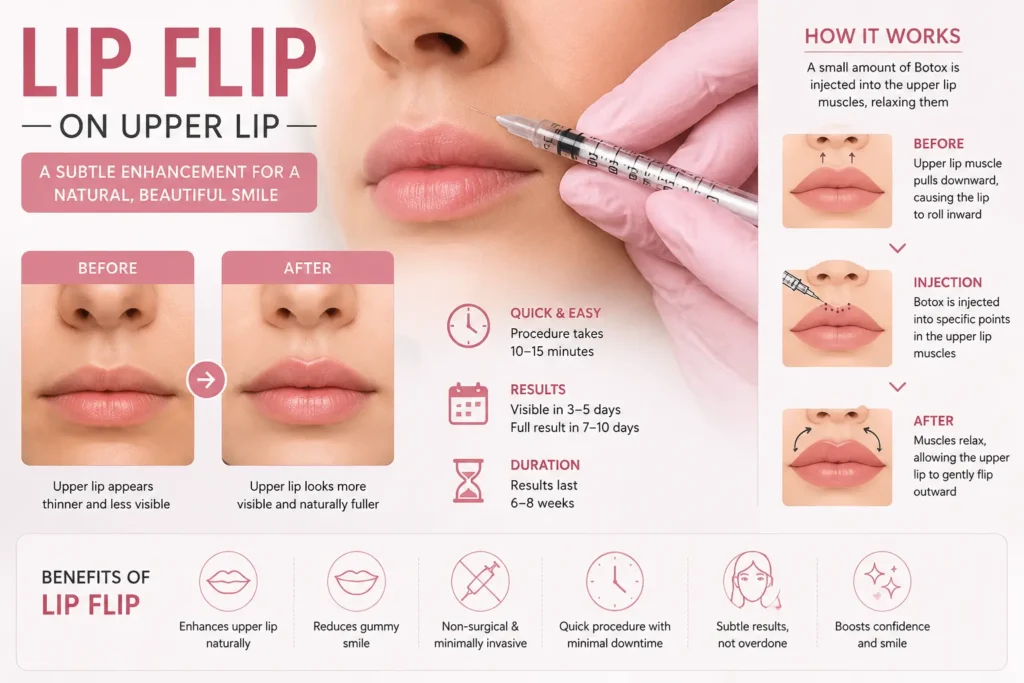
A lip flip on upper lip tissue uses a small amount of botulinum toxin (like Botox, Dysport, or Xeomin) injected into the muscle above the lip. This relaxes the muscle that curls the lip inward, allowing more of the upper lip to show and roll slightly outward. It doesn’t add volume — it repositions what’s already there.
Key Takeaways
- A lip flip relaxes the orbicularis oris muscle around the top lip so more pink tissue shows.
- It uses botulinum toxin, not dermal filler, so there’s no added volume.
- Results typically appear within 2–7 days and last 6–12 weeks.
- It’s best for people with a thin or “hidden” upper lip, or a gummy smile.
- It won’t add plumpness the way filler does — the two treatments solve different problems.
What Is a Lip Flip on the Upper Lip?
A lip flip is a non-surgical treatment that changes the shape of the lip by relaxing the muscle underneath it, rather than adding volume beneath the skin. When it’s done specifically on the top lip, small amounts of neuromodulator are placed just above the vermilion border (the line where your lip color meets your skin).
Once the muscle relaxes, the upper lip rolls slightly outward and upward. This makes the lip look fuller because more of the pink tissue is visible, even though nothing has been injected into the lip itself. For people who feel their top lip “vanishes” when they talk or smile, this is often exactly the fix they’re looking for.
If you want to see what this looks like in practice, browsing real patient results can help set realistic expectations before your consultation.
How Does a Lip Flip Work?
The treatment targets the orbicularis oris, the circular muscle that wraps around the mouth and controls lip movement. This muscle is what pulls your lips inward and downward when you purse them or when you have a gummy smile.
By relaxing part of this muscle with a small dose of neuromodulator, the upper lip is no longer pulled in as tightly. It sits in a slightly more everted (outward-rolled) position, and the visible portion of the lip appears larger. You can read a deeper explanation of how a lip flip works if you want the full mechanics.
This is fundamentally different from filler, which physically adds volume under the skin. A lip flip changes lip position; filler changes lip volume.
Lip Flip vs. Lip Filler: What’s the Real Difference?
This is one of the most common points of confusion, and it’s worth understanding clearly before you book anything.
| Feature | Lip Flip | Lip Filler |
| What it uses | Botulinum toxin (Botox, Dysport, Xeomin) | Hyaluronic acid gel |
| How it works | Relaxes the muscle so lip rolls outward | Adds physical volume under the skin |
| Adds size/volume | No | Yes |
| Best for | Thin top lip, gummy smile, lip that disappears when smiling | Wanting fuller, plumper lips overall |
| Results appear | 2–7 days | Immediately (with some swelling) |
| How long it lasts | 6–12 weeks | 6–18 months |
| Cost (average) | $75–$400 | $500–$1,000+ per syringe |
| Reversible | Wears off naturally | Can be dissolved with hyaluronidase |
For a full side-by-side breakdown, see lip flip vs lip filler. Some patients actually combine both treatments — you can read more about lip flip with filler if you’re curious whether a combination approach suits your goals.
Who Is a Good Candidate for a Lip Flip on the Upper Lip?
A lip flip tends to work best for people who:
- Have a thin or flat upper lip that disappears when smiling
- Show a lot of gum tissue when they smile (a “gummy smile”)
- Want a subtle, natural-looking change rather than added volume
- Aren’t ready for, or don’t want, dermal filler
- Have realistic expectations about how modest the change will be
It’s generally not the right fit for people who want noticeably plumper lips, since a lip flip doesn’t add tissue. If your main goal is more fullness rather than more visibility, filler — or a combination of both — is usually a better match. People with certain neuromuscular conditions, or who are pregnant or breastfeeding, are typically advised against neuromodulator treatments; a licensed provider will screen for this during consultation.
Step-by-Step: What Happens During the Procedure
- Consultation and marking. The provider examines your smile, lip position, and muscle movement, and marks injection points along the upper lip.
- Cleansing the area. The skin is cleaned, and a topical numbing cream may be applied if you’re sensitive to needles.
- Injection. A very fine needle delivers small units of neuromodulator into the upper lip muscle, usually at 2–4 points. You can see typical placement in this guide to lip flip injection sites.
- Aftercare instructions. You’ll be told to avoid lying flat, rubbing the area, or exercising heavily for several hours.
- Follow-up. Most providers recommend checking in around the two-week mark to see the full effect and confirm you’re happy with the result.
The entire appointment usually takes 10–15 minutes, and most people return to normal activities right away.
How Many Units of Botox Are Used for a Lip Flip?
Featured Snippet Answer: A lip flip on the upper lip typically uses 4–10 units of Botox (or the equivalent dose of Dysport or Xeomin), split across 2–4 injection points. The exact number depends on your muscle strength, lip anatomy, and desired outcome — your injector will tailor this during your consultation.
For more detail on dosing logic, see how many units of Botox for a lip flip.
Timeline: When Will You See Results?
- Day 1–2: Little to no visible change; minor swelling or redness may be present.
- Day 3–5: Muscle relaxation begins; the lip starts to look slightly different at rest and when smiling.
- Day 7: Most people see close to the full effect.
- Week 2: Final result is typically visible; this is the best time to judge whether you need a touch-up.
- Week 6–12: Effect gradually fades as the muscle regains normal function.
A detailed day-by-day breakdown is available in lip flip results day by day, and the full lip flip recovery timeline covers healing in more depth.
How Long Does a Lip Flip Last?
Featured Snippet Answer: A lip flip on the upper lip typically lasts 6 to 12 weeks. Because it relies on temporarily relaxing muscle activity rather than adding permanent volume, the effect fades gradually as normal muscle function returns, which is shorter-lived than most dermal fillers.
For a longer explanation of the factors that affect longevity, see how long does a lip flip last.
Benefits of a Lip Flip on the Upper Lip
- Quick appointment with no downtime
- Subtle, natural-looking enhancement
- Can improve a gummy smile
- No added volume, so it suits people who want a minimal change
- Non-surgical and reversible (it simply wears off)
- Lower cost compared to filler
Limitations and Downsides to Consider
- Results are temporary and require repeat treatments to maintain
- It does not add fullness or plumpness — only repositions the lip
- Smiling or speaking may feel slightly different for the first week or two
- Overcorrection can create an unnatural “duck lip” look if too much product is used in the wrong spots
- Not a substitute for filler if your goal is significantly bigger lips
Common Mistakes to Avoid
- Expecting filler-like volume. A lip flip changes shape and visibility, not size.
- Going to an inexperienced injector. Muscle anatomy varies, and incorrect placement can affect your smile or speech temporarily.
- Skipping the consultation. A good provider will assess whether a lip flip, filler, or a mix of both suits your lip shape.
- Overdoing units. Too much product can weaken the muscle too much, leading to an asymmetric or “flat” smile.
If you want to see how results differ depending on starting lip shape, these galleries are useful references: lip flip before and after on thin lips, lip flip before and after full lips, and lip flip before and after gummy smile.
Cost of a Lip Flip on the Upper Lip
Pricing depends on location, provider experience, and the number of units used. On average, a lip flip on upper lip treatment costs between $75 and $400 in the United States. Because it’s priced per unit or as a flat “lip flip” package at many clinics, costs can vary significantly between providers.
For a full cost breakdown by region and provider type, check lip flip cost and how much does a lip flip cost.
Side Effects and Safety
Most side effects are mild and temporary:
- Slight swelling or bruising at injection points
- Temporary tenderness
- Mild asymmetry while the product settles
- Rare: slight difficulty with precise lip movements (like whistling or drinking from a straw) for a few days
Serious complications are uncommon when the treatment is performed by a licensed, experienced injector. As with any injectable treatment, it’s worth discussing your medical history and any medications with your provider beforehand. You can read more about what can go wrong in lip flip side effects and see real examples in lip flip gone wrong.
According to the American Society of Plastic Surgeons, injectable treatments like these should always be performed by a board-certified provider to minimize risk and ensure results align with facial anatomy.
Does a Lip Flip Hurt?
Featured Snippet Answer: Most people describe a lip flip as a quick pinch or sting during injection, similar to a small needle prick. Topical numbing cream is often available, and the discomfort typically lasts only a few seconds per injection point. There’s usually no pain after the appointment beyond mild tenderness.
More detail is available in does a lip flip hurt.
Aftercare Tips
- Avoid touching, rubbing, or massaging the area for at least 4–6 hours
- Skip strenuous exercise for the rest of the day
- Avoid lying flat for a few hours after treatment
- Skip alcohol the day of treatment to reduce swelling and bruising risk
- Stay upright and avoid excessive heat (saunas, hot showers) for the first day
Detailed guidance is available in the full lip flip aftercare guide, including specifics on whether you can eat, drink, exercise, or kiss safely afterward.
Lip Flip on Upper Lip vs. Lower Lip
While this guide focuses on the top lip, some patients also treat the lower lip, particularly if it curls inward or shows minimal pink tissue. Treating both lips isn’t always necessary — many people only need the upper lip addressed. If you’re weighing your options, lip flip on bottom lip covers what’s different about that approach.
Frequently Asked Questions
Is a lip flip only for the upper lip? No, but the upper lip is the most commonly treated area since it’s more prone to disappearing when smiling. The lower lip can also be treated, though it’s requested less often.
Will a lip flip make my top lip bigger? Not exactly. A lip flip makes more of your existing lip tissue visible by relaxing the muscle, which can create the appearance of a slightly fuller top lip — but it doesn’t add volume the way filler does.
Can I combine a lip flip with filler for my upper lip? Yes. Many people pair a lip flip with a small amount of filler to both reposition and add volume. Discuss this combination approach with your injector.
How soon can I see results after a lip flip on my upper lip? Most people notice initial changes within 3–5 days, with the full result visible by around day 7 to 14.
Does a lip flip affect my ability to talk or eat normally? Some people notice very slight changes in speech or lip movement for the first few days, which typically resolves as the muscle adjusts.
Is a lip flip permanent? No. It’s a temporary treatment that generally lasts 6 to 12 weeks before the muscle returns to its normal function.
Can a lip flip fix a gummy smile? Yes, it’s one of the more common reasons people choose this treatment, since relaxing the muscle reduces how far the upper lip pulls up when smiling.
What’s the difference between Botox, Dysport, and Xeomin for a lip flip? All three are neuromodulators that work similarly, but they differ slightly in onset time, diffusion, and dosing units. See Xeomin vs Botox for a lip flip for a direct comparison.
Can men get a lip flip on their upper lip? Yes. Lip flips are increasingly popular among men who want a subtly more balanced smile without an obviously “done” look. See lip flip before and after for men.
Is a lip flip suitable for older adults? Yes, particularly for people whose upper lip has thinned with age. Results can look different than in younger patients, so it helps to look at lip flip before and after for older women for realistic examples.
Does a lip flip help with smoker’s lines above the lip? It can soften some vertical lines by relaxing the pursing muscle, though it’s not a complete fix. More detail is available in lip flip for smokers lines.
What if I have a very thin upper lip — is a lip flip enough? It depends on your goals. A lip flip on thin lips can make the lip appear fuller by increasing visible pink tissue, but if you want significant added volume, filler may be a better primary option. See lip flip on thin lips.
Will my results look different depending on my side profile? Yes, changes to lip position can be more or less noticeable depending on lip projection and profile. You can review lip flip before and after side profile photos for reference.
How is a lip flip different from a surgical lip lift? A lip flip is temporary and uses neuromodulator, while a lip lift is a surgical procedure that permanently shortens the space between the nose and upper lip. See lip lift vs lip flip for a full comparison.
Summary
A lip flip on upper lip tissue is a quick, low-downtime way to make your top lip appear fuller by relaxing the muscle that pulls it inward, rather than by adding volume. It’s best suited for people with a thin or “hidden” top lip, or those managing a gummy smile, and it typically lasts 6 to 12 weeks. It’s not a replacement for filler if your main goal is added plumpness — but for the right candidate, it offers a subtle, natural-looking improvement with minimal commitment.
If you’re still deciding between a lip flip, filler, or a combination of both, a consultation with a licensed, experienced injector is the best next step. They can assess your lip anatomy, smile mechanics, and goals to recommend the option — or combination — that fits you best.
This article is for general informational purposes and does not replace personalized medical advice. Always consult a licensed, board-certified provider before undergoing any cosmetic injectable treatment.