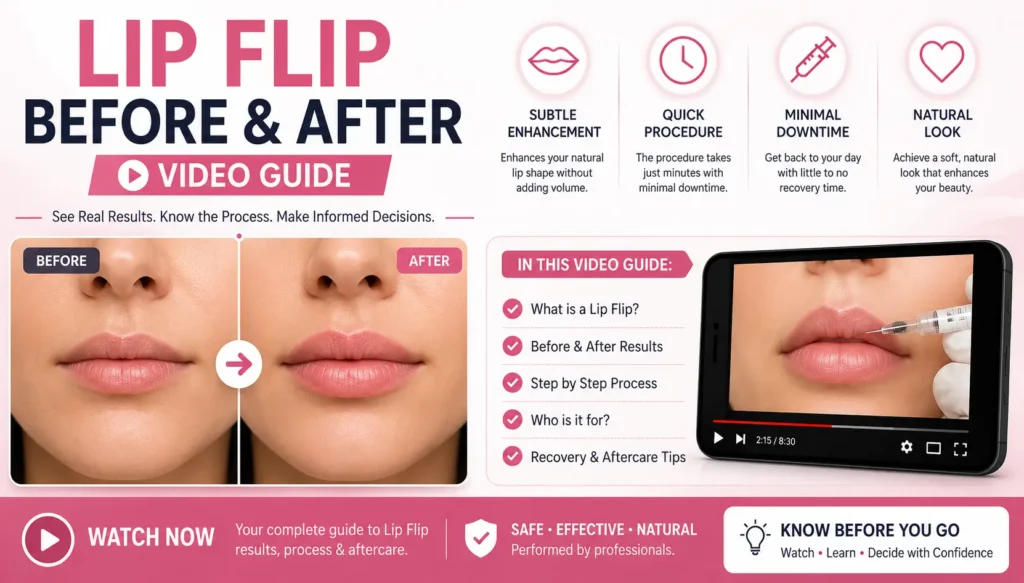
Photos only tell half the story. A single before-and-after picture can’t show you how the lip actually moves, how the smile changes shape, or how the “flip” settles in over two weeks. That’s exactly why more people are searching for a Lip Flip Before and After Video Guide instead of just static images — video captures motion, and lips are all about motion.
This guide walks you through the entire process using a video-first lens: what to look for in real patient footage, how animated diagrams explain the muscle mechanism better than any photo can, and where to find trustworthy video resources instead of misleading ones. You’ll also get a realistic day-by-day timeline so you know what’s normal and what’s worth calling your provider about.
Table of Contents
Quick Answer
A lip flip uses a small dose of botulinum toxin injected above the upper lip to relax the muscle that curls the lip inward. In video footage, results become visible around day 2–3, peak by day 7–14, and last roughly 8–12 weeks. Watching a lip flip before and after video guide shows the subtle upward roll of the lip that photos alone often miss.
Key Takeaways
- A lip flip is temporary, relying on botulinum toxin rather than added volume
- Video content shows lip movement — smiling, talking, drinking — which static photos can’t
- Animated diagrams explain the muscle mechanism more clearly than text alone
- Full results typically show by day 10–14 in video timelines
- Not every “before and after” video online is trustworthy — some are edited or exaggerated
Why a Video Guide Beats a Photo-Only Comparison
Most competitor pages rely entirely on side-by-side photos. That works for showing shape, but a lip flip changes the way lips behave, not just how they look at rest. A proper lip flip before and after video guide should show:
- The lip rolling outward when the patient smiles
- Reduced gum show in a natural, unscripted smile
- Normal speech and drinking to confirm no functional issues
- The transition from swelling (day 1–2) to the final settled look (day 10–14)
If you’re comparing lip flip before and after results, video is simply more honest — it’s harder to fake motion than a still image.
How a Lip Flip Works (The Animation Explained)
Understanding the mechanism makes the video footage make sense. Above your upper lip sits the orbicularis oris muscle, which curls the lip inward when you speak or purse your lips. A small amount of Botox, Dysport, or Xeomin is injected into this muscle, temporarily relaxing it.
An animation of this process typically shows:
- The needle placement just above the vermilion border
- The muscle relaxing over several days
- The upper lip rolling slightly outward, revealing more of the natural pink lip tissue
This is why the effect is often called an “illusion” of fullness rather than true volume — nothing is added, the lip is simply repositioned. For a deeper breakdown, see how does a lip flip work and lip flip injection sites.
Lip Flip Before and After Video Timeline
This is the section most competitor articles skip entirely — a realistic, video-mapped timeline of what to expect.
| Day | What Video Footage Typically Shows |
| Day 0 (procedure day) | Slight redness at injection points, lips look unchanged |
| Day 1–2 | Mild swelling, lip may look uneven on camera |
| Day 3–5 | Early flip becomes visible, especially when smiling |
| Day 7 | Muscle relaxation kicks in fully; visible in speech and smile videos |
| Day 10–14 | Peak result; most “final” before-and-after videos are filmed here |
| Week 8–12 | Gradual fading begins as muscle activity returns |
For a more detailed breakdown, check lip flip results day by day and the lip flip recovery timeline.
Featured Snippet Answer — How long until a lip flip shows results in videos? Most patients see initial movement by day 2–3, with full results visible in follow-up videos between day 10 and day 14. Swelling in the first 48 hours can make early footage misleading, so the two-week mark is the most reliable point for comparison.
What to Look for When Watching Lip Flip Videos
Not all video content online is reliable. Some clinics use flattering lighting, temporary lip liner tricks, or filler stacked underneath to exaggerate results. When evaluating a lip flip before and after video guide, look for:
- Unedited motion: talking, smiling, sipping water
- Consistent lighting and angle between before and after clips
- A visible timestamp or day count
- No filter or beauty mode applied to the footage
Red Flags in “Too Good to Be True” Videos
- Dramatic volume increase (that’s filler, not a flip)
- Only one flattering frame shown, no natural movement
- No mention of provider credentials
If you want to compare this treatment with volume-based options, see lip flip vs lip filler and lip flip with filler.
Lip Flip vs. Lip Filler: Video Comparison
| Feature | Lip Flip | Lip Filler |
| What it uses | Botulinum toxin (Botox, Dysport, Xeomin) | Hyaluronic acid gel |
| Visible in video as | Lip rolling/curling outward | Actual volume increase |
| Duration | 8–12 weeks | 6–18 months |
| Best for | Gummy smiles, subtle upper lip enhancement | Thin lips needing real volume |
| Downtime | Minimal, 24 hours | Minimal, 1–3 days swelling |
For a side-by-side visual comparison, lip filler vs lip flip covers this from the opposite angle, and lip flip without filler explains standalone results.
Trusted Video Resources: Where to Actually Find Reliable Footage
Instead of scrolling random social clips, look for:
- Board-certified dermatologists or plastic surgeons’ own channels, where the provider narrates the injection and follow-up
- Peer-reviewed aesthetic medicine journals that occasionally publish case-study video supplements
- Clinic consultation recordings, where you can ask to see real, unedited patient timelines during your appointment
Professional medical bodies such as the American Society of Plastic Surgeons and the American Academy of Dermatology publish general patient-education material on neuromodulator treatments, which is a useful starting point for understanding the procedure before watching individual patient videos.
Step-by-Step: How to Use Video to Set Realistic Expectations
- Watch full-motion clips, not just static thumbnails
- Compare footage at the same day mark (day 14 is most reliable)
- Check for consistent lighting across before and after shots
- Note the smile and speech, not just the resting lip
- Confirm the provider’s credentials in the video description or caption
Who Is a Good Candidate? (What Video Comparisons Reveal)
Video footage across many patients shows the best, most natural-looking results tend to occur in people who:
- Have naturally thin upper lips (lip flip on thin lips)
- Show a gummy smile when speaking or laughing
- Want a subtle change rather than dramatic volume
- Are not currently using lip filler (though combination approaches exist)
Video is less flattering for people expecting dramatic fullness — that expectation is better matched by filler, not a flip alone.
Common Mistakes People Make After Watching Lip Flip Videos
- Assuming day 1 footage is the final result. Swelling skews early videos.
- Comparing videos from different providers with different dosing. Units used vary widely — see how many units of botox for lip flip.
- Ignoring aftercare shown in follow-up clips. Many videos skip the lip flip aftercare steps that affect final results.
- Expecting filler-level volume from flip-only footage.
Tips for Recording Your Own Before and After Video
If you’re planning to document your own results:
- Film in natural daylight, same time of day, same spot
- Include a neutral face, a full smile, and a speaking clip
- Avoid filters or beauty modes
- Film again at day 3, day 7, and day 14 for an accurate timeline
Safety Considerations and Limitations
A lip flip is generally considered a low-risk, minimally invasive procedure, but results and safety depend heavily on provider experience. Video footage can help you evaluate outcomes, but it cannot replace an in-person consultation. Individual anatomy, muscle strength, and dosing all affect results, and outcomes shown in someone else’s video are not a guarantee of your own results. For anyone with allergies to neuromodulators, neuromuscular conditions, or who is pregnant or breastfeeding, this treatment is not appropriate — a licensed medical provider should always assess candidacy before treatment. If you notice unusual asymmetry, drooping, or difficulty controlling your mouth after treatment, contact your provider promptly.
For a broader look at potential complications, see lip flip side effects and lip flip gone wrong.
Frequently Asked Questions
Is a lip flip visible immediately in videos, or does it take time to show? It’s not immediate. Early footage (day 0–2) often shows swelling, not the true result. The most representative videos are filmed around day 10–14.
Can I trust before-and-after videos posted on social media? Only partially. Lighting, filters, and lip liner can exaggerate results. Look for unedited, timestamped, full-motion clips from verified providers.
How long does the lip flip effect last based on video comparisons? Most video timelines show the effect fading gradually between week 8 and week 12, matching typical Botox duration.
Does a lip flip hurt during the procedure shown in videos? Most patients describe mild pinching rather than significant pain. See does a lip flip hurt for more detail.
What’s the difference between animation diagrams and real patient videos? Animations explain the muscle mechanism (how the injection relaxes the orbicularis oris), while patient videos show the real-world cosmetic outcome. Both are useful for different reasons.
Can I combine lip flip and filler, and would that look different on video? Yes, some patients combine both. Combined results typically show both increased volume and a subtle upward roll — see lip flip with filler for details.
Do video guides show results for men differently than women? The mechanism is identical, but aesthetic goals often differ. See lip flip before and after men for gender-specific examples.
Why do some before and after videos look more natural than others? Dosing, injection placement, and individual muscle strength all affect how visible the flip is. Lower doses generally produce more natural-looking, subtle movement on camera.
Is it normal for one side of the lip to move differently in early footage? Mild asymmetry in the first few days is common and usually resolves as swelling goes down. Persistent asymmetry after two weeks should be discussed with your provider.
Can a lip flip fix a gummy smile, and does video confirm this? Yes, video comparisons frequently show reduced gum show in patients treated specifically for a gummy smile. See Lip Flip Before and After Gummy Smile for examples.
How much does a treatment shown in these videos typically cost? Pricing varies by provider and region. For a general range, see lip flip cost.
Summary
A Lip Flip Before and After Video Guide gives you something photos can’t: proof of how the lip actually moves in real life. Use the timeline in this guide to judge whether footage you’re watching represents an early, swollen result or the true two-week outcome. Stick to unedited, well-lit, full-motion video from credentialed providers, and always treat any single video — including your own future results — as one data point rather than a guarantee. When in doubt, bring your questions to a licensed provider who can assess your lips, your goals, and your anatomy directly.
For more on the procedure itself, explore what is a lip flip and the lip flip procedure.