
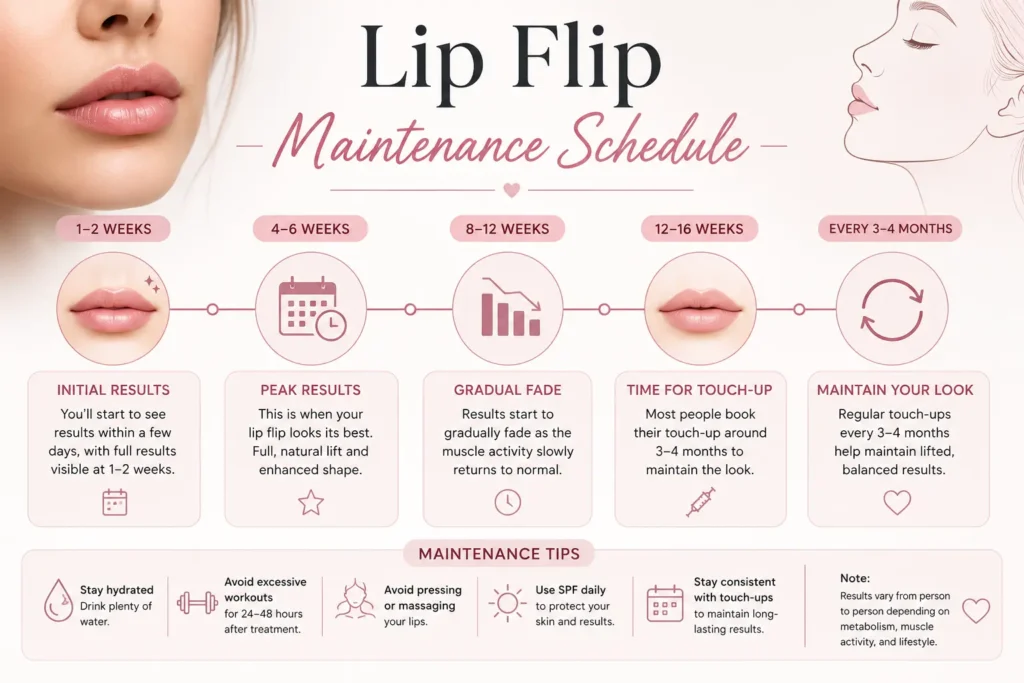
A lip flip gives you a subtle, natural-looking fullness without any filler, but it’s not a one-and-done treatment. If you want to keep that result looking the same six months from now as it did on day one, you need a real lip flip maintenance schedule, not just a vague plan to “go back whenever.”
The tricky part is that maintenance isn’t identical for everyone. Your dosage, metabolism, muscle strength, and even how often you smile or purse your lips can shift how long results last. Some people settle into a steady 10-week rhythm. Others stretch it to 14 or 16 weeks and are happy with a more relaxed cadence.
This guide lays out a realistic maintenance framework, what actually affects your personal timeline, how to budget for it long-term, and how to avoid the two most common mistakes: waiting too long or overtreating too soon.
Most people maintain results by repeating treatment every 8 to 12 weeks. A tighter schedule (8–10 weeks) keeps results more consistent with less visible fade, while a longer one (12–16 weeks) works for those comfortable with the effect softening between visits.
Table of Contents
Key Takeaways
- There’s no universal maintenance schedule — it’s based on how your body metabolizes the neuromodulator.
- Most maintenance plans fall somewhere between 8 and 16 weeks per cycle.
- Tracking your own fade pattern over 2–3 cycles gives you the most accurate personal schedule.
- Consistent maintenance tends to produce smoother, more predictable results than sporadic treatment.
- Budgeting for 4–6 sessions per year is realistic for most people who choose to maintain long-term.
- Your schedule can and should be adjusted with your injector as your response changes over time.
Why a Lip Flip Needs a Maintenance Plan at All
A lip flip works by temporarily relaxing the orbicularis oris muscle with a neuromodulator, allowing the upper lip to roll outward slightly for a fuller appearance. Since it targets muscle activity rather than adding volume, the effect is inherently temporary. For a refresher on the mechanics, see how does a lip flip work and what is a lip flip.
As the neuromodulator gradually wears off, muscle function returns and the flip softens. Without a maintenance schedule, most people end up cycling between “just touched up” and “back to normal,” which can feel inconsistent. A planned schedule keeps results steadier and avoids that stop-start pattern.
Building Your Lip Flip Maintenance Schedule
Step 1: Track Your First Fade Cycle
After your first treatment, take photos at 2, 6, 10, and 14 weeks. This gives you real data instead of a guess. Most people notice the first signs of fading, like slightly more visible upper teeth when smiling, somewhere around week 8–10.
Step 2: Identify Your Personal Window
Compare your photos to see when the change became noticeable. This is your natural cycle length, and it becomes the foundation of your ongoing lip flip maintenance schedule.
Step 3: Book Slightly Ahead of Full Fade
Scheduling your next session a week or two before results fully disappear keeps the transition smooth. Waiting until you’re completely back to baseline just means starting over each time.
Step 4: Reassess After Two or Three Cycles
Muscle response can shift slightly over repeated treatments. After a few rounds, you’ll have a much more reliable sense of your true maintenance interval than after just one session.
Step 5: Build It Into Your Routine
Many patients set a recurring reminder or book their next appointment at the same visit, so maintenance becomes routine rather than something to remember on your own.
Lip Flip Maintenance Schedule Options
| Schedule Type | Frequency | Best For |
| Tight maintenance | Every 8–10 weeks | Those who want minimal fade and consistent fullness |
| Standard maintenance | Every 10–12 weeks | Most patients; balances cost and consistency |
| Relaxed maintenance | Every 12–16 weeks | Those comfortable with more visible softening between visits |
| As-needed | No fixed schedule | Patients who prefer occasional touch-ups rather than routine upkeep |
There’s no wrong answer here — it comes down to your budget, tolerance for fade, and how noticeable the change feels to you personally. For more on adjusting frequency, see how often should you get a lip flip.
What Affects Your Personal Maintenance Timeline
- Metabolism — some people process neuromodulators faster, shortening how long results last.
- Dosage — a higher initial dose may extend the effect slightly, though this varies by provider approach.
- Muscle strength and use — very expressive or active mouth movement can influence how quickly function returns.
- Product used — Botox, Dysport, Xeomin, and Jeuveau can have slightly different onset and duration profiles. Compare options at Dysport lip flip and Xeomin vs Botox lip flip.
- Consistency of treatment — sticking to a regular schedule can make each cycle feel more predictable than sporadic, spaced-out visits.
First Treatment vs. Ongoing Maintenance
| Factor | First Treatment | Maintenance Visits |
| Purpose | Establish baseline results and dosage | Sustain results already achieved |
| Consultation depth | Full mapping and detailed discussion | Shorter check-in, focused on changes since last visit |
| Dosage | Often conservative to start | May be fine-tuned based on prior response |
| Predictability | Unknown how you’ll respond | More predictable once you have 2–3 cycles of data |
| Appointment frequency | One-time | Recurring, based on your chosen schedule |
If you’re weighing whether a touch-up or a fresh full treatment makes more sense at any point, the lip flip touch-up timeline breaks down that distinction in more detail.
Budgeting for Long-Term Maintenance
Featured Snippet Answer: Maintaining a lip flip typically costs the same per session as the first treatment, repeated every 8–12 weeks. Over a year, most patients budget for 4 to 6 sessions, though a longer maintenance interval can reduce that to 3 or 4.
Since pricing varies by provider, product, and dosage, it’s worth reviewing your specific numbers rather than assuming a flat rate. See lip flip cost and how much does a lip flip cost for a fuller breakdown. Some providers offer package pricing for patients committing to a regular maintenance plan, which can lower the per-session cost.
Common Mistakes People Make With Maintenance
- Treating it as a one-time procedure instead of planning for upkeep from the start.
- Letting results fully disappear before rebooking, which resets the cycle each time.
- Assuming a friend’s schedule (say, every 12 weeks) will match your own timeline.
- Not communicating changes in fade pattern to their provider over multiple visits.
- Skipping photo tracking, which makes it much harder to judge fade objectively.
- Overcorrecting with a higher dose after one fast fade, without giving it a full cycle to evaluate first.
When to Adjust Your Schedule
Your maintenance schedule isn’t set in stone. It’s worth revisiting if:
- Results are fading noticeably faster or slower than your last few cycles.
- You’ve changed neuromodulator brands and want to reassess timing.
- Your goals have shifted, such as wanting a subtler or more defined flip than before.
- You’re spacing out visits for budget reasons and want to confirm it won’t undo your progress entirely.
A lip flip consultation is the right setting to discuss any of these changes with a qualified provider rather than adjusting on your own.
This article is intended for general educational purposes and isn’t a substitute for personalized medical advice. Always consult a licensed provider about a schedule that fits your specific response and health history.
Frequently Asked Questions
Is it bad to skip a maintenance visit occasionally? No. Skipping a cycle simply means your lips return to their natural resting state; you can restart maintenance anytime without any lasting downside.
Does maintaining a lip flip long-term change how my lips look permanently? No. The muscle relaxation is temporary each time, so your lips return to baseline whenever treatment stops.
Can I switch from a tight to a relaxed maintenance schedule? Yes, most patients can adjust their interval at any point based on preference, budget, or how their results have been fading.
How many lip flip sessions should I expect per year? Most patients on a standard maintenance schedule book between 4 and 6 sessions annually, though this varies by chosen interval.
Does everyone need the same maintenance schedule? No. Metabolism, dosage, and muscle activity all vary, so your ideal schedule may be shorter or longer than someone else’s.
Should I get bloodwork or medical clearance before starting a maintenance routine? This depends on your health history. Your provider will typically screen for relevant conditions or medications during your initial consultation.
Can combining a lip flip with filler affect my maintenance schedule? The two treatments work independently, since filler adds volume and a lip flip relaxes muscle. Compare the two in lip flip vs lip filler.
What happens if I go months longer than usual between sessions? Your lips will simply return fully to their natural state, and your next treatment will essentially restart the cycle rather than build on anything.
Is it normal for my maintenance interval to change over time? Yes, some patients find their fade pattern shifts slightly after several cycles, which is why periodic reassessment with your provider is useful.
Can I maintain results with at-home products instead of repeat treatment? No topical product can replicate the muscle-relaxing effect of an injected neuromodulator; maintenance requires repeat professional treatment.
Does maintaining a lip flip get more predictable over time? Many patients report their fade pattern becomes more consistent after a few cycles, making future scheduling easier to plan around.
Summary
A reliable lip flip maintenance schedule usually falls between 8 and 12 weeks, but the right interval for you depends on your own fade pattern, not a fixed rule. Tracking results with photos, booking slightly ahead of full fade, and reassessing with your provider after a few cycles will help you build a routine that keeps your results consistent without over- or under-treating. Once you find your rhythm, maintenance becomes far more predictable than that first uncertain treatment ever was.