
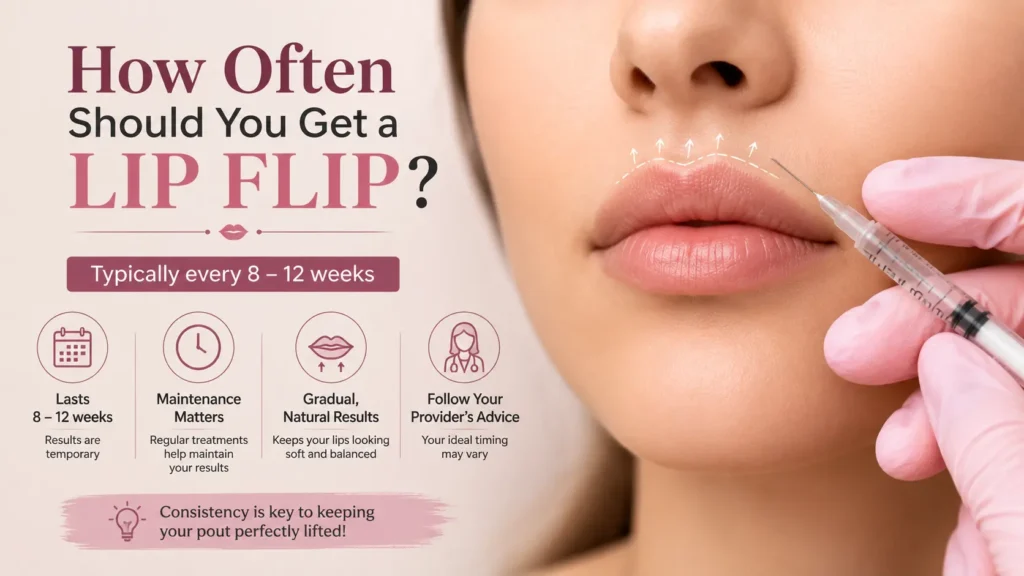
Once your first lip flip settles in and you love the result, the next question is almost always the same: how often should you get a lip flip to keep it looking this way? Unlike a one-time procedure, a lip flip is a maintenance treatment by design, since the neuromodulator behind it naturally wears off over time. That means planning ahead matters just as much as the treatment itself.
The honest answer isn’t a single fixed number that applies to everyone. It depends on how your body metabolizes the product, how noticeable you want your results to stay, and your budget for ongoing treatment. This guide breaks down a realistic maintenance schedule, what affects your personal timing, and how to plan your treatments throughout the year without letting results fully disappear between appointments.
Most people repeat a lip flip every 2 to 5 months, since that’s the typical range results last before fully wearing off. Many patients schedule their next appointment around the 3 to 4 month mark, slightly before results fully fade, to maintain consistent results throughout the year.
Table of Contents
Key Takeaways
- Most lip flip results last 2 to 5 months, making this the typical window between treatments.
- Many patients schedule maintenance appointments around the 3 to 4 month mark, before results fully fade.
- Individual metabolism, muscle strength, and dosing all affect how often you personally need treatment.
- Scheduling slightly before results fully wear off helps maintain consistent results rather than starting over from scratch each time.
- A typical annual schedule involves 3 to 5 treatments per year, depending on individual duration.
- Budgeting for ongoing treatment is an important part of planning a lip flip maintenance schedule.
Why a Lip Flip Requires Ongoing Maintenance
A lip flip works by temporarily relaxing the muscle above your upper lip using a neuromodulator like Botox, Dysport, Xeomin, or Jeuveau. Because this effect is temporary by nature, results gradually fade as your body metabolizes the product and the muscle regains its normal function, covered in more detail in how long does a lip flip last. This is fundamentally different from a one-time procedure; maintaining your results requires an ongoing treatment schedule rather than a single appointment.
What Determines How Often You Need a Lip Flip?
Individual Metabolism
Everyone processes neuromodulators at a slightly different rate. Some people notice results fading closer to the two-month mark, while others maintain a visible effect closer to five months. This is one of the biggest reasons there’s no single universal answer to how often you should get a lip flip.
Muscle Strength
Stronger upper lip muscles can sometimes metabolize the treatment a bit faster, since more active muscle tissue may process the neuromodulator more quickly. Your injector’s initial dosing assessment, covered in how many units of Botox for a lip flip, often accounts for this.
Original Dosing
A slightly higher initial dose, within a safe and appropriate range for your anatomy, may result in results lasting a bit longer than a more conservative dose. This is something worth discussing with your injector if you’re hoping to stretch the time between appointments.
Product Used
Different neuromodulators can have slightly different average durations. Botox is generally reported to last on the longer end of the typical range, sometimes up to 5 months, while Dysport, Xeomin, and Jeuveau tend to fall closer to the 2 to 4 month range. You can compare these directly in dysport-lip-flip, xeomin-lip-flip, and jeuveau-lip-flip.
Personal Preference for Consistency
Some patients prefer to schedule their next treatment right as results are fading, accepting a bit of natural variation throughout the year. Others prefer to book slightly earlier, maintaining a more consistently visible result without ever letting it fully disappear.
Suggested Lip Flip Maintenance Schedule
| Approach | Typical Timing | Best For |
| Standard maintenance | Every 3–4 months | Most patients wanting consistent results without early re-treatment |
| Conservative/budget-focused | Every 4–5 months, closer to full fade | Patients comfortable with some natural variation between treatments |
| Consistency-focused | Every 2–3 months | Patients who want results to never fully fade |
This table reflects general patterns, not a fixed prescription. Your own ideal schedule should be based on how your specific results have faded in the past, something you’ll understand better after your first one or two treatments.
How to Track Your Personal Timeline
- Keep a simple note of your treatment date and the date you first noticed results starting to fade.
- Take a comparison photo at regular intervals, similar to the approach shown in lip flip results day by day, so you have a visual reference over time.
- After your first two or three treatments, look for a pattern in how long your specific results tend to last.
- Use this personal data to schedule future appointments proactively, rather than waiting until results have fully disappeared.
- Adjust as needed if you switch products or your injector adjusts your dosing.
Annual Cost Planning Based on Treatment Frequency
Since maintenance frequency directly affects your total annual cost, it’s worth thinking through this alongside your schedule. Using typical per-session pricing from lip flip botox cost:
| Treatments Per Year | Approximate Annual Cost (at $150–$350 per session) |
| 3 (every 4 months) | $450–$1,050 |
| 4 (every 3 months) | $600–$1,400 |
| 5 (every 2.5 months) | $750–$1,750 |
These figures are general estimates, and your actual cost will depend on your specific provider’s pricing and your personal treatment frequency.
Should You Wait Until Results Fully Fade?
This comes down to personal preference more than a clear right or wrong answer. Waiting until results have completely worn off means you’re not paying for treatment more often than necessary, but it also means experiencing a period where your lips look as they did before treatment. Scheduling your next appointment slightly before full fade, often around the 3 to 4 month mark, helps maintain more consistent results throughout the year, though it does mean slightly more frequent treatment and cost.
Common Mistakes to Avoid
- Waiting too long between treatments and expecting the same starting point each time. Muscle memory and consistency can sometimes be easier to maintain with more regular treatment intervals.
- Assuming everyone needs the exact same schedule. Individual metabolism and dosing significantly affect how often you personally need treatment.
- Not tracking your own results over time. This makes it harder to plan proactively rather than reactively scheduling once you’ve already noticed significant fading.
- Switching products without adjusting your expected schedule. Different neuromodulators can have slightly different typical durations, covered in best botox for lip flip.
- Not budgeting for ongoing treatment. Since this isn’t a one-time cost, planning your annual budget helps avoid financial surprises.
Tips for Planning Your Maintenance Schedule
- Track how long your results last after your first treatment to establish your personal baseline.
- Consider booking your next appointment proactively, around the 3 to 4 month mark, rather than waiting for results to fully disappear.
- Ask your injector for their recommendation based on your specific muscle strength and original dosing.
- Factor ongoing costs into your annual beauty or wellness budget rather than treating each appointment as an isolated expense.
- Revisit your schedule periodically, since your ideal timing may shift slightly as you have more treatments and better understand your personal pattern.
Warnings and Limitations
While maintaining a consistent schedule is a personal choice, it’s worth avoiding the temptation to schedule treatments unusually close together simply to maintain maximum visible results at all times. Overly frequent treatment without adequate spacing isn’t well studied for long-term safety in this specific context, and standard treatment intervals based on typical duration remain the most well-supported approach.
This treatment should only be performed by a licensed provider, such as a physician, nurse injector, or physician assistant, covered in more detail in who should perform a lip flip. This article provides general educational guidance about typical maintenance patterns and isn’t a substitute for a personalized recommendation from your provider based on your specific results and history.
Frequently Asked Questions
How often should you get a lip flip? Most people repeat treatment every 2 to 5 months, with many scheduling around the 3 to 4 month mark to maintain consistent results throughout the year.
Can I wait longer than 5 months between lip flip treatments? Yes, there’s no strict requirement to maintain a fixed schedule. Waiting longer simply means experiencing a period without visible results before your next treatment.
Does getting a lip flip more often make results last longer each time? Not necessarily. Duration is primarily determined by your individual metabolism and dosing, not by how frequently you’ve had previous treatments.
Is it bad to get a lip flip too often? Scheduling treatments unusually close together without adequate spacing isn’t well-supported by current safety data. Standard intervals based on typical duration are the more established approach.
How do I know my personal maintenance schedule? Track how long your results last after your first one or two treatments, and use this personal pattern to plan future appointments proactively.
Does the product I use affect how often I need treatment? Yes, slightly. Botox is sometimes reported to last a bit longer than Dysport, Xeomin, or Jeuveau, though individual variation matters more than average product differences.
Can I switch between different neuromodulators and keep the same schedule? Your schedule may need slight adjustment if you switch products, since typical durations can vary a bit between Botox, Dysport, Xeomin, and Jeuveau.
Should I book my next appointment before my current results fade completely? Many patients do this, often around the 3 to 4 month mark, to maintain more consistent results rather than experiencing a gap between treatments.
How much should I budget annually for lip flip maintenance? This depends on your treatment frequency and per-session pricing, but a typical annual range for 3 to 5 treatments is roughly $450 to $1,750 based on average per-session costs.
Does my dosage affect how often I need a touch-up or new treatment? Yes, dosing can influence both how strong your initial results are and, to some extent, how long they last, which is worth discussing with your injector.
Can I set a reminder for my next lip flip appointment? Yes, many patients find it helpful to schedule their next appointment at the time of their current treatment, based on their personal typical duration.
Is there a maximum number of times I can get a lip flip per year? There’s no universal maximum, but standard treatment intervals based on typical 2 to 5 month duration remain the most well-supported approach for safety and effectiveness.
Summary: How Often Should You Get a Lip Flip
There’s no single universal answer to how often you should get a lip flip, since individual metabolism, dosing, and the specific product used all affect how long your results last. Most people fall within a 2 to 5 month window, with many scheduling maintenance treatments around the 3 to 4 month mark to keep results consistent throughout the year.
The most reliable way to plan your personal schedule is tracking how your own results fade after your first one or two treatments, then using that pattern to schedule proactively rather than reactively. Budgeting for ongoing treatment and discussing timing with your injector helps you maintain the results you want without unnecessary surprises along the way.