
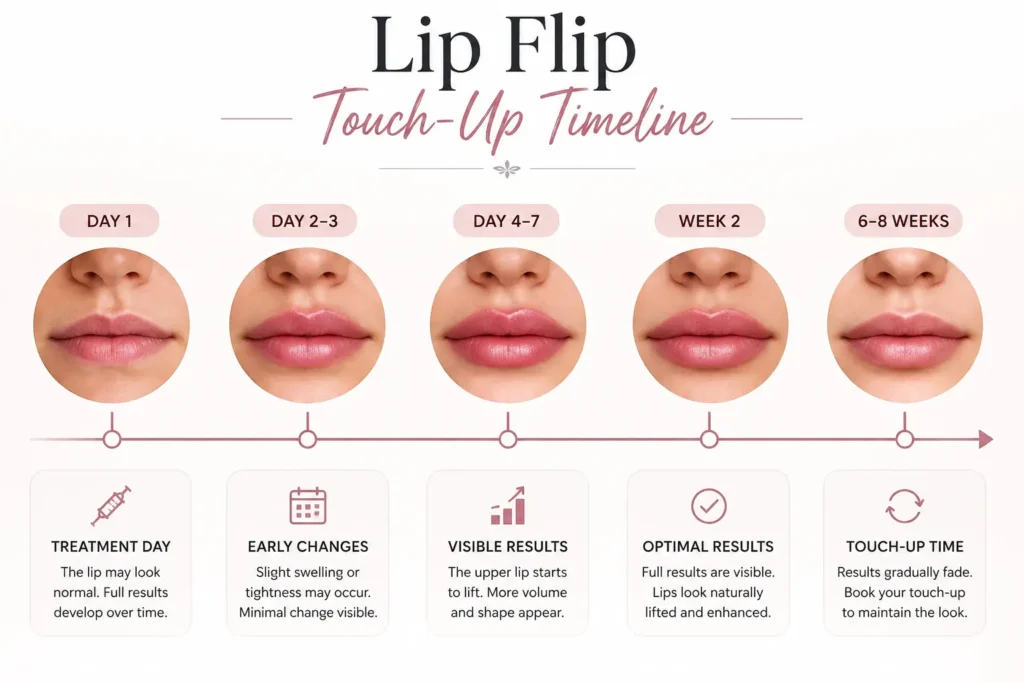
A lip flip isn’t permanent, and that’s actually part of the appeal. But once your first results start to fade, knowing the right lip flip touch-up timeline makes the difference between maintaining a natural look and letting the effect disappear completely before you get back in the chair.
Most people need a touch-up somewhere between 8 and 12 weeks after their first treatment, though this varies based on metabolism, dosage, and how much of a flip you want to maintain. There’s no single “correct” schedule — it’s really about tracking your own fade pattern.
This guide breaks down exactly when a touch-up makes sense, how it differs from your first appointment, what happens if you wait too long (or not long enough), and how to build a maintenance routine that keeps your results consistent over time.
Most patients benefit from a touch-up between 8 and 12 weeks after their initial lip flip, once the effect starts to noticeably soften. Some people stretch this to 14–16 weeks if they prefer a lighter maintenance schedule, while others touch up slightly earlier to keep results fully consistent.
Table of Contents
Key Takeaways
- A lip flip typically lasts 8–12 weeks before the muscle activity starts returning.
- Touch-ups are usually smaller and faster than the initial treatment.
- Getting a touch-up before the effect fully wears off tends to produce smoother, more consistent results long-term.
- Waiting too long doesn’t cause harm, but you’ll essentially start over from scratch.
- Your personal fade timeline is the most reliable guide, not a fixed calendar date.
- Touch-up dosing is often adjusted based on how your lips responded the first time.
How a Lip Flip Fades Over Time
To understand the right touch-up timing, it helps to know how the treatment fades in the first place. A lip flip works by temporarily relaxing the orbicularis oris muscle around the upper lip, which lets the lip roll slightly outward for a fuller look without adding volume. If you’re new to the treatment, what is a lip flip and how does a lip flip work cover the basics.
Neuromodulators don’t wear off overnight. Muscle function returns gradually, which means your flip fades in stages rather than disappearing all at once. Many patients notice subtle changes first — slightly less pout when smiling, a bit more visible upper teeth — before the difference becomes obvious in a mirror.
The Lip Flip Touch-Up Timeline, Week by Week
| Timeframe | What’s Typically Happening |
| Week 1–2 | Full effect settles in after initial treatment |
| Week 3–6 | Peak results; flip is at its most defined |
| Week 7–9 | Subtle softening begins; muscle activity slowly returns |
| Week 10–12 | Most patients notice a clear fade and consider a touch-up |
| Week 13–16 | Effect largely gone for most people if untreated |
| Week 16+ | Muscle function typically back to baseline |
For a closer look at how results build and settle in the early weeks, see lip flip results week by week and lip flip results day by day.
Signs It’s Time for a Touch-Up
- Your smile is starting to show more upper teeth than it did a few weeks ago.
- The subtle outward roll of your upper lip looks flatter than usual.
- Friends or photos make you notice your lips look “the same as before.”
- It’s been roughly 10–12 weeks since your last session.
- You compare a recent photo to your peak results and see a clear difference.
First Treatment vs. Touch-Up: What’s Different
A touch-up isn’t just a repeat of day one. Here’s how the two typically compare.
| Factor | First Treatment | Touch-Up |
| Dosage | Standard starting dose, often conservative | May be adjusted up or down based on prior response |
| Injection sites | Full mapping of the upper lip muscle | Often the same points, sometimes refined |
| Appointment length | Slightly longer due to consultation and mapping | Usually quicker |
| Onset time | 3–7 days for full effect | Often similar, sometimes faster |
| Swelling/bruising | More likely to be closely monitored as a baseline | Generally similar risk, less “unknown” for the patient |
| Cost | Full treatment price | Sometimes discounted as a maintenance visit |
If your first result wasn’t exactly what you wanted, a touch-up is also a chance to fine-tune. Compare your current profile to references like natural lip flip results or browse the lip flip before and after photos gallery to communicate what you’re going for.
Step-by-Step: Planning Your Touch-Up
- Track your fade honestly. Take a photo at 2, 6, and 10 weeks to see your personal timeline instead of guessing.
- Book before full fade, not after. Scheduling around week 8–10 keeps results layered and consistent.
- Bring notes to your consultation. Mention what faded first, what you liked most, and anything you’d adjust.
- Confirm dosage with your injector. Some patients need slightly more, others less, based on how quickly they metabolized the first round.
- Reassess after two touch-ups. By your third session, you’ll likely have a clear, repeatable schedule that works for your body.
Pros and Cons of Staying on a Regular Touch-Up Schedule
Pros
- Results stay consistent instead of cycling between “fresh” and “faded.”
- Smaller, more predictable adjustments over time.
- Easier to maintain a natural look without dramatic before-and-after swings.
Cons
- Requires remembering and budgeting for a recurring appointment.
- Ongoing cost adds up compared to a one-time treatment.
- Skipping a cycle means starting closer to baseline again.
For a full cost breakdown across sessions, see lip flip cost and how much does a lip flip cost.
Common Mistakes With Touch-Up Timing
- Waiting until the effect is completely gone, then being surprised results take a few days to build back up.
- Booking too early, before you can tell what actually faded and what didn’t.
- Assuming everyone follows the same 3-month schedule — your timeline may run faster or slower.
- Skipping the consultation step at touch-up visits and not mentioning changes since your last session.
- Not comparing photos, which makes it harder to judge fade objectively.
How Often Should You Get a Lip Flip Long-Term?
Featured Snippet Answer: Most people repeat a lip flip every 8 to 12 weeks to maintain consistent results. Some extend to every 3–4 months for a lighter maintenance approach, while others touch up slightly sooner to prevent any noticeable fade between sessions.
For more on building a long-term routine, see how often should you get a lip flip.
When to Talk to Your Provider Instead of Self-Scheduling
While tracking your own fade is useful, it’s still worth checking in with your injector rather than treating this as a fixed rule. Muscle response can shift over multiple rounds of treatment, and your provider can tell you if your timeline is trending shorter or longer than average. This is also the right time to flag anything unusual, like uneven fading on one side or results that never fully matched your first treatment. A quick lip flip consultation before each touch-up keeps dosing accurate and avoids guesswork.
This article is intended for general educational purposes and isn’t a substitute for personalized medical advice from a licensed provider.
Frequently Asked Questions
Can I get a lip flip touch-up early if I don’t like how it’s fading? Yes, many providers will see you before the standard window if results have faded unevenly or faster than expected.
Does a touch-up require the same number of units as the first treatment? Not necessarily. Some patients need the same dose, while others adjust up or down based on how their muscles responded initially.
Will repeated touch-ups make results last longer over time? Some patients report that consistent treatment over multiple cycles can lead to a slightly more predictable fade pattern, though this varies by individual and isn’t guaranteed.
Is there a maximum number of times I can get a lip flip touch-up? There’s no fixed limit, but ongoing treatment should always be guided by a qualified provider monitoring your response over time.
What happens if I skip a touch-up cycle completely? Your lips simply return to their natural resting position. You can restart treatment anytime; it just means beginning closer to baseline again.
Does a touch-up hurt more or less than the first treatment? Discomfort levels are typically similar, since the injection technique and needle size don’t usually change between sessions.
How do I know if my touch-up needs a different dose than last time? Discuss how quickly your last result faded and whether it met your expectations — your provider can adjust dosage based on that feedback.
Can I switch neuromodulator brands for my touch-up? Yes, some patients try a different formula like Dysport or Xeomin at their touch-up. See xeomin vs Botox lip flip for a comparison.
Is a touch-up cheaper than the first lip flip? It depends on the provider. Some offer a maintenance discount for returning patients, while others charge the same rate regardless of visit number.
Should I get a touch-up before a big event? Plan ahead — since full effect can take up to a week to develop, book your touch-up at least 7–10 days before any event.
Can bruising or swelling happen again with a touch-up? Yes, touch-ups carry the same general risk of temporary bruising or swelling as the first treatment. See lip flip bruising timeline for what to expect.
Do touch-ups build on previous results, or start fresh each time? Each treatment is essentially independent, since the neuromodulator’s effect wears off completely. A touch-up refreshes results rather than layering on top of anything residual.
Summary
The right lip flip touch-up timeline usually falls between 8 and 12 weeks, though your personal fade pattern is the most reliable guide. Booking before the effect fully wears off keeps results smooth and consistent, while waiting too long just means starting closer to baseline again. Tracking your own timeline with photos, staying in touch with your provider, and adjusting dosage as needed will help you build a maintenance routine that actually works for your body.