A lip flip is a quick, low-downtime treatment, but that doesn’t mean your skin won’t react. Bruising is one of the most common side effects patients ask about before booking, and understanding the lip flip bruising timeline ahead of time can save you a lot of unnecessary worry.
Most bruising after a lip flip shows up within the first day, peaks around day two or three, and fades within a week to ten days. But the exact timeline depends on your skin, the injector’s technique, and how you care for the area afterward.
This guide walks through exactly what happens at each stage, how bruising compares to normal swelling, what speeds up healing, and when a bruise might mean something you should call your provider about.
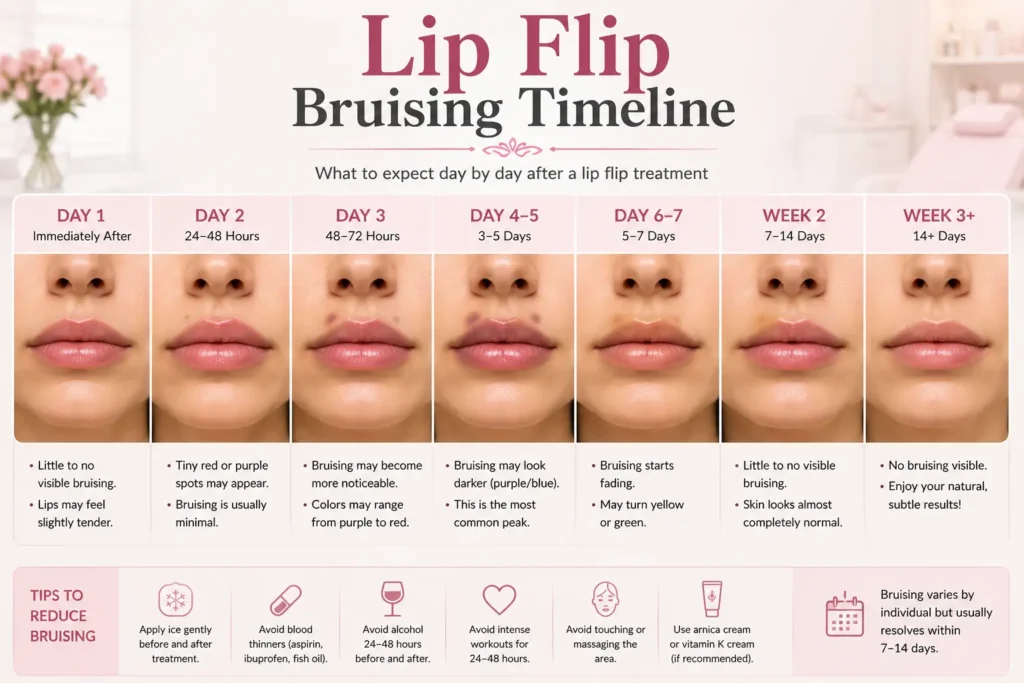
Lip flip bruising typically lasts 5 to 10 days. It usually appears as a small red or purple mark near the injection site within 24 hours, deepens in color by day 2–3, then fades through yellow-green tones before disappearing completely within a week or two.
Table of Contents
Key Takeaways
- Not everyone bruises after a lip flip — it depends on individual blood vessel placement and injector technique.
- Bruising follows a predictable color pattern: red/purple → blue/black → green/yellow → fading.
- Most bruises resolve on their own within 7–10 days without treatment.
- Ice, arnica, and avoiding blood thinners can shorten the healing window.
- Bruising is different from swelling — they often overlap but heal on different timelines.
- Persistent, spreading, or painful bruising after several days warrants a call to your provider.
Why Does a Lip Flip Cause Bruising in the First Place?
A lip flip uses a neuromodulator, usually Botox, Dysport, Xeomin, or Jeuveau, injected into small muscles around the upper lip (the orbicularis oris) to relax them and create a subtle flip in the lip border. If you’re still deciding between formulas, this Botox lip flip overview and Dysport lip flip comparison break down the differences.
The mouth area has a dense network of small blood vessels close to the surface. When a fine needle passes through the skin, it can occasionally nick one of these vessels. Blood leaks into the surrounding tissue, and that’s what creates the visible discoloration known as a bruise.
Bruising is not a sign the treatment was done incorrectly. Even highly experienced injectors can’t always predict exactly where a tiny capillary sits under the skin. That said, choosing who should perform a lip flip carefully still matters, since technique and needle control influence how often bruising happens and how severe it tends to be.
The Lip Flip Bruising Timeline, Stage by Stage
Here’s a realistic breakdown of what most patients experience.
Day 0 (Treatment Day)
Right after the injections, you may notice mild redness, small raised bumps where the needle entered, and possibly a faint pink or reddish tint. True bruising hasn’t fully developed yet — it takes a few hours for blood to pool visibly under the skin.
Day 1
This is often when bruising becomes noticeable. Small red, pink, or purplish marks may appear near the injection points. Mild swelling usually overlaps with this stage too, so lips may look slightly puffy as well as discolored. For a broader look at what’s normal at this point, see the lip flip swelling timeline.
Day 2–3
Bruises typically reach their darkest point here, shifting from red/purple to a deeper blue or almost blackish tone. This is a normal part of the healing process — hemoglobin breaking down under the skin causes the color change. It can look more dramatic than it feels; most patients report little to no pain by this stage.
Day 4–6
The bruise starts breaking down further, moving into green and yellowish shades as your body reabsorbs the blood. Swelling has usually gone down significantly by now, so any remaining discoloration is easier to see clearly (and easier to conceal with makeup if needed).
Day 7–10
For most people, bruising has faded to a faint yellow tint or disappeared entirely by the end of this window. Full resolution can occasionally stretch to two weeks for larger bruises or people who bruise easily in general.
| Day | What’s Typically Happening |
| Day 0 | Mild redness, needle marks, possible faint pink tint |
| Day 1 | Bruise becomes visible; red/purple coloring, mild swelling |
| Day 2–3 | Peak darkness; blue, purple, or blackish tone |
| Day 4–6 | Color shifts to green/yellow as it fades |
| Day 7–10 | Bruise mostly or fully resolved |
| Day 10–14 | Rare cases with larger bruises fully clear |
If you want to compare bruising against the full recovery picture, the lip flip recovery timeline and lip flip healing stages guides cover swelling, tenderness, and final results side by side.
Bruising vs. Swelling: What’s the Difference?
Patients often use these terms interchangeably, but they’re not the same thing, and they don’t follow identical timelines.
| Feature | Bruising | Swelling |
| Cause | Blood leaking under the skin from a nicked vessel | Fluid and inflammation response to needle trauma |
| Appearance | Red, purple, blue, green, or yellow discoloration | Puffiness, fullness, tightness |
| Typical duration | 5–10 days | 24–72 hours, occasionally up to a week |
| Pain level | Usually minimal | Can feel tight or slightly tender |
| How common | Occurs in a minority of patients | Expected in nearly everyone to some degree |
Swelling usually calms down faster than bruising, which is why it’s common to still see a faint mark after the “puffy” phase has already passed. To see how final shape settles once both resolve, check lip flip results day by day or when will I see lip flip results.
What Affects How Long Your Bruise Lasts
Several factors influence where you’ll fall on the bruising timeline:
- Skin type and vessel location — thinner, fairer skin often shows bruising more visibly.
- Blood thinners and supplements — aspirin, ibuprofen, fish oil, vitamin E, and certain herbal supplements can increase bruising risk.
- Alcohol — drinking in the 24 hours before treatment can thin blood and worsen bruising.
- Injector technique and needle count — fewer, more precise injection points generally mean less trauma to the tissue.
- Individual healing rate — some people simply bruise more easily and heal more slowly than others, regardless of technique.
- Aftercare habits — icing promptly and avoiding pressure on the area can shorten the timeline.
How to Heal Lip Flip Bruising Faster
Featured Snippet Answer: To heal lip flip bruising faster, apply ice in short intervals during the first 24–48 hours, avoid blood thinners and alcohol, sleep with your head slightly elevated, and consider arnica gel or supplements, which some patients find speeds up bruise resolution.
- Ice early and often. Apply a cold compress for 10–15 minutes at a time during the first day, with breaks in between, to reduce blood flow to the area.
- Avoid touching or massaging the lips. Extra pressure can spread bruising or slow healing.
- Skip blood-thinning products. Hold off on aspirin, NSAIDs, and alcohol for a couple of days if your doctor has cleared this.
- Try arnica. Topical arnica gel or oral arnica tablets are commonly recommended by injectors, though results vary by person.
- Sleep slightly elevated. Keeping your head raised can reduce fluid pooling overnight.
- Be patient with makeup. Wait until any pinpoint marks have closed before applying concealer directly over injection sites.
For a fuller day-by-day care routine beyond just bruising, see the lip flip aftercare guide.
Common Mistakes That Make Bruising Worse
- Taking ibuprofen or aspirin right after treatment “just in case” of pain.
- Rubbing or pressing on the lips to “check” the result.
- Going straight into a workout — see can you exercise after a lip flip for timing guidance.
- Drinking alcohol the same night, which can thin blood and prolong discoloration.
- Applying heat instead of cold in the first 48 hours.
- Skipping the consultation step and not disclosing supplements or medications beforehand — this is exactly what a proper lip flip consultation is meant to catch.
When Bruising Might Not Be Normal
Most bruising is harmless and resolves on its own, but a few signs are worth flagging to your provider:
- Bruising that keeps spreading well beyond the injection site after several days.
- Significant, worsening pain rather than mild tenderness.
- A hard lump that doesn’t soften over time.
- Signs of infection, such as increasing warmth, redness, or discharge.
- Any sudden change in lip color or texture that feels unusual to you.
This article is for general education and isn’t a substitute for personalized medical advice. If something feels off, contact the provider who performed your treatment, or a qualified medical professional, directly rather than waiting it out.
Bruising and Your Results Timeline
It’s worth remembering that bruising is a surface-level side effect and generally has no bearing on your final results. The neuromodulator itself works on the muscle, not the skin, so a bruise fading has nothing to do with whether your flip is “working.” For a sense of how long the actual effect lasts once healing is done, see how long does a lip flip last.
If you’re comparing before-and-after photos while your bruise heals, keep in mind early photos may look different from your settled result — the lip flip before and after photos gallery shows examples across the full healing window, not just day one.
Frequently Asked Questions
Is bruising after a lip flip common? It’s fairly common but not universal. Many patients experience little to no bruising, while others develop a small, visible mark near one or more injection points.
Does a bruised lip flip mean it was done wrong? No. Bruising happens when a needle passes near a small blood vessel, which isn’t always visible or predictable, even for skilled injectors.
Can I cover lip flip bruising with makeup? Yes, once the tiny injection points have closed, usually within a few hours, a color-correcting concealer can help minimize visible bruising.
Does icing really help bruising heal faster? Ice constricts blood vessels and can reduce how much blood pools under the skin, which may limit the size and darkness of a bruise if applied soon after treatment.
Will bruising affect how my lip flip results look? No. Bruising is a surface-level reaction and doesn’t affect how the neuromodulator works on the underlying muscle.
Should I take Tylenol or ibuprofen for bruising pain? Acetaminophen (Tylenol) is generally preferred over ibuprofen or aspirin after injectables, since NSAIDs can increase bruising. Always confirm with your provider.
How long until I can wear lipstick over a bruise? Most providers recommend waiting several hours to a full day before applying lip products, to reduce infection risk at the injection sites.
Can arnica prevent bruising entirely? Arnica may help reduce the size or duration of a bruise for some people, but it won’t prevent bruising from occurring in the first place.
Is one side of my lip more bruised than the other normal? Yes, this is common. Blood vessel placement varies from side to side, so bruising is often uneven.
Does bruising happen more with Botox or Dysport lip flips? Bruising risk is more closely tied to needle placement and individual anatomy than the specific brand used. See Dysport lip flip vs. Xeomin vs Botox lip flip for brand-specific differences.
Can I get a lip flip again if I bruised badly last time? Yes. A previous bruise doesn’t predict future ones, though letting your injector know can help them adjust technique or timing.
How soon after a lip flip can bruising appear? It can show up within a few hours, though it’s more commonly noticed the next morning.
Summary
Bruising after a lip flip is a normal, usually minor side effect that follows a fairly predictable pattern: it appears within a day, darkens by day two or three, then fades through green and yellow tones before clearing up within a week to ten days. It’s separate from swelling, doesn’t affect your final results, and can often be minimized with simple aftercare like icing and avoiding blood thinners. If bruising seems unusually severe, painful, or long-lasting, checking in with your provider is always the safest move.