Not every disappointing lip flip is actually a medical problem — sometimes it’s just poor results from a rushed consultation, the wrong dose, or expectations that were never realistic to begin with. If you’re staring in the mirror wondering whether you got a bad lip flip, the first step is figuring out which category you’re actually in, because the fix is very different depending on the cause.
This guide walks through every reason a lip flip can disappoint — from technique mistakes to simple mismatched expectations — how to tell normal settling from an actual problem, and what to realistically do next. We’ll also cover how to avoid poor results the next time around.
Table of Contents
Key Takeaways
- A disappointing outcome usually falls into one of three buckets: normal healing mistaken for a problem, poor technique or dosing, or a mismatch between expectations and what a lip flip can actually deliver.
- Botox-based lip flips can’t be reversed instantly — most issues resolve naturally within 6 to 8 weeks.
- Poor results are often preventable with the right injector, a conservative starting dose, and a clear consultation about what you actually want.
- Sudden, severe, or one-sided facial changes are different from disappointing cosmetic results and need prompt medical evaluation.
Quick Answer: What Causes a Bad Lip Flip?
Poor results usually come from one of three things: an inexperienced injector placing Botox off-target, a dose that’s too high or too low for your anatomy, or unrealistic expectations about what a lip flip can achieve compared to filler. Most technique-related issues fade within 6–8 weeks as the toxin wears off naturally.
The Three Types of “Bad Lip Flip” — Which One Do You Have?
Most people searching for this topic are actually dealing with one of three different situations, and they’re often lumped together when they shouldn’t be.
1. Normal Healing That Feels Alarming
In the first one to two weeks, mild stiffness, a little trouble with straws, or subtle asymmetry from swelling is expected. This isn’t a failed treatment — it’s your lip adjusting as intended. If you want a clear picture of what’s typical at each stage, this lip flip recovery timeline and lip flip healing stages breakdown is worth reviewing before you assume something went wrong.
2. Technique or Dosing Problems (True Poor Results)
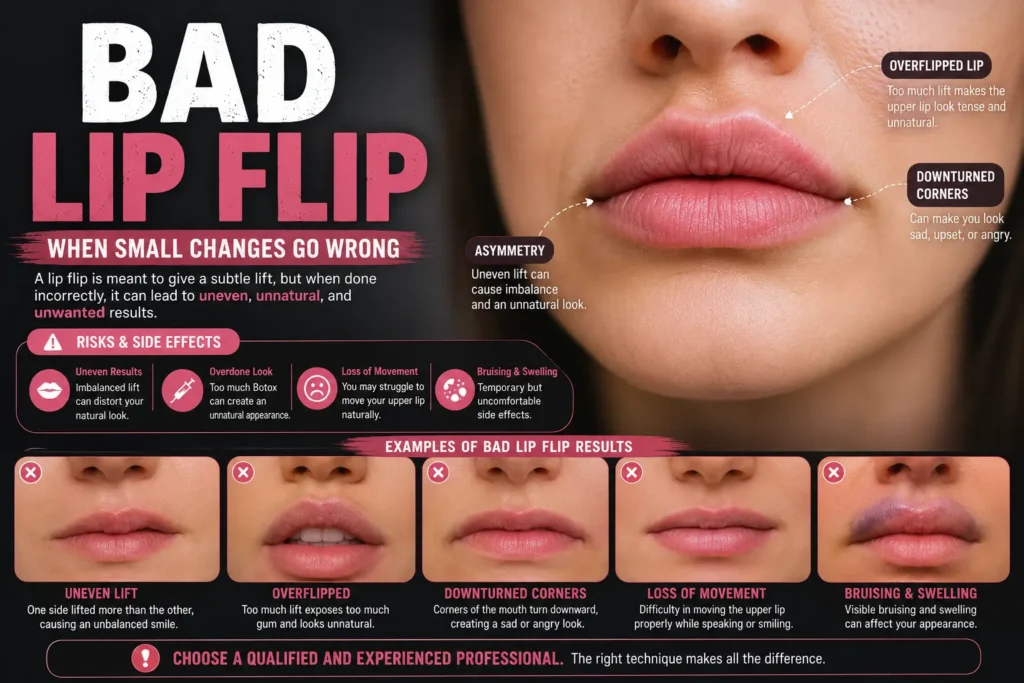
This is when the treatment itself didn’t go as it should — visible asymmetry, an overly stiff or “duck lip” look, drooping, or trouble speaking that goes beyond mild adjustment. This is the category most people actually mean, and it’s the focus of most of this guide.
3. Expectation Mismatch (Not Technically a Failure)
Sometimes the injection itself was done correctly, but the result simply isn’t what the patient pictured — often because a lip flip and filler create different effects, and the two get confused. A lip flip subtly repositions the upper lip; it doesn’t add volume the way filler does. If you wanted noticeably plumper lips, comparing lip flip vs. lip filler beforehand usually prevents this disappointment entirely.
Common Causes of Poor Lip Flip Results
Overtreatment (Too Much Product)
Only a small amount of Botox is needed for a lip flip — often just a few units. When an injector uses too much, the muscle relaxes more than intended, which can cause:
- Difficulty speaking, singing, or playing wind instruments
- Trouble keeping food or drink in the mouth
- Numbness or a “heavy” feeling that lasts beyond the first week
- Drooling
- An unnatural, overly flattened lip look
Undertreatment (Too Little Product)
The opposite problem also counts as a poor result: too little product and you won’t see any meaningful change at all, which can feel like a wasted appointment. Getting the dose right depends on individual anatomy — see how many units of Botox are typically used for a lip flip for a general reference range.
Incorrect Injection Placement
Precision matters here more than almost any other Botox treatment area. Injecting too deep, too low, or off-center can create asymmetry or affect muscles involved in speech and smiling. Understanding where Botox is injected for a lip flip or reviewing typical lip flip injection sites can help you ask more informed questions at your consultation.
Inexperienced Injector
Not every provider who offers Botox has real experience specifically with lip flips. A rushed consultation, no discussion of your natural lip asymmetry, or a “one-size-fits-all” dosing approach are all warning signs.
Unrealistic or Miscommunicated Expectations
If you asked for a “bigger lip” and got a lip flip alone, the result will likely disappoint you — that’s a filler job, not a Botox one. A thorough consultation should clarify this before you’re ever injected.
Signs You Might Have Poor Results
| Sign | Likely Just Normal Healing | Likely a True Poor Result |
| Mild stiffness in week 1 | ✅ | |
| Slight trouble with “P/B” sounds | ✅ | |
| Subtle asymmetry that’s fading | ✅ | |
| Visible one-sided drooping | ⚠️ Contact your injector | |
| Overly flat, “frozen” upper lip | ⚠️ Likely overtreatment | |
| No visible change at all after 2 weeks | ⚠️ Likely undertreatment | |
| Ongoing numbness past 2–3 weeks | ⚠️ Contact your injector | |
| Difficulty controlling drooling | ⚠️ Contact your injector | |
| Facial changes beyond the lip (eye, cheek) | ❌ Seek medical evaluation |
How Long Do Poor Lip Flip Results Last?
Because these procedures rely on botulinum toxin, almost all technique-related issues are temporary rather than permanent.
| Stage | What’s Typically Happening |
| Days 1–3 | Swelling from injections; too early to judge the outcome |
| Days 4–7 | Effects begin to show; this is when undertreatment or overtreatment becomes noticeable |
| Days 10–14 | Peak effect — the clearest picture of your actual result |
| Weeks 3–6 | Gradual softening as muscle movement returns |
| Weeks 6–8 (up to 12) | Full resolution as the toxin wears off completely |
For more detail on what to expect day by day, see lip flip results day by day or how long it takes for a lip flip to work.
Featured snippet answer: Poor results caused by overtreatment or poor technique typically resolve within 6 to 8 weeks as the Botox wears off. There’s no way to reverse it immediately — recovery depends on time, not intervention.
What to Do If You Think Your Results Went Wrong
- Wait until at least day 10–14 before judging the result. Peak effect takes about two weeks to show, so early impressions can be misleading.
- Contact your original injector. They know your dose and technique and are best positioned to assess whether it’s settling normally or needs correction.
- Ask about a small balancing touch-up. In select cases, a minor corrective injection can help even out asymmetry — but only after enough time has passed to see the full effect.
- Avoid chasing a fix from a new, unfamiliar provider right away. Switching providers mid-correction often complicates rather than solves the issue.
- Track your symptoms with photos. Comparing week 1 to week 3 photos helps you and your injector see whether it’s actually improving.
- Escalate to urgent care if symptoms extend beyond the lip — eye drooping, slurred speech, or facial numbness elsewhere are not typical lip flip side effects.
Bad Lip Flip vs. a Genuinely Botched One: Is There a Difference?
“Bad lip flip” and a truly botched result often get used interchangeably, but there’s a useful distinction. A bad lip flip usually means the outcome is underwhelming, uneven, or overdone — a technique or dosing issue that’s frustrating but fixable with time. A more serious “botched” case typically involves visible, functional problems like drooling you can’t control or one side of the mouth that won’t move at all. If you’re dealing with drooping specifically or want a deeper breakdown of when to worry versus when to wait, this guide on lip flip gone wrong covers that distinction in detail.
Pros and Cons Worth Remembering
| What Works in Your Favor | What Increases Risk of Poor Results |
| Effects are temporary — mistakes fade | Can’t be reversed instantly once injected |
| Small, quick procedure with minimal downtime | Requires precise technique and experience |
| Can be adjusted at a follow-up appointment | Overtreatment can’t be “undone” faster than natural wear-off |
| Easy to compare real results beforehand | Expectation mismatches are common without a thorough consultation |
How to Avoid Poor Results Next Time
Vet your injector properly.
- Confirm licensure (MD, DO, NP, or PA) and specific lip flip experience, not just general Botox experience
- Ask to see real lip flip before and after photos from their own patients
- Look at examples similar to your lip type, such as before and after for thin lips or full lips
Get the goal right before you get injected.
- Understand what a lip flip actually is and how it works
- If your goal is more volume rather than a subtle roll, ask about combining with filler, or compare lip flip with filler versus doing it without filler
- If you’re addressing a specific concern like a gummy smile, make sure that’s discussed directly during your consultation
Start conservative on dose.
- A smaller starting dose can always be built on later
- This matters especially for smaller or thinner lips, which tend to be more sensitive to product
Follow aftercare instructions exactly.
- Skip massaging, heavy exercise, and alcohol on treatment day
- Full guidance is available in this lip flip aftercare guide, including specifics like eating, drinking, exercising, and even kissing after treatment
Understand the cost of getting it right the first time.
- Cutting corners on price often means cutting corners on experience — see typical lip flip cost ranges and what factors into how much a lip flip costs at reputable providers
When a Lip Flip Might Not Be the Right Treatment for You
A disappointing outcome sometimes traces back to the treatment being a poor fit in the first place, not the injection itself. You may want to explore alternatives if you have:
- Pre-existing lip or smile asymmetry
- A profession relying on precise lip control (singing, wind instruments, public speaking)
- A goal centered on volume rather than subtle repositioning
In these cases, it’s worth comparing a surgical lip flip vs. Botox lip flip or a lip lift vs. lip flip with a qualified provider.
Frequently Asked Questions
Can a bad lip flip be fixed the same day? No. Because the result depends on botulinum toxin settling into the muscle, there’s no same-day fix. Most providers wait at least two weeks before considering a small corrective touch-up.
Is it normal to see no change at all after a lip flip? If it’s been more than two weeks and there’s still no visible change, the dose may have been too conservative for your anatomy. This is worth discussing with your injector rather than assuming the treatment simply doesn’t work for you.
Why does my lip look stiff or “frozen” instead of flipped? This usually points to overtreatment — too much product relaxing the muscle more than intended. It typically softens as the toxin wears off over several weeks.
How do I know if it’s poor results or just normal swelling? Swelling from the injection itself typically resolves within a few days. If asymmetry, stiffness, or drooping persists or worsens after the first week, it’s more likely a true technique issue than simple swelling.
Can I get a touch-up if my lip flip results are uneven? Sometimes, yes — but only after enough time has passed to see the full effect, usually around two weeks. Adding product too early can overcorrect the result.
Does a bad lip flip mean I chose the wrong injector? Not always, but it’s a common factor. Overtreatment, poor placement, and lack of anatomical assessment during consultation are the most frequent causes tied directly to injector experience.
Is a bad lip flip permanent? Rarely. Because it’s Botox-based, almost all poor results resolve completely within 6 to 8 weeks as the product wears off naturally.
What’s the difference between poor results and a medical complication? Poor results usually mean disappointing or uneven cosmetic outcomes — overdone, underdone, or asymmetric. A medical complication typically involves functional issues extending beyond the lip, like eye drooping or slurred speech, which need prompt evaluation.
Should I massage a bad lip flip to help it settle? Gentle care is fine, but aggressive massaging doesn’t speed up how quickly the toxin metabolizes and may irritate the area. Time remains the main factor in resolution.
Can men and women experience different types of poor results? The underlying causes are the same, but ideal dosing can differ based on lip size and muscle mass. This lip flip before and after for men guide shows how results are typically approached differently.
Do older patients have a higher risk of poor lip flip results? Changes in skin elasticity and lip volume with age can make asymmetry more visible. See this lip flip before and after for older women resource for a realistic comparison.
Does the type of neurotoxin used affect the chance of a bad result? Botox, Dysport, and Xeomin work similarly, though dosing units differ between products. Compare specifics in this Dysport lip flip guide or Xeomin vs. Botox for lip flip breakdown.
Bottom Line
A bad lip flip is usually one of three things: normal healing mistaken for a problem, a genuine technique or dosing issue, or a mismatch between what you wanted and what a lip flip can actually deliver. Most true poor results resolve naturally within 6 to 8 weeks, and the best prevention is choosing an experienced injector, starting with a conservative dose, and having a clear conversation about your goals before you’re ever injected.
Before your next appointment, it’s worth reviewing real lip flip results and the full lip flip procedure so you know exactly what to expect — and what questions to ask.
This article is for general educational purposes and isn’t a substitute for personalized medical advice. If you’re experiencing concerning symptoms after a cosmetic procedure, consult a licensed medical professional promptly.