If you’ve ever looked at a diagram of lip flip injection sites and wondered why the dots are placed exactly where they are, you’re asking the right question. Placement isn’t random — it’s based on the specific anatomy of the muscle that controls your upper lip. Get the sites right, and you get a natural, soft roll-out. Get them wrong, and you can end up with an uneven smile or a lip that feels stiff.
This guide walks through the exact injection points used in a standard lip flip, the anatomy behind each one, how many units typically go where, and what can go wrong when placement is off. You’ll also see how site selection changes depending on your goals — whether that’s a fuller pout, a softer smile, or less gum showing when you laugh.
Table of Contents
Quick Answer: Where Are Lip Flip Injection Sites?
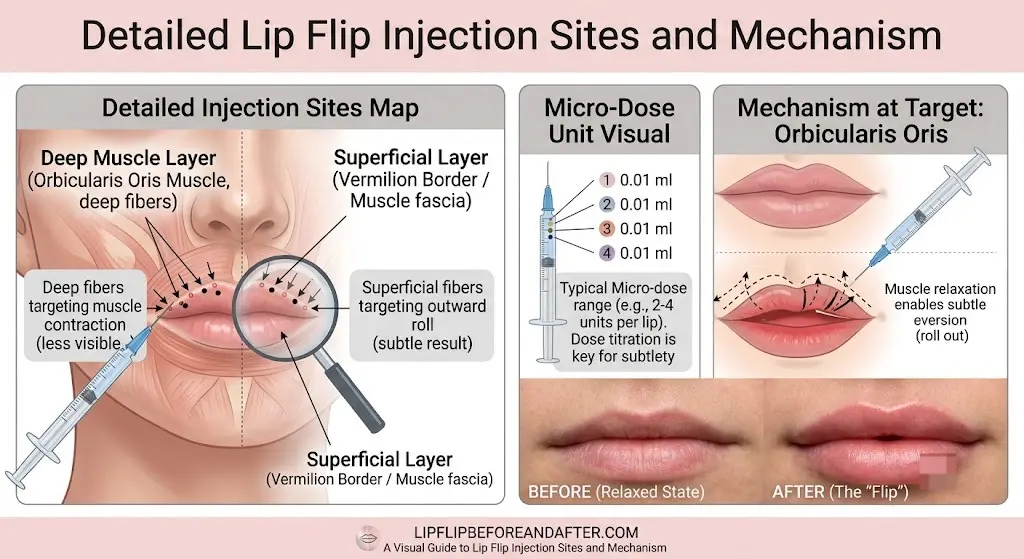
Lip flip injections typically target 4 to 6 points along the upper lip, spaced evenly just above the vermilion border (where the lip color meets the skin), on either side of the philtrum (the vertical groove under the nose). Some providers also treat the corners (oral commissures) or lower lip depending on the goal.
Key Takeaways
- Lip flip injection sites target the orbicularis oris muscle, the ring-shaped muscle around the mouth
- Most treatments use 4 to 6 injection points on the upper lip only
- Injections sit 2–3 mm above the vermilion border, avoiding the wet/dry lip line
- Total dose is usually 4 to 10 units of Botox, split across all sites
- Site selection changes based on whether you’re targeting volume appearance, smile softening, or gummy smile correction
- Precise placement is what separates a natural result from an uneven or “duck lip” look
Understanding the Anatomy Behind Injection Site Selection
Before looking at exact points, it helps to understand what’s under the skin. The orbicularis oris is a circular sphincter muscle that wraps around the mouth. It’s responsible for puckering, pressing your lips together, and pulling the upper lip down and in when you talk or smile.
Two other muscle groups matter for site selection:
- Levator labii superioris – lifts the upper lip and contributes to a gummy smile when overactive
- Depressor anguli oris – pulls the corners of the mouth downward
Most standard lip flips focus only on the orbicularis oris, but providers may adjust placement slightly if the goal includes softening a gummy smile or lifting downturned corners. This is why two people can get a “lip flip” and end up with injections in noticeably different spots — their anatomy and goals aren’t identical.
The Standard Lip Flip Injection Sites, Explained
Here’s the typical layout used by most experienced injectors:
1. Central Points (Either Side of the Philtrum)
Two injection points sit just above the vermilion border, roughly 3–5 mm on either side of the center of the upper lip (the philtral columns). These are usually the first points injected and have the biggest visual impact on the “flip” of the central lip.
2. Mid-Lip Points
Moving outward, two more points are typically placed further along the upper lip border, roughly above where the cupid’s bow curves down. These help create a smooth, even roll rather than a peak in the center only.
3. Lateral (Outer) Points
In some protocols, one or two additional points are placed closer to the corners of the mouth, especially if the goal includes softening the smile line more broadly or addressing a gummy smile that shows more on the sides.
4. Optional Lower Lip Points
A traditional lip flip only treats the upper lip, since that’s where most people want the visible roll-out effect. Some providers offer a modified version that includes 1–2 points on the lower lip for a more balanced look, though this is less common and requires a more conservative dose to avoid affecting lip function.
Featured snippet answer: Standard lip flip injection sites include 4 to 6 points along the upper lip, positioned just above the vermilion border on either side of the philtrum, with occasional additional points near the corners for smile softening or gummy smile correction.
Step-by-Step: What Happens During Injection
- Consultation and marking. The provider examines your lip anatomy, smile pattern, and gum show, then marks injection points with a skin-safe marker.
- Cleansing. The area is cleaned to reduce infection risk.
- Optional numbing. A topical anesthetic may be applied for a few minutes.
- Injection at each site. A fine needle delivers a small amount of botulinum toxin at each marked point, usually 1–2 units per site.
- Even distribution check. The provider assesses symmetry across the marked points before finishing.
- Post-injection guidance. You’re advised to stay upright and avoid touching the area for several hours.
The full appointment, including marking and injections, usually takes 10 to 15 minutes.
How Injection Sites Change Based on Your Goal
Not every lip flip targets the same outcome, and site selection shifts depending on what you’re trying to achieve. If you want to see how these different approaches translate visually, our lip flip before and after gallery shows a range of real outcomes.
| Goal | Primary Injection Focus | Typical Site Count |
| Fuller-looking upper lip | Central and mid-lip points | 4–6 |
| Softer smile line | Central, mid-lip, plus lateral points | 5–6 |
| Gummy smile correction | Points closer to nasolabial folds, sometimes higher placement | 4–6 |
| Balanced upper and lower lip | Upper lip points plus 1–2 conservative lower lip points | 6–8 |
| Corner lift / downturned mouth | Added points near oral commissures (depressor anguli oris) | Varies by provider |
You can see gummy-smile-specific results on our gummy smile before and after page, and general smile changes on our lip flip before and after smile page.
How Much Botox Goes at Each Site?
Dosing varies by provider and by the brand of neuromodulator used, but here’s a general reference range:
| Injection Area | Typical Units (Botox) |
| Each central point | 1–2 units |
| Each mid-lip point | 1–2 units |
| Each lateral point | 1 unit |
| Total upper lip dose | 4–10 units |
Because these numbers are small compared to areas like the forehead or glabella, precision matters even more — a single unit placed slightly off-target can shift the result. This is one reason lip flip pricing tends to be lower than larger treatment areas; you can compare typical outcomes and pricing considerations on our botox lip flip page.
What Happens If Injection Sites Are Off?
Precise placement is what makes the difference between a subtle, natural flip and a result that looks uneven or feels strange. Common issues from poor site selection include:
- Asymmetry – if one side receives slightly different placement or dosing than the other
- “Duck lip” appearance – if too much toxin goes into the central points without balancing the sides
- Reduced lip mobility – if injections stray too close to the wet/dry border or go too deep
- Minimal visible change – if the dose is too conservative or points are placed too far from the muscle’s active zone
- Uneven smile – if lateral points aren’t matched precisely on both sides
These risks are a strong reason to choose an experienced, licensed injector who understands perioral anatomy specifically, rather than someone who primarily treats other areas of the face.
Lip Flip Injection Sites vs. Filler Injection Points
It’s worth noting that lip flip and lip filler use completely different injection strategies, since they’re solving different problems.
| Feature | Lip Flip Sites | Filler Sites |
| Target | Orbicularis oris muscle | Lip tissue (submucosal) |
| Depth | Superficial, at muscle level | Deeper, within lip body |
| Number of points | 4–8 | 4–10+ depending on technique |
| Substance | Botulinum toxin | Hyaluronic acid gel |
| Goal | Relax muscle pull | Add physical volume |
Understanding this difference matters if you’re deciding between the two or considering combining them — our what is a lip flip guide breaks this down further, and our how does a lip flip work article covers the muscle mechanism in more depth.
Common Mistakes Around Injection Site Selection
- Choosing a provider without perioral experience. Injecting near the mouth requires more precision than larger, flatter areas like the forehead.
- Assuming more sites means better results. A well-placed 4-point pattern often outperforms a poorly distributed 8-point pattern.
- Not accounting for facial asymmetry. Most faces are naturally a little uneven, and skilled injectors adjust dosing per side accordingly.
- Ignoring smile dynamics. Injection sites that look good at rest can behave differently when you smile or speak if the injector didn’t assess your dynamic movement first.
Tips for a Well-Placed Lip Flip
- Ask your injector to explain their planned injection points before starting
- Bring reference photos if you have a specific look in mind, like softer smile lines or reduced gum show
- Mention if you have any lip asymmetry so it can be accounted for in dosing
- Avoid rubbing or massaging the area for several hours after injection, since this can shift toxin diffusion
- Schedule a follow-up check around the 2-week mark to assess symmetry once the full effect has set in
Safety Considerations
Injections near the mouth are generally safe when performed by a licensed, trained provider, but the area does carry some unique considerations. The lips are highly mobile and used constantly for speech, eating, and expression, so even small differences in placement can be noticeable. Report any unusual weakness, drooping, or trouble with lip movement to your provider promptly, since these are not typical and should be assessed.
This information is educational and doesn’t replace a consultation with a licensed medical professional. Individual anatomy varies, and only a qualified injector can determine the right injection sites and dosing for your face.
Frequently Asked Questions
How many injection sites are used for a lip flip? Most lip flips use 4 to 6 injection points along the upper lip, though this can vary based on your anatomy and goals, such as adding lateral points for gummy smile correction.
Do lip flip injections go into the lip itself? No. They target the orbicularis oris muscle just above the vermilion border, not the lip tissue itself. This is different from filler, which is injected directly into the lip.
Is the lower lip ever injected during a lip flip? Traditionally, no — a standard lip flip only treats the upper lip. Some providers offer a modified version with conservative lower lip points, but this is less common and requires careful dosing.
Can injection site placement affect how natural the result looks? Yes, significantly. Even spacing and symmetric dosing across sites are what create a smooth, natural roll rather than an uneven or exaggerated look.
Does it hurt more at certain injection sites? Some points, especially closer to the corners of the mouth, can feel slightly more sensitive due to higher nerve density in that area, but discomfort is generally brief at every site.
How do injectors decide exactly where to place each point? They assess your lip shape, smile pattern, gum show, and any asymmetry, then mark points based on where the orbicularis oris muscle needs the most relaxation to achieve your goals.
Can lip flip injection sites be adjusted for a gummy smile? Yes. Providers may add points positioned to also soften the levator labii superioris muscle’s pull, which helps reduce gum visibility when smiling.
Will I be able to see the injection points afterward? Tiny injection marks may be visible for a few minutes, but they typically fade quickly and aren’t noticeable once any minor redness settles.
How long does the injector spend on each site? Each injection itself takes only seconds. Most of the appointment time goes into marking, planning, and assessing symmetry before and after injecting.
What if my injection sites feel uneven after treatment? Mild asymmetry can happen as the toxin settles over the first week. If unevenness persists past two weeks, follow up with your provider, who may be able to make minor adjustments.
Do injection sites change if I’ve had a lip flip before? Sometimes. Returning patients may need slightly different placement if their muscle response has changed over repeated treatments, which is why providers often reassess at each visit rather than repeating the exact same plan.
Summary: Why Injection Site Precision Matters
Lip flip injection sites aren’t arbitrary — they’re chosen based on the specific anatomy of the orbicularis oris muscle and adjusted for your individual lip shape, smile pattern, and goals. A well-planned 4-to-6-point pattern along the upper lip is usually all it takes to create a natural, subtle roll-out, while poor placement can lead to asymmetry or an unnatural look.
If you’re preparing for a consultation, it’s worth reviewing real lip flip results and understanding the full lip flip procedure so you know what questions to ask your injector about their specific injection plan.