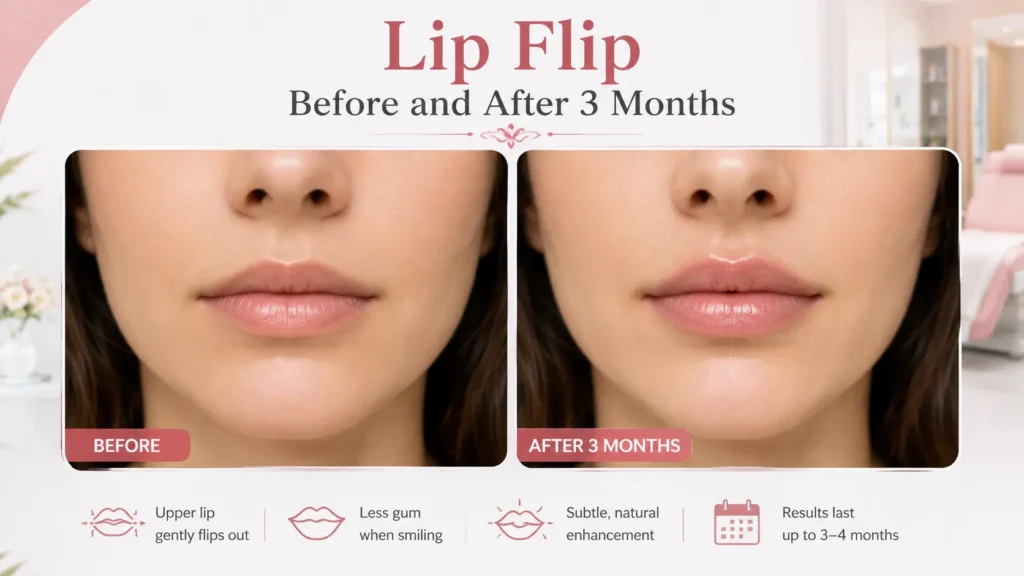
Three months is where a lot of people start second-guessing their lip flip. The dramatic “before” photos from your consultation feel like a distant memory, and now you’re wondering if your lips look the same as they did before treatment. A lip flip before and after 3 months comparison usually tells a very specific story: the effect is softening, and that’s expected, not a sign anything went wrong.
This guide explains exactly what’s happening to your lips at this stage, why the muscle relaxation fades on this timeline, and how to decide whether to book a touch-up or let it wear off completely.
By 3 months, most lip flip results have noticeably faded or fully returned to baseline. This happens because the neuromodulator wears off as the treated muscle regains normal function, typically within 8 to 12 weeks of the original injection.
Table of Contents
Key Takeaways
- A lip flip before and after 3 months comparison usually shows partial to full fading of the original effect.
- The average lip flip lasts 2 to 4 months, so 3 months falls right at the edge of most people’s results.
- Fading happens gradually, not overnight — you may notice your smile “returning to normal” over several weeks.
- Repeat treatments often last slightly longer as the muscle adapts to regular relaxation.
- If your results are already gone at 3 months, that’s within the normal range, not a treatment failure.
What Actually Happens to a Lip Flip by 3 Months
A lip flip relaxes the orbicularis oris muscle using a neuromodulator like Botox, Dysport, or Xeomin. That muscle relaxation is what creates the subtle outward roll of the upper lip. Neuromodulators don’t dissolve or “wear off” instantly — the nerve-to-muscle connections gradually rebuild over time, and muscle activity returns bit by bit.
By the 3-month point, most people are somewhere between “slightly less flip than before” and “completely back to normal.” Where you land depends on your original dose, your metabolism, and how strong your lip muscle naturally is. If you want to see how you got here, our lip flip results day by day and lip flip before and after 1 month guides walk through the earlier stages.
Lip Flip Before and After 3 Months: Timeline Overview
| Timeframe | Muscle Activity | Visible Result |
| Week 2–4 | Fully relaxed | Peak result, most visible flip |
| Week 6–8 | Slight activity returning | Result still strong, minor softening |
| Week 8–10 | Noticeable activity returning | Flip becomes subtler |
| Week 10–12 (3 months) | Significant to full return | Little to no visible flip for most people |
| Week 12+ | Full muscle function | Back to pre-treatment baseline |
For the full breakdown of how long effects hold before this point, see how long does a lip flip last.
Why Results Fade Faster for Some People
Not everyone reaches the 3-month mark at the same pace. Several factors influence how quickly a lip flip fades:
- Metabolism — People with faster metabolisms often process neuromodulators more quickly, shortening the effect.
- Original dosage — Lower unit counts wear off sooner than higher, more targeted doses.
- Muscle strength — A naturally strong orbicularis oris muscle can regain function faster.
- Product type — Botox, Dysport, and Xeomin have slightly different onset and duration profiles; see Dysport lip flip and Xeomin vs Botox lip flip for specifics.
- Repeat treatment history — Some patients report longer-lasting results after several consistent treatments, though this varies by individual.
- Activity level — Frequent, intense facial movement (talking, exercising) may theoretically speed up how fast the muscle “relearns” activity, though this isn’t strongly established in research.
Lip Flip After 3 Months: What’s Normal vs What’s Not
| Normal at 3 Months | Worth a Follow-Up |
| Flip has faded evenly on both sides | One side faded much faster than the other |
| Lips look like pre-treatment baseline | Lips look different in shape, not just less flipped |
| No discomfort or unusual sensation | Ongoing numbness, pain, or asymmetry |
| Smile feels completely normal | Difficulty with lip movement or speech |
Uneven fading is common and usually not a concern — it typically just means one side is returning to baseline slightly faster. Persistent asymmetry or new symptoms are different and worth discussing with your injector.
Lip Flip Before and After 3 Months vs Earlier Milestones
| Milestone | What You’ll Likely See |
| 2 weeks | Full effect kicking in |
| 1 month | Peak, most photographed result |
| 6–8 weeks | Still strong, very gradual softening |
| 3 months | Noticeably faded or back to baseline |
| 4+ months | Time to consider a touch-up if you want to maintain the look |
If you’re comparing your own photos, our page on lip flip results week by week is a useful reference point alongside this one.
Common Questions People Have at the 3-Month Mark
“Is it normal for my lip flip to be completely gone at 3 months?” Yes. The average duration is 2 to 4 months, so full fading by 3 months is well within the typical range, especially for a first treatment or a conservative dose.
“Why did my friend’s lip flip last longer than mine?” Duration varies by metabolism, muscle strength, dosage, and injector technique. Two people can receive similar treatments and still see different timelines.
“Should I get a touch-up right at 3 months, or wait?” Most injectors recommend booking a touch-up once you notice the effect has faded to a point you’re not happy with, rather than on a fixed schedule. Learn more in our lip flip touch-up guide.
How to Maintain Results Past 3 Months
- Track your fading timeline. Take photos at 4, 8, and 12 weeks so you know your personal pattern for next time.
- Book your next appointment before full fade-out. Many people schedule touch-ups around week 10–12 to avoid a “before and after” cycle.
- Discuss dosage adjustments. If your results faded faster than expected, a slightly higher dose next time may extend duration.
- Consider your product. If you’re not happy with your current neuromodulator’s duration, ask your injector about alternatives — see lip flip vs Dysport or lip flip vs Jeuveau.
- Stay consistent with your injector. Repeat treatments with the same provider often produce more predictable, repeatable timelines.
Lip Flip Fading: Pros and Cons of the 3-Month Timeline
| Pros | Cons |
| Low commitment — nothing permanent to reverse | Requires repeat visits to maintain results |
| Easy to stop if you don’t like the look | Fading can happen faster than expected for some |
| No downtime for follow-up treatments | Ongoing cost adds up over a year |
| Muscle function fully returns, no lasting effect | Results aren’t guaranteed to last a fixed period |
For cost planning across repeat treatments, see how much does a lip flip cost.
Lip Flip vs Filler: Why One Fades Faster
A lip flip fading by 3 months is one of the biggest differences between it and lip filler, which typically lasts 6 to 18 months. Filler adds physical volume with a gel that breaks down slowly, while a lip flip only relaxes muscle activity — a process the body naturally reverses much sooner. If longevity matters more to you than subtlety, it’s worth comparing both options on our lip flip vs lip filler page.
Frequently Asked Questions
How long does a lip flip actually last before fading? Most people see results for 2 to 4 months, with noticeable softening often starting around week 8.
Will my lip flip fade evenly on both sides? Usually, though slight unevenness during the fading process is common and typically resolves as the muscle fully returns to baseline.
Can I extend my lip flip results past 3 months? Booking a touch-up before the effect fully fades — often around week 10 to 12 — is the most common way to maintain continuous results.
Does a second lip flip last longer than the first? Some patients report longer-lasting results with repeat treatments, though this isn’t guaranteed and depends on individual response.
Is it bad if my lip flip barely lasted 2 months? No — shorter duration is more common with lower doses or faster metabolisms and isn’t a sign of a failed treatment.
What should I do if my lips look uneven while fading? Give it a few more weeks, since fading doesn’t always happen at the same rate on both sides. Persistent asymmetry is worth mentioning to your injector.
Can I switch neuromodulators for longer-lasting results? Yes, some patients try Dysport, Xeomin, or Jeuveau to compare duration, though individual response varies more than the product itself.
Do repeat lip flips cost the same as the first one? Pricing is typically similar per session, though some clinics offer package deals for regular touch-ups.
Is there a way to know exactly when my results will fade? Not precisely — duration depends on multiple individual factors, but tracking your own timeline after each treatment helps predict future sessions.
Should I be worried if my lip flip results are already gone before 3 months? Not necessarily. Faster metabolism or a lighter dose can shorten duration, and it doesn’t affect how a future treatment will perform.
Summary
A lip flip before and after 3 months comparison typically shows a treatment that’s fading or fully worn off, and that’s expected given the average 2 to 4 month duration of neuromodulator-based lip flips. Uneven softening, a gradual return to your natural smile, and no lasting side effects are all normal parts of this stage. If you want to maintain your look, most people book a touch-up around week 10 to 12 rather than waiting for a complete fade-out. If anything feels off beyond simple fading — persistent asymmetry, pain, or unusual sensation — that’s worth a conversation with your injector.
This article is for general educational purposes and isn’t a substitute for personalized advice from a licensed injector or medical professional.