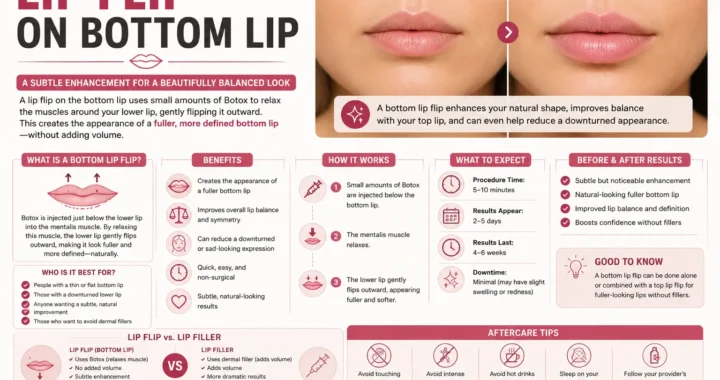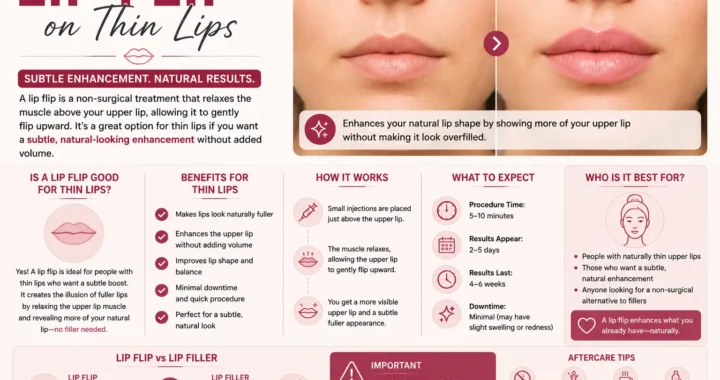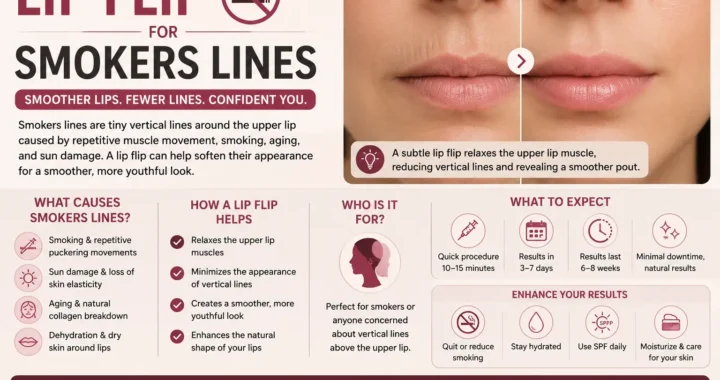

Getting the dose right is the single biggest factor in how natural a lip flip looks. Ask how many units of Botox for lip flip treatments and you’ll get a range depending on who you ask — but the real answer depends on your muscle strength, your lip anatomy, and even which brand of botulinum toxin your injector uses.
This guide walks through the typical unit ranges, how dosing is split across injection points, why Botox, Dysport, and Xeomin aren’t measured the same way, and what actually happens if you get too much or too little. For a look at how correct dosing translates into visible change, our lip flip before and after photos gallery is a useful reference point before your consultation.
Table of Contents
Quick Answer: How Many Units of Botox Does a Lip Flip Need?
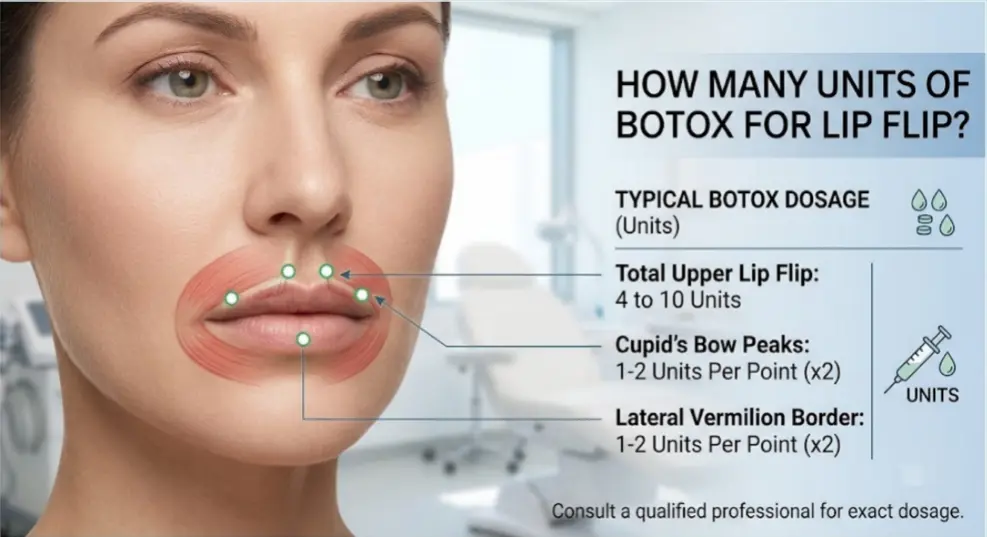
A standard Botox lip flip uses 4 to 8 units total, split across 2–4 injection points along the upper lip, just above the vermilion border. Some providers add 2 units to the lower lip for a mild, balanced effect. The exact number depends on your muscle strength and desired subtlety — always set by a licensed injector during consultation.
Key Takeaways
- Most patients need 4–8 units for the upper lip alone; total dosing rarely exceeds 10 units.
- How many units of Botox for lip flip treatment depends on lip anatomy, muscle strength, and how subtle or noticeable you want the flip.
- Dysport and Xeomin use different unit scales than Botox — “units” are not interchangeable between brands.
- Starting conservative and topping up at a follow-up is safer than overdosing on the first visit.
- Units are typically split across 2 central and 2 lateral points, sometimes with a small amount in the lower lip.
- Too few units mean minimal or short-lived results; too many can affect speech, straw drinking, or smiling.
Why Unit Count Matters So Much for a Lip Flip
Unlike Botox for forehead lines, where a wider margin of error is more forgiving, the lip flip works in a small, highly functional area. The orbicularis oris muscle isn’t just cosmetic — it controls speech, eating, drinking, and smiling. A dose that’s slightly off can be the difference between a subtle, natural flip and a lip that feels stiff or uneven.
This is also why how many units of Botox for lip flip procedures require is rarely a fixed number. It’s a range that a trained injector narrows down based on what they see and feel during your consultation — not a one-size-fits-all formula.
Typical Unit Range by Injection Point
Most lip flips distribute product across a handful of small, precise points rather than one large injection.
| Injection Point | Location | Typical Units |
| Central points (x2) | Just above the Cupid’s bow, flanking the philtrum | 1–2 units each |
| Lateral points (x2) | Outer upper lip, toward the corners | 0.5–1.5 units each |
| Lower lip (optional) | Center of lower lip | 0–2 units total |
| Typical total | 4–8 units |
Some injectors use only 2 injection points with slightly higher doses per point, while others prefer 4–6 points with smaller amounts each for a more even distribution. Both approaches can work well — what matters more is the injector’s experience with the technique than the exact number of needle sticks.
Botox vs. Dysport vs. Xeomin: Unit Conversions Aren’t the Same
This is one of the most overlooked details in lip flip dosing conversations. “Units” of Botox, Dysport, and Xeomin are not equivalent — a unit of Dysport is not as potent as a unit of Botox.
| Brand | Relative Potency | Typical Lip Flip Unit Range |
| Botox (onabotulinumtoxinA) | Baseline reference | 4–8 units |
| Dysport (abobotulinumtoxinA) | Roughly 2.5–3x less potent per unit | 12–20 units |
| Xeomin (incobotulinumtoxinA) | Roughly 1:1 with Botox | 4–8 units |
If you’re comparing quotes or prior treatments between clinics, always ask which brand was used before comparing unit counts directly. A “12-unit” Dysport lip flip and an “6-unit” Botox lip flip can produce a very similar result.
What Happens With Too Few Units
If your injector is conservative — often intentional for a first-time patient — you may notice:
- A very subtle or barely visible flip
- Results fading sooner than the typical 8–12 week window
- The need for a top-up appointment 2–3 weeks later
Starting low and adjusting is a common, safe approach, especially for patients unfamiliar with how their lips respond to botulinum toxin.
What Happens With Too Many Units
Overdosing a lip flip creates function-related side effects rather than just a cosmetic miss:
- Difficulty drinking from a straw or whistling
- A stiff, “frozen” feeling in the upper lip
- Trouble fully closing the lips or controlling saliva
- Subtle changes in speech, especially with sounds like “P,” “B,” and “M”
These effects are temporary and resolve as the product wears off, typically within several weeks, but they can be uncomfortable in the meantime. This is exactly why how many units of Botox for lip flip dosing should always be tailored, not templated.
Factors That Affect Your Ideal Unit Count
Muscle Strength
Patients with a strong, highly active orbicularis oris muscle (often visible as deep lip lines when pursing or smiling) typically need more units to achieve a visible flip.
Lip Anatomy
Thinner upper lips with less visible vermilion at rest often respond well to lower doses, since even a small muscle relaxation reveals more pink tissue.
Desired Subtlety
Patients wanting a barely-there change may ask for the lower end of the range, while those wanting a more noticeable flip may need a few units more — within safe limits.
First Treatment vs. Repeat Treatment
Many injectors start new patients slightly conservative, then adjust the unit count at the next appointment based on how the first round responded. Repeat patients often have a well-established “sweet spot” number.
Gender
Men typically request smaller unit counts for a barely-visible lift, since a strong flip can look feminizing on facial structures that already have fuller vermilion at baseline. Our lip flip before and after men page shows how conservative dosing plays out visually.
Dosage by Goal: A Practical Comparison
| Goal | Typical Total Units | Notes |
| Very subtle, barely-there lift | 2–4 units | Common for first-time patients or men |
| Standard, noticeable flip | 4–6 units | Most common target range |
| Fuller flip with lower lip included | 6–10 units | Adds 2 units to the lower lip for balance |
| Gummy smile correction focus | 4–8 units | Slightly different point placement, similar dosing |
If you’re not sure which category applies to you, comparing real examples — like lip flip before and after for thin lips versus lip flip before and after for full lips — can help you communicate your goals more precisely at your consultation.
Step-by-Step: How Your Injector Determines Your Dose
- Assessment — Your injector examines lip shape, muscle strength, and how much vermilion shows at rest and when smiling.
- Goal discussion — You describe how subtle or noticeable you want the result to be.
- Point mapping — Injection points are marked, usually 2–4 along the upper lip.
- Conservative starting dose — Especially for first-timers, injectors often start at the lower end of the range.
- Functional check — You may be asked to smile, purse your lips, and speak to confirm symmetry before finishing.
- Follow-up plan — A two-week check-in lets your injector add a small top-up if the result is milder than expected.
Timeline: When Does the Dose “Kick In”?
| Timeframe | What to Expect |
| Day 0–2 | No visible change yet; possible mild swelling |
| Day 3–7 | Early signs of the flip appear |
| Day 10–14 | Full effect of the dose is visible |
| Week 8–12 | Effect gradually fades as muscle activity returns |
If your result still looks minimal at the two-week mark, that’s the right time to discuss a small top-up rather than waiting for the full effect to fade first.
Mistakes to Avoid With Dosing
- Assuming more units means better results — beyond a certain point, extra product only adds function-related risk, not more lift.
- Comparing unit counts across brands — a Dysport number will look much higher than a Botox number for the same effect.
- Choosing an injector based on the lowest quoted unit price — the skill of point placement matters more than the per-unit cost.
- Skipping the follow-up appointment — small adjustments are easiest to make within the first 2–3 weeks.
- Requesting a specific unit count without an assessment — your ideal dose depends on your own anatomy, not a number you read online.
Cost Considerations Tied to Unit Count
Since Botox is typically priced per unit, your total cost scales with your dose.
| Factor | Effect on Cost |
| Total units used | Directly increases price, usually $10–$25 per unit |
| Brand used | Botox, Dysport, and Xeomin have different per-unit pricing |
| Injector experience | Specialists may charge a flat procedure fee rather than strict per-unit pricing |
| Geographic location | Urban markets tend to price per unit higher than smaller markets |
A typical 4–8 unit Botox lip flip costs roughly $75–$300 in the US, though this varies by provider and region.
Frequently Asked Questions
What is the average number of units for a first-time lip flip? Most first-time patients start with 4–6 units, giving the injector room to add more at a follow-up if the effect is milder than desired.
Can I ask my injector for a specific unit count? You can share your goals, but the exact number should come from your injector’s assessment of your muscle strength and lip anatomy, not a fixed request.
Is 2 units enough for a lip flip? Two units can produce a very subtle change in patients with naturally relaxed lip muscles, but most people need at least 4 units to see a noticeable flip.
Do more units mean longer-lasting results? Not significantly. Duration is driven more by individual metabolism and muscle activity than by a slightly higher unit count.
Why did my Dysport lip flip need more units than my friend’s Botox one? Dysport units are less potent than Botox units, so a Dysport treatment typically uses roughly 2.5–3 times more units for a comparable effect.
What happens if my injector uses too many units in the lower lip? Over-relaxing the lower lip can affect your ability to drink from a straw, whistle, or fully close your mouth. This resolves once the product wears off.
Can my dose change between appointments? Yes. Many injectors adjust the unit count slightly based on how your lips responded to the previous treatment.
Does a bigger dose mean a bigger lip? No. A lip flip changes lip position, not volume, regardless of dose. For actual size increase, filler is the appropriate treatment.
How do I know if I was overdosed? Signs include difficulty speaking clearly, trouble sipping from a straw, or a stiff, immobile feeling in the upper lip that goes beyond a subtle flip.
Is there a maximum safe unit count for a lip flip? Total dosing rarely needs to exceed 10 units for the upper and lower lip combined. Higher counts increase the risk of function-related side effects without adding cosmetic benefit.
Should I get fewer units if this is a touch-up rather than a first treatment? Often, yes — many patients need less product at maintenance visits once the muscle responds predictably to treatment.
Can unit count help with a gummy smile as well as lip flip appearance? Yes. Similar dosing, sometimes with adjusted point placement, is commonly used to soften a gummy smile alongside the lip flip effect.
Summary
How many units of Botox for lip flip treatment comes down to a range, not a fixed number: typically 4–8 units for the upper lip, occasionally with a small addition to the lower lip, spread across 2–4 precise injection points. The right dose depends on your muscle strength, lip anatomy, and how subtle or visible you want the result — and it should always be set by a licensed injector after an in-person assessment, not based on a number you saw online. Since Botox, Dysport, and Xeomin measure potency differently, always confirm which product your injector is using before comparing unit counts to anyone else’s experience.
To see how different dosing choices translate into real outcomes, explore our lip flip results page, or read more about how does a lip flip work and where to inject Botox for lip flip placement before your consultation.
This article is for educational purposes only and does not replace professional medical advice. Botox dosing should always be determined by a licensed, qualified injector based on an in-person evaluation.