
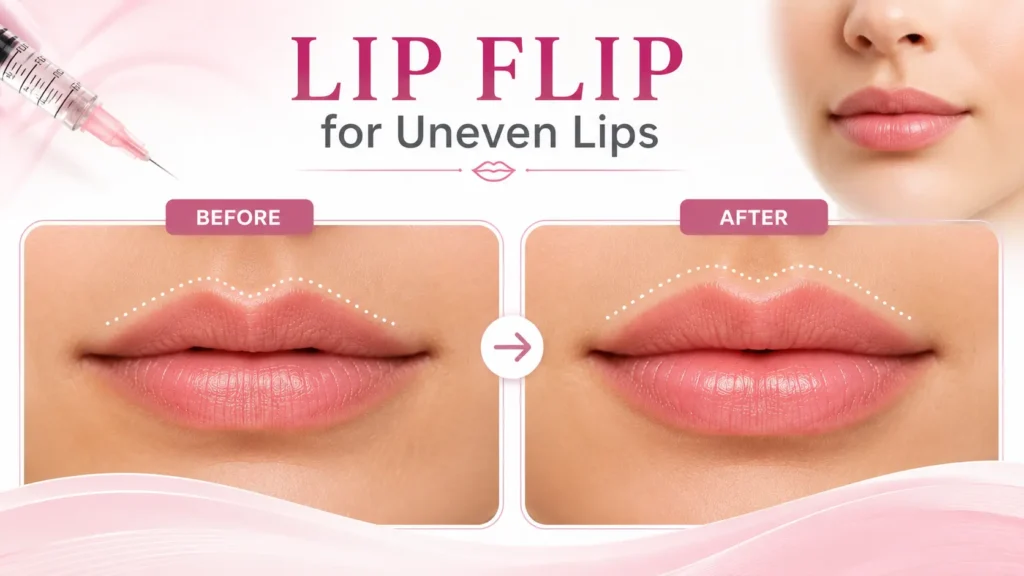
Almost no one has perfectly symmetrical lips, but for some people, the unevenness is noticeable enough to affect how confident they feel about their smile. A lip flip for uneven lips is one of the most searched solutions, largely because it’s non-surgical and reversible, but it’s important to understand it only helps with certain types of asymmetry.
Lip unevenness can come from muscle imbalance, natural anatomy, previous injury, or even how you habitually use your mouth when talking or smiling. A lip flip specifically targets muscle activity, which means its effectiveness depends heavily on what’s actually causing your particular asymmetry.
This guide covers what causes uneven lips, when a lip flip can genuinely help, what results realistically look like, and when a different approach might be more appropriate.
A lip flip can improve uneven lips when the asymmetry is caused by unequal muscle activity, since it relaxes the upper lip muscle and can help balance how each side moves during a smile. It’s less effective for asymmetry caused by structural differences in bone, tissue, or natural lip shape.
Table of Contents
Key Takeaways
- Lip asymmetry has several possible causes, and only some respond well to a lip flip.
- Muscle-related asymmetry is the best candidate for improvement with this treatment.
- Structural asymmetry (bone, tissue, natural shape) generally isn’t significantly changed by a lip flip.
- Results are most visible during smiling or talking, not necessarily at rest.
- A careful assessment before treatment is especially important for asymmetry cases.
- Overcorrection is a real risk if dosing isn’t carefully calibrated to each side individually.
What Causes Uneven Lips in the First Place
Understanding the root cause is the single most important step before considering a lip flip for asymmetry. Common causes include:
- Muscle imbalance — one side of the orbicularis oris muscle is naturally stronger or more active than the other.
- Natural anatomical variation — most people have some degree of built-in facial asymmetry, including in the lips.
- Previous injury or dental work — trauma, past procedures, or even long-term dental issues can subtly affect lip movement.
- Habitual movement patterns — favoring one side when talking, chewing, or smiling over time can reinforce visible unevenness.
- Nerve-related factors — in rarer cases, subtle nerve differences can affect how evenly the lip muscles respond.
A lip flip is most likely to help with the first and last categories, since both involve muscle activity, which the treatment directly targets. For the general mechanism, see how does a lip flip work.
How a Lip Flip Can Help With Muscle-Related Asymmetry
When one side of the upper lip muscle is more active or stronger than the other, it can pull unevenly during a smile, creating a lopsided appearance even if the lips are structurally similar at rest. A lip flip can be dosed asymmetrically, meaning slightly different amounts of neuromodulator on each side, to help balance out that muscle activity. This requires a more nuanced injection approach than a standard, evenly dosed lip flip. See where to inject Botox for lip flip for general placement principles.
When a Lip Flip Likely Won’t Help
If your asymmetry comes from structural differences, like naturally uneven lip volume, bone structure, or scar tissue from a past injury, a lip flip’s muscle-relaxing mechanism won’t meaningfully change the underlying shape. In these cases, filler, surgical correction, or a combination approach is typically more effective.
Muscle-Related vs. Structural Asymmetry: A Quick Comparison
| Type of Asymmetry | Cause | Does a Lip Flip Help? |
| Muscle imbalance | Uneven muscle strength or activity | Yes, often significantly |
| Natural lip shape variation | Built-in anatomical differences | Limited effect |
| Injury or scar tissue | Physical trauma affecting tissue | Limited to no effect |
| Habitual movement patterns | Learned asymmetric mouth use | Can help, especially combined with awareness |
| Bone structure differences | Skeletal asymmetry | Not addressed by a lip flip |
What Results Typically Look Like
At Rest
Change may be minimal if your asymmetry is mostly visible during expression rather than at rest.
While Smiling
This is usually where the most noticeable improvement shows, since a properly dosed, asymmetric lip flip can help both sides move more evenly during a smile.
Timeline
- Day 0–2: Minimal visible change.
- Day 3–5: Gradual balancing effect as muscle activity softens.
- Day 5–7: Full effect typically visible.
- Week 8–12: Effect gradually fades as muscle function returns.
For more on the general recovery pattern, see lip flip results day by day.
Step-by-Step: What to Expect When Treating Uneven Lips
- Get a thorough assessment. Your provider should evaluate your asymmetry both at rest and while smiling to identify the likely cause.
- Discuss whether the cause is muscle-related. This determines whether a lip flip is a good fit or whether other options should be considered.
- Receive an individualized dosing plan. Asymmetric dosing, more product on the more active side, is often used rather than a standard even dose.
- Wait for full effect before judging results. Balancing effects typically take the full 5–7 days to appear.
- Reassess and adjust at your next session. Fine-tuning over two or three treatments is common for asymmetry cases, since it can take a session or two to find the ideal dosing balance.
A detailed lip flip consultation is especially important here, more so than for a standard lip flip, given the added complexity of asymmetric dosing.
Risks Specific to Treating Uneven Lips
- Overcorrection — too much product on the stronger side can create a new, opposite imbalance.
- Undertreatment — too conservative a dose may not create a noticeable improvement.
- Misdiagnosed cause — treating muscle activity when the real issue is structural won’t produce the expected result.
This is why choosing an experienced injector matters more for asymmetry correction than for a standard lip flip. See who should perform a lip flip for what to look for.
Pros and Cons of Using a Lip Flip for Uneven Lips
Pros
- Non-surgical, reversible option for muscle-related asymmetry.
- Can meaningfully improve smile balance without altering lip volume.
- Adjustable over multiple sessions to fine-tune results.
- Minimal downtime compared to surgical correction.
Cons
- Ineffective for structural causes of asymmetry.
- Requires more precise, individualized dosing than a standard lip flip.
- Temporary, so improvement needs to be maintained with repeat treatment.
- Risk of overcorrection if not carefully calibrated.
Common Mistakes When Treating Uneven Lips
- Assuming all lip asymmetry is muscle-related without a proper assessment.
- Requesting a standard, evenly dosed lip flip when an asymmetric approach is actually needed.
- Judging results too early, before the full 5–7 day development window.
- Choosing an inexperienced injector for what is a more nuanced treatment than a standard lip flip.
- Expecting a single session to perfectly balance longstanding asymmetry.
Is a Lip Flip the Right Fix for Your Uneven Lips?
Featured Snippet Answer: A lip flip can help correct uneven lips when the asymmetry is caused by unequal muscle activity, using individualized dosing to balance movement on each side. It’s less effective for asymmetry caused by bone structure, scar tissue, or natural lip shape differences, which may require filler or surgical options instead.
This article is intended for general educational purposes and isn’t a substitute for personalized medical advice. A qualified provider can assess the specific cause of your lip asymmetry and recommend the most appropriate treatment.
Frequently Asked Questions
How do I know if my uneven lips are caused by muscle or structure? A qualified provider can typically assess this during consultation by observing your lips both at rest and while smiling or talking.
Can a lip flip make asymmetry worse if dosed incorrectly? Yes, uneven or miscalibrated dosing can create a new imbalance, which is why an experienced injector is especially important for this specific use case.
How many sessions does it typically take to correct uneven lips with a lip flip? It varies by individual, but many patients need two or three sessions to fine-tune dosing and achieve the desired balance.
Will my lips look perfectly symmetrical after treatment? Most people have some natural asymmetry that treatment softens rather than eliminates completely; perfect symmetry isn’t a realistic or necessary goal for most patients.
Can I combine a lip flip with filler to correct uneven lips? Yes, if the asymmetry involves both muscle activity and structural volume differences, combining treatments can address both factors. See lip flip with filler.
Does uneven lip asymmetry get worse with age? Age-related changes can sometimes make existing asymmetry more noticeable as volume and elasticity shift, though this varies by individual.
Is asymmetric dosing more expensive than a standard lip flip? Pricing structures vary by provider; ask directly during consultation whether asymmetric treatment involves different costs than a standard lip flip.
Can dental issues cause lip asymmetry that a lip flip can fix? If dental factors are affecting muscle activity or lip movement, a lip flip may help; if they’re affecting bone or tooth structure directly, it likely won’t.
How long does correction from a lip flip last for uneven lips? Similar to a standard lip flip, effects typically last 8–12 weeks before muscle function gradually returns and touch-up treatment is needed to maintain balance.
Should I see a specialist for significant lip asymmetry rather than a general injector? For pronounced asymmetry, especially if structural causes are suspected, consulting a provider experienced specifically in asymmetry correction is a reasonable step.
Can facial exercises help correct uneven lips instead of a lip flip? There’s limited strong evidence that facial exercises alone significantly correct established muscle-related asymmetry, though this is worth discussing with a qualified provider.
Summary
A lip flip for uneven lips can be a genuinely effective, non-surgical option when the asymmetry comes from unequal muscle activity, using carefully calibrated, individualized dosing to help both sides move more evenly. It won’t meaningfully change asymmetry rooted in bone structure or tissue differences, which is why an accurate assessment before treatment matters more here than with almost any other lip flip application. Working with an experienced provider who understands this distinction is the most reliable path to a result that actually addresses your specific concern.