
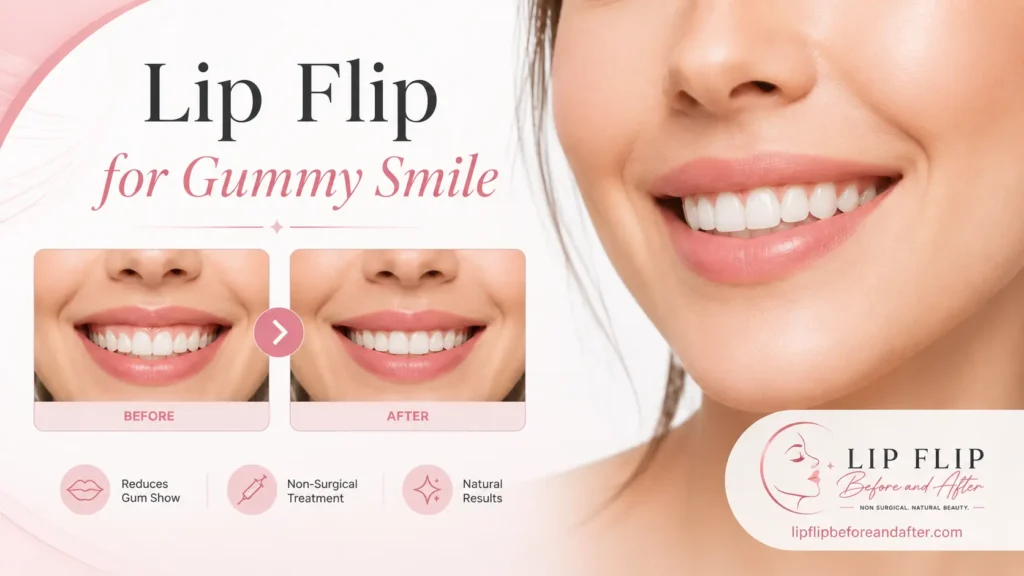
If your smile shows more gum tissue than you’d like, a lip flip for gummy smile is probably one of the first treatments you’ve come across in your research. It’s minimally invasive, quick, and specifically targets one of the muscles most responsible for that upward pull during smiling.
A gummy smile happens when the upper lip lifts higher than usual when you smile, exposing more gum above the teeth. A lip flip uses a neuromodulator to gently limit how far the lip elevator muscle can pull, which can visibly reduce gum exposure for people whose gummy smile is caused primarily by muscle activity.
This guide covers exactly how a lip flip addresses a gummy smile, who’s actually a good candidate, what results look like, and when a different treatment might be a better fit.
Yes, a lip flip can reduce a gummy smile when the cause is an overactive upper lip elevator muscle. By relaxing that muscle, the lip doesn’t rise as high during smiling, which shows less gum tissue. It works best for muscle-related gummy smiles, not those caused by bone structure, gum size, or tooth position.
Table of Contents
Key Takeaways
- A lip flip targets muscle-based gummy smiles, not structural or dental causes.
- Results typically show most clearly when smiling, not at rest.
- Effect usually lasts 8–12 weeks before muscle activity gradually returns.
- Not every gummy smile responds equally; a proper assessment matters.
- Results build over about a week after treatment.
- Combination approaches exist for gummy smiles with multiple contributing causes.
What Causes a Gummy Smile in the First Place
Before understanding how a lip flip helps, it’s worth knowing that a gummy smile can come from several different sources:
- Hyperactive upper lip muscle — the lip lifts higher than average during a smile.
- Excess gum tissue — more gum is visible regardless of lip position.
- Vertical maxillary excess — a skeletal factor involving upper jaw bone growth.
- Short upper lip — the lip itself doesn’t fully cover the gum line at rest.
- Tooth eruption or position — teeth that appear shorter can make gums look more prominent.
A lip flip specifically addresses the first cause: excessive muscle pull. This is why a proper assessment matters before treatment, since a lip flip won’t meaningfully change a gummy smile caused by bone structure or gum tissue alone.
How a Lip Flip Reduces a Gummy Smile
A lip flip involves injecting a neuromodulator, most often Botox, into the muscles that elevate the upper lip during a smile, primarily the levator labii superioris. Relaxing this muscle limits how high the lip can rise, which reduces visible gum tissue when smiling. For the general mechanism, see how does a lip flip work and where to inject Botox for lip flip.
Because the treatment works on muscle function rather than tissue or bone, it’s considered one of the least invasive gummy smile options available, with no cutting, no anesthesia beyond the injection itself, and minimal downtime.
What Results Actually Look Like
At Rest
Little to no visible change, since the treated muscle is only active during smiling or similar expressions.
While Smiling
This is where the treatment shows its effect. Less gum tissue is visible as the upper lip doesn’t rise as high, giving the smile a more balanced, teeth-forward appearance.
Timeline
- Day 0–2: Minimal visible change.
- Day 3–5: Gradual softening of the elevator muscle’s pull.
- Day 5–7: Full effect typically visible during smiling.
- Week 8–12: Effect slowly fades as muscle function returns.
For a more detailed general timeline, see lip flip results day by day and when will I see lip flip results.
Are You a Good Candidate for a Lip Flip for Gummy Smile?
| Good Candidate | Less Ideal Candidate |
| Gummy smile mostly caused by muscle overactivity | Gummy smile caused primarily by excess bone (vertical maxillary excess) |
| Wants a non-surgical, temporary option | Wants a permanent correction |
| Comfortable with results needing maintenance every 8–12 weeks | Prefers a one-time solution |
| Mild to moderate gum exposure | Severe gummy smile requiring surgical evaluation |
A thorough consultation, including looking closely at what happens to your lip and gum line specifically while smiling, is the most reliable way to determine whether a lip flip alone will make a meaningful difference for you.
Lip Flip vs. Other Gummy Smile Treatments
| Treatment | Mechanism | Duration | Invasiveness |
| Lip flip (Botox) | Relaxes lip elevator muscle | 8–12 weeks | Minimal, injection only |
| Gum contouring | Removes excess gum tissue | Permanent | Minor surgical procedure |
| Lip lift | Shortens upper lip surgically | Permanent | Surgical |
| Orthodontic treatment | Adjusts tooth position | Permanent, but slow | Non-surgical but lengthy |
| Orthognathic surgery | Corrects jaw bone position | Permanent | Major surgical procedure |
For patients with a combination of causes, providers sometimes recommend pairing a lip flip with another approach. If you’re comparing lip flip against a lip lift more specifically, lip lift vs lip flip breaks that down further.
Pros and Cons of a Lip Flip for Gummy Smile
Pros
- Non-surgical with minimal downtime.
- Reversible since the effect naturally wears off.
- Quick appointment, often 15–30 minutes.
- Can meaningfully improve mild to moderate muscle-related gumminess.
Cons
- Only addresses muscle-related causes, not bone or tissue-related ones.
- Temporary, requiring maintenance every 8–12 weeks.
- Overcorrection can occasionally affect smile naturalness if dosage isn’t well calibrated.
- Not appropriate for severe cases needing surgical evaluation.
Common Mistakes With Lip Flip for Gummy Smile
- Assuming it will work regardless of the underlying cause without a proper evaluation.
- Expecting a permanent fix from a temporary, muscle-based treatment.
- Choosing an inexperienced injector for a treatment area where precise dosing really matters.
- Not discussing combination options if your gummy smile has more than one contributing factor.
- Judging results before the 5–7 day mark, before full effect has developed.
Step-by-Step: What to Expect From Consultation to Results
- Get assessed for the cause of your gummy smile. A qualified provider can usually tell from a smiling photo or in-person exam whether muscle activity is the main driver.
- Discuss realistic outcomes. Ask specifically how much gum reduction is achievable in your case.
- Receive the injection. Typically a quick, in-office procedure targeting the upper lip elevator muscles.
- Wait for full effect. Results build over about a week.
- Reassess and plan maintenance. If results meet your goals, plan your next session around the 8–12 week mark. See lip flip maintenance schedule.
A lip flip consultation is the appropriate setting to determine whether this treatment fits your specific gummy smile pattern.
When to Consider a Different Approach
Featured Snippet Answer: If a gummy smile is caused mainly by excess bone growth, a short upper lip, or excess gum tissue rather than muscle overactivity, a lip flip alone typically won’t produce a significant change. In these cases, gum contouring, a lip lift, or orthodontic and surgical options may be more appropriate.
This article is intended for general educational purposes and isn’t a substitute for personalized medical or dental advice. A qualified provider, which may include a dentist, oral surgeon, or dermatologist depending on the underlying cause, can determine the most appropriate treatment for your specific gummy smile.
Frequently Asked Questions
How much gum reduction can I expect from a lip flip? This varies by individual and depends heavily on how much of your gummy smile is caused by muscle activity versus other factors; your provider can give a more specific estimate after assessment.
Will a lip flip make my smile look frozen or unnatural? When dosed appropriately by an experienced injector, results are designed to look natural, not stiff, though overcorrection is a risk worth discussing at consultation.
Can I combine a lip flip with orthodontic treatment for a gummy smile? Yes, some patients use a lip flip for faster, temporary improvement while pursuing longer-term orthodontic correction.
Is a lip flip for gummy smile the same procedure as a lip flip for fuller lips? It uses a similar injection technique but typically targets slightly different muscle groups depending on whether the goal is gum reduction or lip fullness.
How do I know if my gummy smile is caused by muscle or bone? A qualified provider can usually assess this during consultation by examining how your lip and gum line behave at rest versus while smiling.
Does a lip flip for gummy smile hurt more than a regular lip flip? Discomfort is typically similar, since both use fine needles and a comparable injection technique.
Can teenagers get a lip flip for a gummy smile? This depends on individual circumstances and is a conversation to have directly with a licensed provider, since candidacy and consent considerations apply.
Will my gummy smile look the same as before once the lip flip wears off? Yes, since the effect is temporary, your smile will gradually return to its previous pattern as muscle function returns.
Is gum contouring a better option than a lip flip for a gummy smile? It depends on the cause. Gum contouring addresses excess tissue directly and is permanent, while a lip flip addresses muscle activity and is temporary; the right choice depends on what’s actually causing your gummy smile.
Can a lip flip make a gummy smile worse if done incorrectly? Improper dosing or placement could affect smile symmetry or naturalness, which is why choosing an experienced injector matters for this specific application.
How soon can I see if a lip flip actually helped my gummy smile? Wait until day 5–7, once the full effect has developed, before evaluating how much difference the treatment made.
Summary
A lip flip for gummy smile can be a genuinely effective, low-downtime option when the underlying cause is muscle overactivity, softening how much gum shows during a smile without any surgery. It won’t meaningfully change a gummy smile driven by bone structure or excess gum tissue, which is why an accurate assessment before treatment matters more here than with most other lip flip applications. A detailed consultation with a qualified provider is the best way to find out whether this approach fits your specific smile.