
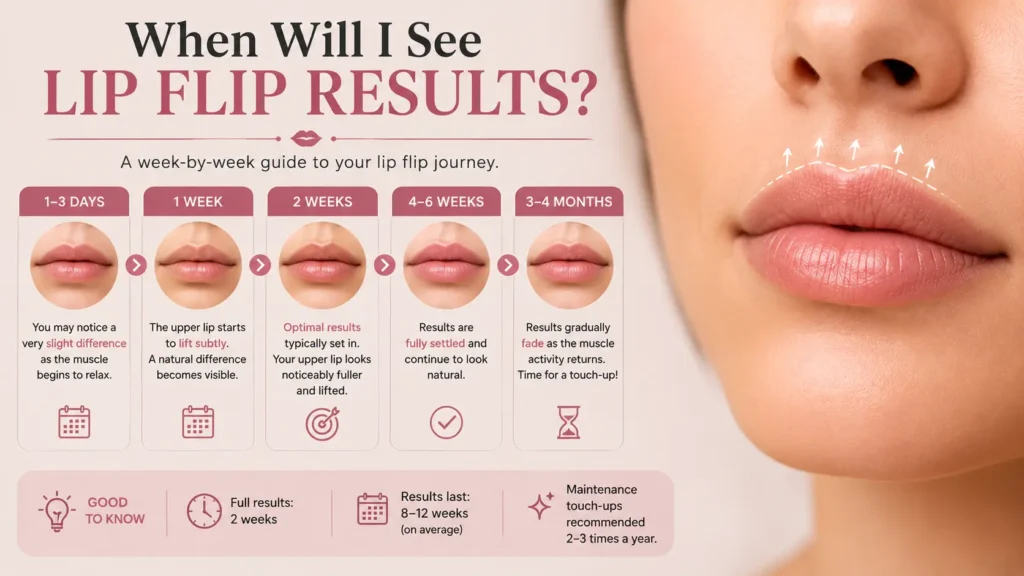
If you’re staring in the mirror three days after your appointment wondering when you’ll see lip flip results, you’re not alone, and you’re probably not doing anything wrong. This is one of the most common questions people ask right after treatment, mostly because a lip flip doesn’t create an instant, dramatic change the way some other cosmetic treatments do. It works gradually, as the neuromodulator slowly relaxes the targeted muscle.
Knowing exactly when to expect changes, and why the timeline varies from person to person, helps you avoid unnecessary worry in those first few days and know exactly when it’s actually appropriate to judge your final outcome. This guide gives you a clear, honest answer, along with what can speed up or slow down your personal timeline.
Most people start noticing initial lip flip results within 3 to 7 days after treatment, with full, settled results typically visible by around 2 weeks. Products like Dysport and Jeuveau are often reported to work slightly faster, sometimes within 1 to 3 days, while Botox and Xeomin tend to fall in the 3 to 7 day range.
Table of Contents
Key Takeaways
- Initial results typically appear within 3 to 7 days, though this varies by product and individual response.
- Full, settled results are generally visible by around the two-week mark.
- Dysport and Jeuveau are often reported to have a faster onset than Botox or Xeomin.
- Judging results before two weeks frequently leads to an inaccurate impression of your final outcome.
- If you’re seeing no change at all after two full weeks, this is worth discussing with your injector.
- Individual metabolism and dosing are the biggest factors influencing your personal timeline.
Why a Lip Flip Doesn’t Work Instantly
A lip flip uses a neuromodulator, such as Botox, Dysport, Xeomin, or Jeuveau, to relax the orbicularis oris muscle above your upper lip. This process requires the product to bind to nerve endings and gradually block the signals that trigger muscle contraction, which simply takes time to fully develop. It’s a biological process, not an immediate mechanical change, which is why results build progressively rather than appearing the moment you leave your appointment. You can see the full mechanism explained in how does a lip flip work.
Onset Timeline by Product
| Product | Typical Onset |
| Dysport | Often 2–3 days |
| Jeuveau | Often 1–3 days |
| Botox | 3–7 days |
| Xeomin | 3–7 days |
These are general patterns rather than guarantees, since individual response varies. You can see more detail on each specific product in dysport-lip-flip, jeuveau-lip-flip, botox-lip-flip, and xeomin-lip-flip.
Full Results Timeline: When Should You Actually Judge Your Outcome?
While initial changes may appear within the first week, most providers recommend waiting the full two weeks before evaluating your final results. This is the point where the muscle relaxation has typically fully developed and any early unevenness has had time to settle. Judging your results too early is one of the most common reasons people mistakenly believe their treatment “didn’t work” when, in reality, it simply hadn’t fully taken effect yet. A more detailed breakdown of this settling process is available in lip flip results week by week and lip flip healing stages.
What Affects How Quickly You’ll See Results?
Product Used
As shown above, Dysport and Jeuveau are generally reported to have a faster onset than Botox and Xeomin, though the difference is measured in days, not weeks.
Dosing
The amount of product used can influence how quickly the effect becomes noticeable, though your injector’s dosing decision, covered in how many units of Botox for a lip flip, is based on your specific anatomy and goals rather than simply maximizing speed.
Individual Metabolism
Just as some people process medications faster or slower than others, individual metabolism affects how quickly a neuromodulator takes effect and how long it ultimately lasts, covered further in how long does a lip flip last.
Muscle Strength
Naturally stronger upper lip muscles may show initial signs of relaxation a bit differently than weaker ones, though this generally evens out by the two-week mark regardless of starting muscle strength.
What to Do If You’re Not Seeing Results Yet
- Check how many days it’s actually been. If you’re within the first week, this is expected, and it’s simply too early to judge.
- Look for subtle signs rather than dramatic change. Early results are often uneven or barely noticeable before fully settling.
- Compare against your own baseline photos, not against other people’s before-and-after examples, since individual timelines vary.
- Wait until the full two-week mark before drawing any conclusions about whether your treatment achieved your goals.
- Contact your injector if you still see zero change after two full weeks. While rare, this is worth discussing directly rather than assuming the worst.
Common Mistakes to Avoid
- Checking for results too obsessively in the first few days. This can create unnecessary anxiety before the treatment has had time to work.
- Comparing your timeline directly to someone else’s. Individual metabolism and product differences mean timelines genuinely vary between people.
- Assuming no visible change after 3 days means the treatment failed. For many products, this is still well within the normal onset window.
- Requesting a touch-up before two weeks have passed. Results are often still developing, and an early touch-up risks overcorrecting once the full effect appears. See lip flip touch-up for more on appropriate timing.
- Not accounting for mild swelling masking early results. Initial swelling from the injections themselves can sometimes make it harder to see the muscle relaxation effect clearly in the first few days.
Tips for Managing the Waiting Period
- Take a baseline photo on the day of treatment so you have an accurate starting point for comparison.
- Avoid checking obsessively; a photo every few days is more useful than constant mirror-checking.
- Remind yourself that subtlety, especially in the first week, is normal and expected.
- Plan any event or photos you’re hoping to look your best for at least two weeks after treatment, not right after.
- If you have specific concerns during the waiting period, reach out to your provider rather than guessing on your own.
Warnings and Limitations
While most patients see initial results within the general timeframes described here, some individual variation is normal and doesn’t necessarily indicate a problem. If you experience no change whatsoever after a full two weeks, or notice concerning symptoms such as spreading weakness, difficulty breathing, or difficulty swallowing, this warrants prompt communication with your provider, covered in more detail in lip flip botox side effects.
This treatment should only be performed by a licensed provider, such as a physician, nurse injector, or physician assistant trained in facial injectables. This article provides general educational information about typical onset timing and isn’t a substitute for a professional assessment of your specific results.
Frequently Asked Questions
When will I see lip flip results? Most people notice initial changes within 3 to 7 days, with full, settled results typically visible by around two weeks after treatment.
Why don’t I see any results yet after 2 days? This is completely normal. Most neuromodulators used for a lip flip take at least a few days to begin taking effect, and it’s too early to judge your outcome this soon.
Does Dysport work faster than Botox for a lip flip? Yes, many patients report seeing initial results with Dysport within 2 to 3 days, compared to the typical 3 to 7 day onset for Botox.
How do I know if my results have fully settled? Most providers recommend waiting the full two weeks after treatment before evaluating your final results, since the effect builds gradually during this period.
What if I still see no change after two weeks? This is uncommon but worth discussing with your injector, since it could indicate a need for reassessment or, in rare cases, adjustment to your treatment plan.
Can swelling from the injections make it harder to see early results? Yes, mild swelling in the first few days can sometimes mask or distort how the underlying muscle relaxation looks, which is another reason to wait before judging your outcome.
Does a higher dose mean faster results? Not necessarily. Dosing is determined based on your specific anatomy and goals, and while it can influence your overall outcome, it doesn’t reliably speed up onset time.
Is it normal for one side to show results faster than the other? Some asymmetry in how quickly each side responds is common in the first week and often evens out by the time results fully settle around two weeks.
Should I judge my results by day 5? It’s generally too early. While some initial changes may be visible by this point, waiting until the full two-week mark gives a much more accurate picture of your final outcome.
Can stress or illness affect how quickly I see results? There’s no strong evidence that everyday stress or minor illness significantly changes onset timing, though individual metabolism in general can play a role in timing.
How soon should I schedule an event after getting a lip flip? It’s best to plan at least two weeks ahead of any event where you want your results fully visible, allowing time for the treatment to completely settle.
What’s the difference between when results start and when they fully settle? Results typically start appearing within the first week but continue developing and evening out until they’re fully settled, usually by around the two-week mark.
Summary: When Will I See Lip Flip Results
Most people notice their first signs of lip flip results within 3 to 7 days, with Dysport and Jeuveau often working a bit faster than Botox or Xeomin. Full, settled results are generally visible by around the two-week mark, which is the appropriate time to judge whether your outcome matches your goals.
Because individual metabolism, dosing, and product choice all influence your personal timeline, some variation from these general patterns is completely normal. Giving your results the full two weeks before drawing conclusions, and reaching out to your provider if something seems genuinely off, is the most reliable way to accurately assess your outcome.