Right after your appointment, it’s normal to stare in the mirror and wonder if this is really what you signed up for. Swelling, slight unevenness, and a strange numb feeling are common in the first few days, but they don’t reflect your final result. Understanding the lip flip healing stages ahead of time makes the entire process far less stressful, because you’ll know exactly what’s normal at each point and when to actually expect your results.
This guide breaks the healing process down stage by stage, from the moment the needle leaves your lip to the day your results fully settle, along with the mistakes that can slow healing and the warning signs that need a follow-up.
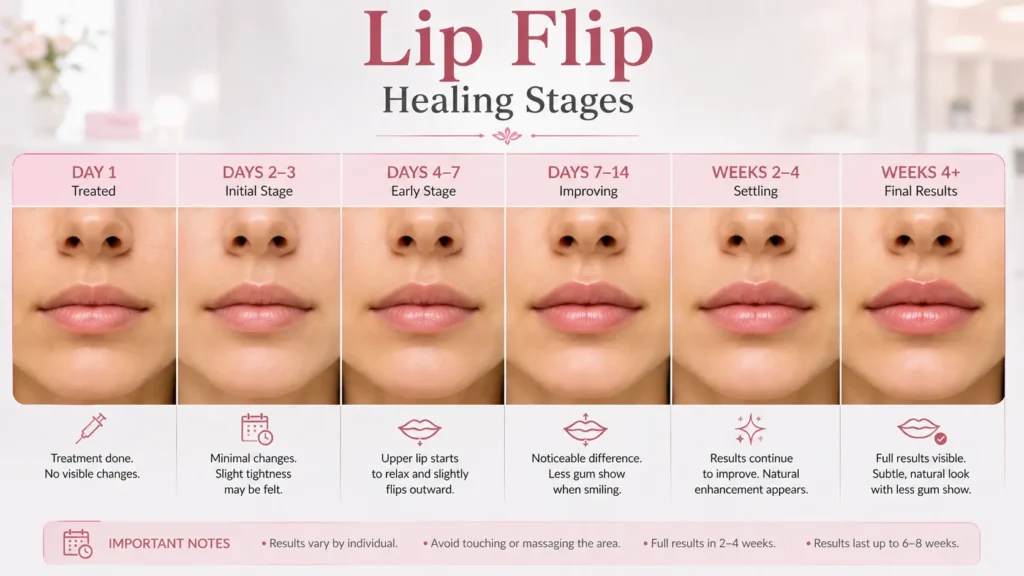
The lip flip healing process has four main stages: swelling and mild bruising (days 1–3), settling and initial movement changes (days 4–7), the neuromodulator taking effect (days 7–14), and full, settled results (day 14 onward). Most people feel completely normal within a week.
Table of Contents
Key Takeaways
- The full lip flip healing stages span roughly two weeks, though most discomfort resolves within the first 3–4 days.
- Peak swelling happens within the first 24–48 hours, not immediately after injection.
- Your true result isn’t visible until the neuromodulator fully takes effect around day 10–14.
- Avoiding certain activities in the first 24 hours can meaningfully reduce swelling and bruising.
- Ongoing pain, drooping, or difficulty moving your lips past the first week is not a normal healing stage and needs follow-up.
What Is a Lip Flip and Why Healing Looks Different From Filler
A lip flip uses a small dose of a neuromodulator — usually Botox, Dysport, or Xeomin — injected into the upper lip muscle. It doesn’t add volume like filler does; instead, it relaxes the muscle so the lip rolls slightly outward. Because of this, lip flip healing follows a different pattern than filler healing. There’s less swelling overall, but the visible result takes longer to appear since the neuromodulator needs time to take effect. If you haven’t already, our page on how does a lip flip work covers the mechanism in more detail.
The 4 Lip Flip Healing Stages
Stage 1: Injection Day (Day 0)
Right after treatment, expect small red bumps at the injection sites, mild swelling, and possibly a bit of tenderness. Lips may look slightly uneven — this is from the injection itself, not the treatment’s actual effect.
What’s normal: Light redness, pinprick marks, minor swelling What to avoid: Touching or rubbing the area, lying face-down, applying makeup immediately
Stage 2: Swelling and Settling (Days 1–3)
This is usually the most noticeable stage. Swelling often peaks within 24 to 48 hours before starting to go down. Some people also notice mild bruising, especially around the injection points.
What’s normal: Puffiness, slight asymmetry, tightness when smiling What to avoid: Alcohol, intense exercise, excessive heat (saunas, hot showers)
For activity-specific guidance, see can you exercise after a lip flip and can you drink after a lip flip.
Stage 3: Transition Period (Days 4–7)
Swelling should be mostly or fully gone by now. This stage can feel confusing because your lips may look almost back to normal — but the neuromodulator hasn’t fully kicked in yet, so the flip effect isn’t visible at full strength.
What’s normal: Lips looking close to their pre-treatment appearance What to avoid: Assuming the treatment “didn’t work” — it’s simply too early to judge results
Stage 4: Full Effect and Settled Results (Days 10–14+)
By day 10 to 14, the neuromodulator has typically reached full effect. This is the point where you can accurately judge your results. Our lip flip before and after 2 weeks page shows what this stage tends to look like in more detail.
What’s normal: Visible, settled upper lip flip, natural movement when talking or smiling What to avoid: Booking a touch-up before this stage — wait for the full effect before deciding if you need more
Lip Flip Recovery Stages: Full Timeline Table
| Day | Stage | What to Expect |
| Day 0 | Injection | Redness, small bumps, mild tenderness |
| Day 1–2 | Peak swelling | Puffiness, possible light bruising |
| Day 3–4 | Swelling reduction | Lips looking closer to normal |
| Day 5–7 | Transition | Minimal visible flip, muscle still adjusting |
| Day 8–10 | Onset of effect | Flip becomes gradually noticeable |
| Day 10–14 | Full effect | Settled, final result |
| Day 14+ | Maintenance phase | Result holds steady for several weeks |
For a broader view beyond just healing, our lip flip recovery timeline and lip flip results day by day pages track the process all the way through to fading.
Common Mistakes That Slow Down Healing
- Touching or massaging the lips too soon — this can spread the neuromodulator to unintended muscles.
- Skipping ice in the first 24 hours — cold compresses help control swelling early on.
- Working out too soon — increased blood flow can worsen swelling and bruising.
- Drinking alcohol in the first 24–48 hours — this can increase bruising risk.
- Wearing heavy lip products right away — this can irritate healing injection sites.
- Panicking during the transition stage — judging results before day 10 leads to unnecessary worry.
Tips to Support Each Healing Stage
- Apply a clean, cold compress for 10–15 minutes at a time during the first 24 hours to reduce swelling.
- Sleep slightly elevated the first night to minimize morning puffiness.
- Avoid straws, since excessive lip pursing can irritate the area early on.
- Stay hydrated to support normal tissue healing.
- Take a photo each day for the first two weeks so you can track your own healing stages accurately.
For a full aftercare checklist, see our lip flip aftercare guide.
Lip Flip Healing Stages: Normal vs Warning Signs
| Normal Healing | Contact Your Injector |
| Mild swelling for 2–3 days | Swelling that worsens after day 4 |
| Slight asymmetry that improves over time | Asymmetry that doesn’t improve by week 3–4 |
| Tightness when smiling for the first week | Ongoing difficulty moving lips or speaking |
| Minor bruising that fades within a week | Bruising that spreads or doesn’t fade |
| Temporary numbness near injection sites | Numbness lasting more than a few days |
If something feels off, it’s always reasonable to reach out to your provider rather than wait it out. For more on what an unwanted outcome can look like, see lip flip gone wrong.
How Lip Flip Healing Compares to Filler Healing
| Lip Flip | Lip Filler | |
| Peak swelling | Days 1–2 | Days 1–3 |
| Visible early results | Minimal | Immediate (post-swelling) |
| Full result timeline | 10–14 days | A few days |
| Bruising risk | Low to moderate | Moderate |
| Downtime | Minimal | Minimal to moderate |
Curious how the two treatments differ beyond healing? Check out lip flip vs lip filler.
Frequently Asked Questions
How long does the lip flip healing process take overall? Most visible healing wraps up within a week, but the treatment’s full, settled effect isn’t visible until around day 10 to 14.
Is it normal for one side to heal faster than the other? Yes, mild differences in swelling or muscle response between sides are common in the first one to two weeks and usually even out.
When can I wear lipstick again after a lip flip? Most injectors recommend waiting at least 24 hours to let injection sites settle before applying lip products.
Why do my lips look normal a few days after treatment? This is the transition stage — swelling has gone down, but the neuromodulator hasn’t reached full effect yet, so the flip isn’t fully visible.
Can I speed up the healing stages? You can’t speed up how quickly the neuromodulator takes effect, but reducing swelling early with ice and rest supports a smoother recovery.
Is bruising a normal part of lip flip healing? Mild bruising is common, especially near injection points, and typically fades within 5 to 7 days.
What does it mean if I don’t see any change by day 14? It may mean the dose was conservative or your muscle response is naturally subtle. This is worth discussing with your injector rather than assuming the treatment failed.
Does eating or drinking affect the healing stages? Extremely hot drinks or wide mouth movements (like biting into a large sandwich) in the first 24 hours can add unnecessary strain to the area. See can you eat after a lip flip for specifics.
How do I know when I’ve reached the final healing stage? When swelling is fully gone, movement feels normal, and your result has looked the same for a few days in a row, you’ve reached the settled stage.
Should I avoid kissing during the healing stages? It’s generally recommended to avoid intense pressure on the lips for at least the first 24 hours. Our can you kiss after a lip flip page has more detail.
Summary
The lip flip healing stages move through a predictable pattern: initial redness and swelling, a settling period where lips can temporarily look unchanged, and finally the full, visible result around day 10 to 14. Most discomfort resolves within the first few days, and the confusing “did it even work” phase in the middle is completely normal. Tracking your healing with photos and following basic aftercare — avoiding touching, alcohol, and intense exercise early on — supports a smoother recovery. If anything feels off beyond typical swelling or mild asymmetry, checking in with your injector is always the right move.
This article is for general educational purposes and isn’t a substitute for personalized advice from a licensed injector or medical professional.