
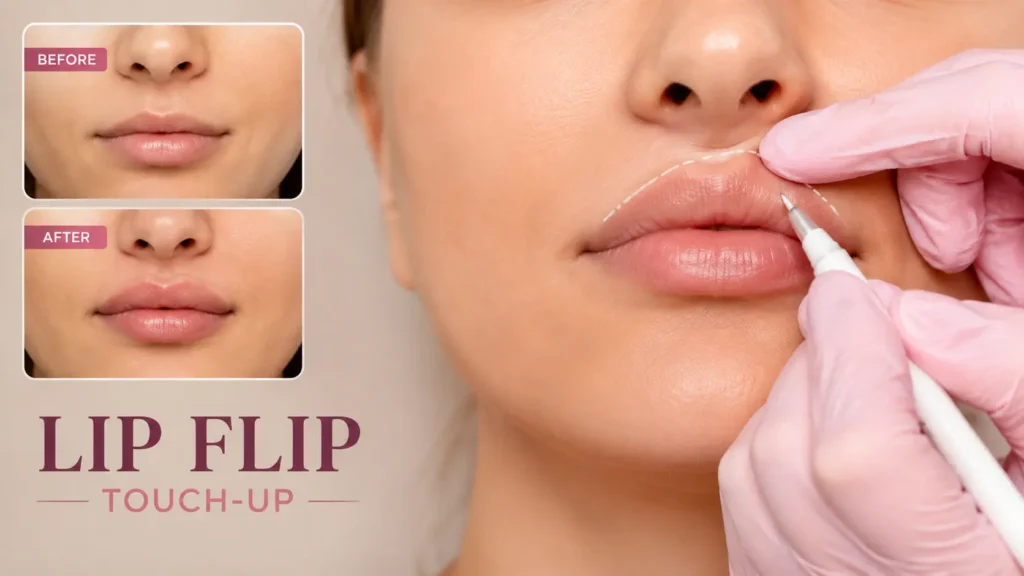
A lip flip touch-up is one of those topics that doesn’t get explained clearly enough before treatment, leaving a lot of people unsure whether their subtle results mean something went wrong or simply that their first dose was conservative. The truth is, touch-ups are a normal, expected part of the lip flip process for many patients, not a sign of a failed treatment.
Understanding when a touch-up makes sense, how it differs from your original treatment, what it typically costs, and how to tell the difference between “still settling” and “needs adjusting” can save you both money and unnecessary worry. This guide walks through exactly that, along with what to expect if you do need one.
A lip flip touch-up is a small, additional dose of neuromodulator given after your initial treatment has fully settled, typically around the two-week mark, if your results seem too subtle or uneven. It’s not a full repeat treatment, but a targeted adjustment to fine-tune your original results.
Table of Contents
Key Takeaways
- A touch-up is typically considered after the two-week settling period, once your original results have fully developed.
- Touch-ups are usually smaller in dose than your initial treatment, focused on specific areas needing adjustment.
- Common reasons for a touch-up include subtle initial results, mild asymmetry, or an underdosed area.
- Many providers include a touch-up window, often two to three weeks, as part of your original treatment price.
- A touch-up doesn’t extend how long your results last beyond the original treatment’s typical duration.
- Judging your results too early is one of the most common reasons people mistakenly seek an unnecessary touch-up.
What Counts as a Touch-Up vs. a Full Repeat Treatment?
It’s worth drawing a clear line here, since these two things are often confused. A touch-up is a small, additional dose added shortly after your original treatment, once your results have settled but before the neuromodulator has worn off. A full repeat treatment is a completely new session, typically scheduled a few months later, once your original results have faded, as covered in how long does a lip flip last.
| Feature | Touch-Up | Full Repeat Treatment |
| Timing | Within 2–3 weeks of original treatment | 2–5 months later, once results have faded |
| Dose size | Small, targeted addition | Full new treatment dose |
| Purpose | Fine-tune existing results | Renew results after they’ve worn off |
| Typical cost | Often included or discounted | Full treatment price |
When Should You Consider a Lip Flip Touch-Up?
Results Seem Too Subtle
If, after the full two-week settling period described in how long does it take for a lip flip to work, your results still seem minimal or barely noticeable, this is a reasonable time to discuss a touch-up with your provider.
Mild Asymmetry That Hasn’t Resolved
Some unevenness in the first week or so is common while your results settle. If asymmetry persists beyond two weeks, it’s worth mentioning to your injector, who can assess whether a small touch-up on one side would help balance your results. More on typical healing patterns is available in lip flip healing stages.
One Area Underdosed Relative to Another
Occasionally, one part of the lip, such as one corner of the mouth, responds less than another. A touch-up can specifically address this uneven response without requiring a full new treatment.
Gummy Smile Not Fully Addressed
If your original goal was reducing gummy smile visibility and you’re still seeing more gum tissue than you’d hoped, this is a reasonable touch-up conversation, and you can see typical outcomes in Lip Flip Before and After Gummy Smile.
When a Touch-Up Is NOT the Right Move
- Before the two-week mark. Results are still developing, and judging too early often leads to an unnecessary touch-up.
- If you’re hoping for added volume. A touch-up won’t create the plumping effect that filler provides. See lip flip vs lip filler if that’s actually your goal.
- If your results already look natural and balanced. Wanting a slightly more dramatic effect than originally planned is a conversation for your next full treatment, not necessarily an immediate touch-up.
- Right after noticing mild, expected swelling. Early swelling is normal and typically resolves within a few days on its own.
Step-by-Step: What Happens During a Touch-Up Appointment
- Your provider reviews your original treatment, including the product used and initial dosing.
- They assess your current results against your original goals, checking for symmetry, subtlety, and overall effect.
- They determine whether a small additional dose is appropriate, and where specifically it should be placed.
- A small amount of neuromodulator is injected at the targeted area, similar to your original treatment but in a much smaller quantity.
- You’re given similar aftercare guidance to your first treatment, detailed in lip flip aftercare.
Does a Touch-Up Cost Extra?
This varies by provider. Many clinics build a touch-up window, often two to three weeks after your original appointment, into their pricing structure, meaning a reasonable adjustment during this period is included or offered at a reduced cost. Others may charge separately based on the additional units used. It’s worth asking about this policy directly during your original consultation, covered in more detail in lip flip consultation, so you know what to expect if you do need an adjustment. General pricing context is available in lip flip botox cost.
Does a Touch-Up Extend How Long Results Last?
Not significantly. A touch-up is meant to fine-tune your existing results, not restart your treatment timeline. Your overall results will still generally follow the same 2 to 5 month duration typical of your original treatment, since the touch-up dose is usually much smaller than a full treatment and was administered partway through that timeline rather than as an entirely new starting point.
How to Know If You Genuinely Need a Touch-Up
- Wait the full two weeks before evaluating your results, since early impressions are often misleading.
- Compare your results directly to your original goals and any reference photos you shared during your consultation.
- Check for symmetry between both sides of your smile in natural lighting and multiple expressions.
- Ask yourself whether your concern is about subtlety (a possible touch-up scenario) or lack of volume (a filler conversation instead).
- When in doubt, reach out to your original provider for their professional assessment rather than guessing on your own.
Common Mistakes to Avoid
- Requesting a touch-up too early. Give your results the full two-week settling period before judging them.
- Assuming subtle results mean the treatment failed. A lip flip is designed to be subtle by nature; some patients simply need a bit more to reach their personal preference.
- Seeking a touch-up hoping for added volume. This isn’t what a touch-up is designed to achieve, and filler is the more relevant option in that case.
- Not asking about touch-up policy before your original treatment. Understanding this upfront helps you know what to expect if adjustment is needed.
- Going to a different, unfamiliar provider for a touch-up. Your original injector already knows your specific dosing and treatment plan, which can lead to more precise adjustments.
Tips for a Successful Touch-Up
- Bring your original before photos and any notes about your specific concerns to the touch-up appointment.
- Be specific about what feels off, whether that’s overall subtlety, asymmetry, or a particular area.
- Ask your provider to explain their assessment before proceeding with any additional injections.
- Confirm whether the touch-up is included in your original price or billed separately.
- Give the touch-up its own settling period, generally another one to two weeks, before making any further adjustments.
Warnings and Limitations
A lip flip touch-up carries the same general risks as the original treatment, including mild swelling, bruising, or temporary asymmetry, all of which are covered in more detail in lip flip botox side effects. Because touch-ups involve adding to an already-active dose of neuromodulator, precise assessment and conservative dosing matter significantly to avoid overcorrecting your results.
This treatment should only be performed by a licensed provider, ideally the same injector who performed your original treatment, given their familiarity with your specific dosing and anatomy. This article provides general educational information about when touch-ups are typically considered and isn’t a substitute for a professional assessment of your specific results.
Frequently Asked Questions
When is the right time to get a lip flip touch-up? Generally after the full two-week settling period, once your original results have fully developed and you can accurately assess whether an adjustment is needed.
Is a touch-up the same as a full new treatment? No. A touch-up is a smaller, targeted addition to your existing results, while a full treatment is a completely new session typically scheduled months later once your original results have worn off.
Does a touch-up cost extra? This varies by provider. Many clinics include a touch-up window in their original pricing, while others charge separately based on additional units used.
Will a touch-up make my results last longer? Not significantly. Your overall results will generally still follow the typical 2 to 5 month duration of your original treatment.
Can I get a touch-up if I want bigger lips, not just adjustment? No, a touch-up only fine-tunes your existing lip flip result. If you want added volume, lip filler is the more relevant option.
How soon after my lip flip can I request a touch-up? Most providers recommend waiting the full two-week settling period before assessing whether a touch-up is genuinely needed.
Is it normal to need a touch-up after a lip flip? Yes, this is common and doesn’t necessarily indicate anything went wrong with your original treatment. Many patients simply need a small adjustment to reach their ideal result.
Can I get my touch-up from a different provider? You can, but your original injector typically has more context on your specific dosing and treatment plan, which often leads to a more precise, well-matched adjustment.
What if my results look uneven right after treatment? Mild asymmetry in the first week or so is common while results settle. If it persists past two weeks, this is a reasonable time to discuss a touch-up.
Does a touch-up hurt more than the original treatment? No, it typically involves a much smaller amount of product and a similar quick injection process to your original treatment.
How do I know if I’m judging my results too early? If it’s been less than two weeks since your treatment, your results are likely still settling, and it’s worth waiting before deciding whether a touch-up is needed.
Can too many touch-ups cause an overdone result? Yes, this is why conservative, professional assessment matters for each touch-up request rather than repeatedly adding product without a clear, specific reason.
Summary: Lip Flip Touch-Up
A lip flip touch-up is a normal, often expected part of the process for many patients, not a sign that your original treatment failed. It’s typically considered after the full two-week settling period, when results still seem too subtle, uneven, or don’t fully address your original goal, like gummy smile reduction.
Understanding the difference between a touch-up and a full repeat treatment, along with giving your results adequate time to settle before requesting one, helps you make a more informed decision and avoid unnecessary additional injections. When in doubt, your original provider is best positioned to assess whether a touch-up genuinely makes sense for your specific results.