
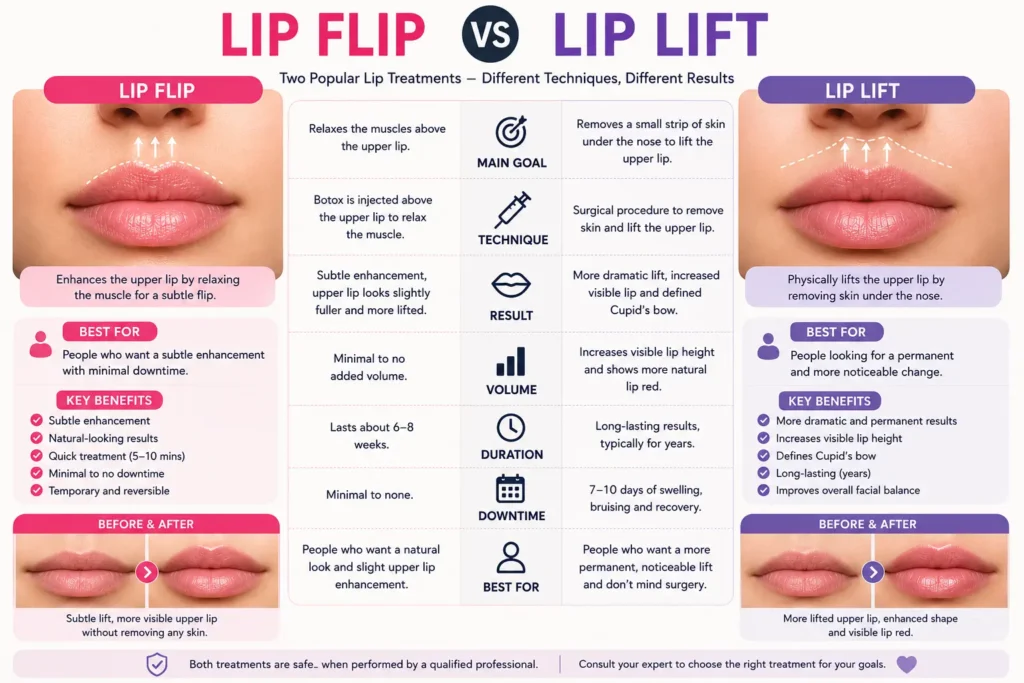
Trying to decide between a lip flip vs lip lift usually comes down to one core question: are you looking for a temporary, low-commitment tweak, or a permanent structural change? These two treatments get compared often, but they’re not really competing options — they solve different problems in very different ways.
This guide breaks down exactly how each works, what results look like, how long they last, what recovery involves, and who tends to be a better candidate for each. By the end, you’ll have a clear sense of which direction makes sense for your lips and your goals.
Table of Contents
Quick Answer
Featured Snippet Answer: A lip flip is a non-surgical treatment using botulinum toxin to relax the lip muscle, temporarily revealing more of the upper lip. A lip lift is a surgical procedure that permanently shortens the space between the nose and upper lip, creating lasting exposure of the lip and a more youthful profile. One is temporary and muscle-based; the other is permanent and surgical.
Key Takeaways
- A lip flip is non-surgical, temporary, and relaxes the lip muscle; a lip lift is surgical and permanent.
- Lip flip results last 6–12 weeks; a lip lift is designed to be a one-time, lasting change.
- Recovery from a lip flip is essentially immediate; lip lift recovery takes 1–2 weeks with visible healing.
- A lip lift addresses a long upper lip (philtrum length), which a lip flip cannot change.
- Cost, downtime, and permanence are the biggest factors separating the two.
What Is a Lip Flip?
A lip flip is a non-surgical treatment that uses a small dose of neuromodulator, such as Botox, Dysport, or Xeomin, injected into the muscle above the upper lip. This relaxes the muscle that curls the lip inward, allowing more of the lip to show when smiling or at rest.
It’s commonly used for people whose upper lip seems to vanish when they smile, or to soften a gummy smile. For a full explanation, see what is a lip flip and how does a lip flip work.
What Is a Lip Lift?
A lip lift is a surgical procedure that removes a small strip of skin just below the nose, shortening the distance between the nose and the upper lip (known as the philtrum). This permanently exposes more of the upper lip’s pink tissue and can create a more youthful, defined lip shape.
Unlike a lip flip, a lip lift doesn’t rely on muscle relaxation — it’s a structural, surgical change that doesn’t wear off over time.
Lip Flip vs Lip Lift: Full Comparison Table
| Feature | Lip Flip | Lip Lift |
| Type of treatment | Non-surgical injection | Surgical procedure |
| Main ingredient/method | Botulinum toxin | Surgical skin removal |
| Adds volume | No | No (repositions, doesn’t add volume) |
| Permanence | Temporary (6–12 weeks) | Permanent |
| Recovery time | None | 1–2 weeks |
| Average cost | $75–$400 | $3,000–$7,000+ |
| Reversible | Wears off naturally | Not reversible |
| Anesthesia required | No | Local anesthesia (sometimes light sedation) |
| Best for | Temporary lip exposure, gummy smile | Long philtrum, permanent lip exposure |
How Do the Two Treatments Actually Work?
Lip Flip Mechanism
A lip flip targets the orbicularis oris, the muscle circling the mouth. Relaxing part of this muscle allows the lip to roll slightly outward, increasing visible lip tissue without any structural change to the face.
Lip Lift Mechanism
A lip lift physically shortens the space between the base of the nose and the top of the upper lip by removing a thin strip of skin and suturing the area closed. This permanently raises the upper lip and increases how much pink tissue shows, independent of muscle activity.
Step-by-Step: What Each Procedure Involves
Lip Flip
- Consultation and marking of injection points
- Optional numbing cream
- Injection of a small dose of neuromodulator at 2–4 points
- Brief aftercare instructions
- Follow-up around the two-week mark
Lip Lift
- Consultation to assess philtrum length and candidacy
- Local anesthesia (sometimes with light sedation)
- Precise removal of a small strip of skin below the nose
- Sutures placed to close the incision
- Follow-up appointments over 1–2 weeks to monitor healing and remove sutures
Results Comparison: What Actually Changes
- Lip flip results: More visible lip tissue when smiling, softened gummy smile, subtle change that fades over time.
- Lip lift results: Permanently shorter space between nose and lip, more visible upper lip at rest and when smiling, often described as a more youthful appearance.
If you want a lasting structural change and have a naturally long philtrum, a lip lift addresses that directly. If you’re not ready for surgery or want a reversible option first, a lip flip is a lower-commitment way to see a similar (though more subtle and temporary) type of change. You can browse examples in our lip flip before and after gallery or see natural lip flip results for a look at how subtle these outcomes tend to be.
Timeline Comparison
| Stage | Lip Flip | Lip Lift |
| Day 1 | Minimal change, mild swelling possible | Swelling, bruising, visible sutures |
| Day 3–7 | Muscle relaxation becomes visible | Swelling starts to reduce |
| Day 10–14 | Full result settles | Sutures typically removed, healing progresses |
| Week 6–12 | Effect starts fading | Scar continues to fade and soften |
| Month 6+ | Long since worn off | Final results fully visible, permanent |
For more detail on lip flip timing specifically, see lip flip results day by day and lip flip recovery timeline.
Cost Comparison
| Treatment | Typical Cost Range | Frequency Needed |
| Lip Flip | $75–$400 per session | Every 6–12 weeks to maintain |
| Lip Lift | $3,000–$7,000+ | One-time (permanent) |
See lip flip cost and how much does a lip flip cost for more detail on lip flip pricing.
Pros and Cons
Lip Flip
Pros:
- Low cost per session
- No downtime
- Fully reversible by waiting it out
- Helps with gummy smile
Cons:
- Temporary, needs frequent repeats
- Doesn’t change philtrum length
- Slight risk of overcorrection if too many units used
Lip Lift
Pros:
- Permanent results
- Addresses a long philtrum directly
- No ongoing maintenance costs
- Can improve overall facial proportion
Cons:
- Surgical, with real recovery time
- Higher upfront cost
- Leaves a small scar (usually well-hidden under the nose)
- Not reversible if you change your mind later
Who Should Choose a Lip Flip?
A lip flip tends to suit people who:
- Want a temporary, reversible option
- Have a thin lip that disappears when smiling
- Are managing a gummy smile
- Aren’t ready for or interested in surgery
See lip flip on thin lips and lip flip on upper lip for more on how this plays out for different lip types.
Who Should Choose a Lip Lift?
A lip lift tends to suit people who:
- Have a naturally long philtrum (space between nose and lip)
- Want a permanent solution rather than ongoing maintenance
- Are comfortable with surgical recovery and a visible healing period
- Have tried a lip flip and want a longer-lasting version of similar results
Can a Lip Flip Help You “Test” What a Lip Lift Might Look Like?
Some providers use a lip flip as a temporary way to preview part of the effect a lip lift might create, since both increase visible lip tissue when smiling. However, the two aren’t a perfect substitute for one another — a lip flip won’t shorten the philtrum or create a permanently different resting lip position. For a deeper look at how these two options compare directly, see lip lift vs lip flip and surgical lip flip vs Botox lip flip.
Common Mistakes When Choosing Between the Two
- Expecting a lip flip to permanently shorten the space between the nose and lip
- Choosing surgery before trying a lower-commitment option first, if you’re unsure
- Not accounting for the scar and recovery period that comes with a lip lift
- Assuming a lip lift will add volume, when it actually repositions rather than plumps the lip
- Skipping a consultation with a board-certified surgeon before committing to a permanent procedure
Safety Considerations
A lip flip is generally considered low-risk when performed by a licensed injector, with side effects limited to mild swelling, bruising, or temporary asymmetry. A lip lift, being a surgical procedure, carries the general risks associated with any minor surgery, including infection, scarring, or asymmetry, and should only be performed by a board-certified plastic surgeon or facial plastic surgeon. According to the American Society of Plastic Surgeons, any surgical or injectable cosmetic procedure should involve a thorough consultation to review risks, recovery expectations, and candidacy.
For more on the injectable side of things, see lip flip side effects and does a lip flip hurt.
Frequently Asked Questions
Can a lip flip replace the need for a lip lift? Not fully. A lip flip can create a temporary, similar-looking increase in visible lip tissue, but it can’t shorten the philtrum or produce a permanent change the way a lip lift does.
Is a lip lift painful? Most patients describe post-surgical discomfort as mild to moderate, managed with prescribed pain relief, and it typically improves significantly within the first week.
How long does a lip lift scar take to fade? Scarring is usually well-hidden at the base of the nose and tends to fade significantly over several months, though individual healing varies.
Can I get a lip flip and later decide to get a lip lift? Yes. Many people try a lip flip first to get a sense of the general effect before committing to a permanent surgical option.
Does a lip lift add volume to the lips? No. Like a lip flip, it repositions and exposes more of the existing lip rather than adding volume — that’s a separate goal handled by filler.
Is a lip lift covered by insurance? No. It’s considered a cosmetic procedure and is typically paid out of pocket.
How soon can I return to work after a lip lift? Many patients return to work within about a week, though visible swelling and sutures may still be present during that time.
Can a lip lift be combined with a lip flip? It’s uncommon, since a lip lift already addresses lip exposure permanently, but some patients use a lip flip afterward if a gummy smile persists for other reasons.
Which option is better for someone unsure about long-term commitment? A lip flip, since it’s fully reversible simply by letting it wear off, while a lip lift is intended as a permanent change.
Does age affect which option is more suitable? It can. Some older patients choose a lip lift specifically to address age-related philtrum elongation, while a lip flip is used across a wider age range for more temporary needs.
How do I know if I have a long philtrum that would benefit from a lip lift? A consultation with a board-certified surgeon is the best way to assess your specific proportions and determine whether a lip lift, lip flip, or another option fits your face.
Summary
Choosing between lip flip vs lip lift really comes down to how permanent you want the change to be. A lip flip is a temporary, low-cost, non-surgical option well suited for people wanting a subtle, reversible tweak or relief from a gummy smile. A lip lift is a surgical, permanent solution best suited for those with a long philtrum who want a lasting change without repeat treatments. If you’re unsure, starting with a lip flip can offer a low-commitment way to explore the general effect before considering surgery. A consultation with a licensed injector or board-certified surgeon is the most reliable way to determine which path is right for your face.
If you’d like a more visual side-by-side breakdown, our lip flip before and after video guide is a helpful next step.
This article is for general informational purposes and does not replace personalized medical advice. Always consult a licensed, board-certified provider before undergoing any cosmetic or surgical treatment.