
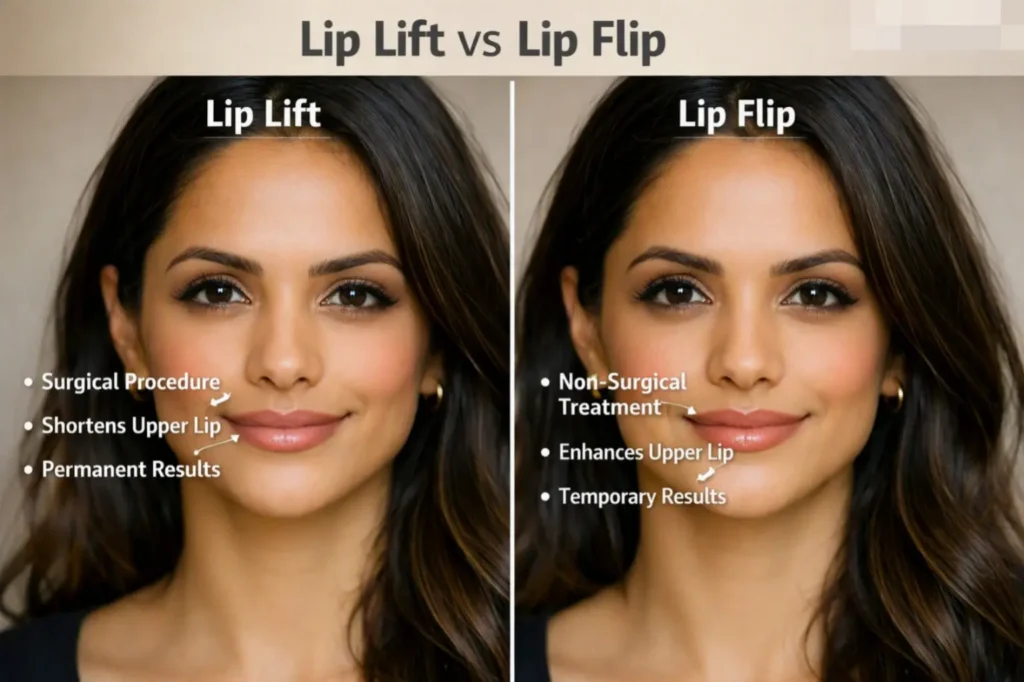
Choosing between a lip lift vs lip flip isn’t really about which procedure is “better.” It’s about which one actually matches your anatomy, your goals, and how much change you’re ready for. These two procedures often get lumped together because they create a similar visual effect, but the decision-making process behind each one is quite different.
A lip flip is a quick, temporary Botox injection. A lip lift is a permanent surgical procedure. Beyond that basic difference, the right choice depends on things like your upper lip length, how much correction you actually need, your tolerance for downtime, and whether you want a trial run before committing to anything permanent.
This guide walks through the decision from a practical angle: what each procedure is actually solving, who tends to be a genuinely good candidate for each, and the questions worth asking yourself before booking a consultation. For a full side-by-side breakdown of cost, recovery, and permanence, this guide to surgical lip flip vs Botox lip flip covers that comparison in detail.
Table of Contents
Quick Answer: Lip Lift vs Lip Flip
A lip flip uses Botox to temporarily relax the upper lip muscle for a subtle outward roll, lasting 2 to 4 months. A lip lift is permanent surgery that shortens the space between the nose and upper lip. Choose a lip flip to trial the look or fix mild gumminess; choose a lip lift for a lasting structural change.
Key Takeaways
- A lip flip is injectable and temporary; a lip lift is surgical and permanent.
- The right choice depends more on your specific anatomy than personal preference alone.
- A long philtrum (space between nose and lip) is a stronger indicator for a lip lift.
- A gummy smile without a long philtrum is often better addressed with a lip flip.
- Many people try a lip flip first before deciding whether a lip lift is worth it long-term.
What Problem Is Each Procedure Actually Solving?
This is the part most comparisons skip, and it’s the most useful way to think about lip lift vs lip flip.
A lip flip addresses muscle behavior. If your upper lip disappears when you smile, or you show more gum than you’d like specifically when smiling, that’s a muscle and movement issue, which Botox can directly relax. Learn more about how a lip flip works to understand this mechanism.
A lip lift addresses structure. If your upper lip looks long or flat even when your face is completely relaxed, that’s often a proportion issue between your nose and lip, which only a physical shortening of that space can meaningfully change.
Lip Lift vs Lip Flip: Core Differences
| Feature | Lip Flip | Lip Lift |
| Category | Injectable, non-surgical | Surgical procedure |
| Fixes | Muscle movement, mild gumminess | Philtrum length, lip proportion |
| Permanence | Temporary, 2–4 months | Permanent |
| Recovery | Minimal | 1–2 weeks visible, months to fully heal |
| Cost | $80–$500 | $2,500–$6,000+ |
| Reversibility | Fully reversible | Not reversible |
How to Tell Which Anatomy Fits Which Procedure
Signs a Lip Flip May Be Right for You
- Your upper lip looks fine at rest but disappears when you smile
- You have a gummy smile specifically triggered by lip movement
- Your lips are already average to full, and you just want a subtle lift
- You want to test the general look before considering anything permanent
Signs a Lip Lift May Be Right for You
- Your upper lip appears long or flat even at rest
- You have a naturally long philtrum (the space between your nose and upper lip)
- You’ve tried a lip flip and feel it doesn’t create enough change
- You’re looking for a permanent structural improvement, not a temporary effect
Step-by-Step: How to Figure Out Which One You Need
- Look at your upper lip at rest. If it looks proportionate and the concern only shows up when smiling, that points toward a lip flip.
- Check your philtrum length. A visually long space between your nose and upper lip is a stronger indicator for a lip lift.
- Consider your comfort with permanence. If you’re unsure, temporary is almost always the safer starting point.
- Think about downtime. A lip flip fits into a lunch break; a lip lift requires real recovery time.
- Book a consultation with both options in mind. A qualified provider can assess your specific anatomy and tell you honestly which one will address your concern.
Lip Lift vs Lip Flip: Results Timeline
| Stage | Lip Flip | Lip Lift |
| Onset | 2–4 days | Immediate, but swelling masks true result |
| Full results visible | 10–14 days | 3–6 months (as swelling fully resolves) |
| Duration | 2–4 months | Permanent |
You can see how gradual the Botox version looks in this lip flip results day by day guide, which is useful context if you’re leaning toward trying the non-surgical option first.
Cost Considerations: Lip Lift vs Lip Flip
A lip flip is the clear winner on upfront affordability, typically running $150 to $300 per session. A lip lift costs significantly more, often $2,500 to $6,000, but doesn’t require repeat sessions. If you’re trying to compare long-term value, it helps to calculate what several years of Botox lip flip maintenance would cost against a single surgical investment. This lip flip cost guide breaks down the non-surgical side of that math.
Can You Try a Lip Flip Before Committing to a Lip Lift?
Yes, and many providers actively recommend this approach. Since a lip flip is temporary and low-risk, it’s a practical way to preview a fuller-looking upper lip before deciding whether the more permanent structural change of a lip lift is worth it for you. Keep in mind that a lip flip and lip lift don’t create identical results, since one relaxes muscle and the other changes structure, but it can still give you a general sense of whether more lip visibility appeals to you.
Pros and Cons Side by Side
Lip Flip
Pros: Low cost, no downtime, fully reversible, low risk Cons: Temporary, doesn’t fix structural proportion issues, requires repeat visits
Lip Lift
Pros: Permanent, addresses structural proportion, no ongoing maintenance Cons: Higher cost, surgical risks, longer recovery, not reversible
Common Mistakes When Choosing Between the Two
- Choosing a lip lift to fix a purely movement-based gummy smile. If the issue only appears when smiling, a lip flip often solves it more directly.
- Choosing a lip flip expecting it to fix a naturally long philtrum. Botox can’t change bone or skin proportion, only muscle behavior.
- Skipping a proper consultation. Both procedures require an assessment of your specific anatomy, not just personal preference.
- Assuming one is universally “better.” They solve different problems, so the better option depends entirely on what’s actually causing your concern.
Frequently Asked Questions
What’s the main difference between a lip lift and a lip flip? A lip lift is a permanent surgical procedure that shortens the space between the nose and upper lip. A lip flip is a temporary Botox injection that relaxes the upper lip muscle.
Can a lip flip fix a long philtrum? No. A lip flip only relaxes muscle movement; it can’t change the actual proportion between your nose and upper lip, which is what a lip lift addresses.
Is a lip lift more effective than a lip flip for a gummy smile? Not necessarily. If your gummy smile is caused by lip movement rather than lip length, a lip flip may address it more directly and at a much lower cost.
How do I know if I have a long philtrum? A long philtrum typically means your upper lip looks flat or elongated even when your face is relaxed, not just when you smile. A consultation with a qualified provider can confirm this more precisely.
Should I try a lip flip before considering a lip lift? Many providers recommend this, since it’s a low-risk way to preview added lip visibility before committing to a permanent surgical procedure.
Which procedure has less risk, lip lift or lip flip? A lip flip generally carries less risk, since it’s non-surgical and fully reversible, while a lip lift involves the risks associated with any minor surgery.
Can I get a lip lift if I’ve had lip flips for years? Yes. Many patients transition from repeat Botox lip flips to a permanent lip lift once they’re confident in the look they want long-term.
Does a lip lift replace the need for a lip flip? Not always. Some patients still choose occasional Botox lip flips after a lip lift if they want additional muscle relaxation on top of their surgical results.
Is one procedure more natural-looking than the other? Both can look very natural when performed by an experienced provider. The difference is more about permanence and mechanism than which one looks more “real.”
Can a lip lift and lip flip be combined? In some cases, yes, though this depends on your provider’s assessment of your anatomy and goals. A consultation is the best way to explore whether combining approaches makes sense for you.
Does age affect which option is better? Age can influence lip and skin elasticity, which may factor into your provider’s recommendation, but the more important factor is usually your specific philtrum length and movement pattern rather than age alone.
Which option is easier to reverse if I change my mind? A lip flip is far easier to “reverse,” simply by letting the Botox wear off naturally. A lip lift is considered a permanent change and isn’t designed to be undone.
Summary
The lip lift vs lip flip decision comes down to understanding what’s actually driving your concern: muscle movement or structural proportion. A lip flip is the lower-risk, reversible option that works well for gummy smiles and subtle lift, while a lip lift offers a permanent solution for a naturally long philtrum or flat upper lip. For many people, trying a lip flip first is a practical, low-commitment way to explore the look before deciding whether a permanent procedure is the right long-term investment.
To keep exploring the non-surgical route, check out real lip flip before and after photos, review the lip flip procedure step by step, or learn about proper lip flip aftercare before your consultation.
This article is for informational purposes only and doesn’t replace personalized medical advice. Always consult a licensed, qualified injector or board-certified surgeon to determine which procedure best fits your specific anatomy and goals.