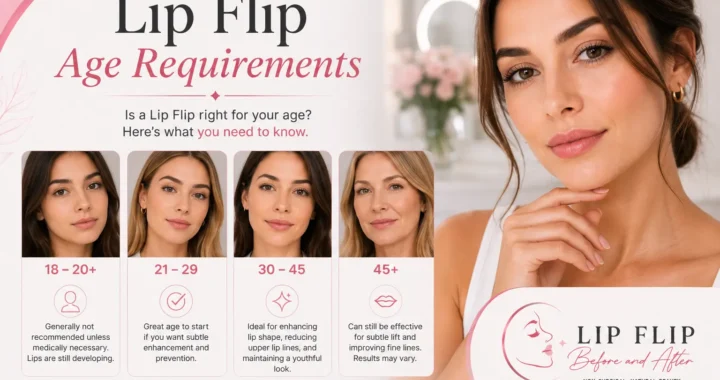
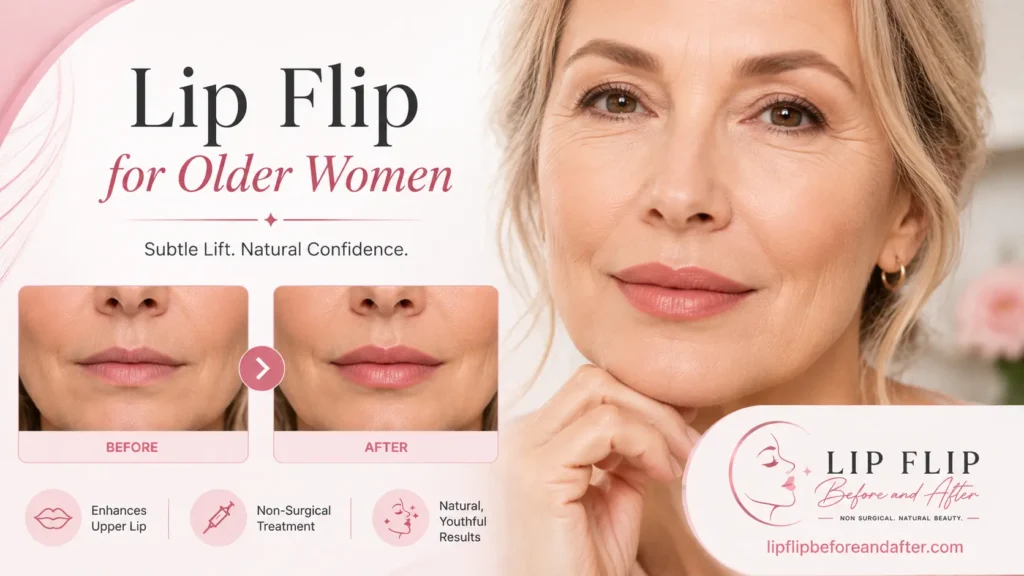
As lips naturally thin and lose definition over time, a lip flip for older women has become a common question for anyone noticing their smile looks a little different than it used to. It’s worth understanding upfront that age changes how this treatment performs, and being realistic about that difference matters more here than for younger patients.
Lips lose collagen, elastin, and volume as we age, and the upper lip in particular can lengthen and flatten. A lip flip works by relaxing the muscle around the mouth, which can help, but it doesn’t address volume loss the way filler does. For many women over 50, understanding this distinction is the difference between a treatment that meets expectations and one that doesn’t.
This guide covers how aging affects lip flip candidacy and results, realistic outcomes for mature lips, how it compares to filler, and what combination options are worth discussing with a provider.
Yes, a lip flip can work well for older women, particularly for softening a flattened smile or subtly repositioning the upper lip. However, since it doesn’t restore lost volume, women whose main concern is age-related thinning often see better results combining it with filler rather than using a lip flip alone.
Table of Contents
Key Takeaways
- Aging changes lip structure through volume loss, elongation, and reduced elasticity, which affects how a lip flip performs.
- A lip flip addresses muscle-related lip position, not age-related volume loss.
- Combination treatment with filler is common and often recommended for mature lips.
- Results are typically subtle, most visible when smiling or talking.
- Duration is similar to younger patients, generally 8–12 weeks.
- A detailed consultation is especially important to assess candidacy accurately.
How Lips Change With Age
Understanding why a lip flip performs differently on older lips starts with knowing what actually changes over time:
- Volume loss — natural collagen and fat decline reduce overall lip fullness.
- Lip elongation — the space between the nose and upper lip (the philtrum) tends to lengthen, making the upper lip appear flatter and show less pink.
- Reduced elasticity — skin loses some of its ability to spring back, affecting how the lip responds to muscle relaxation.
- Thinning of the vermillion border — the defined edge of the lip can become less crisp over time.
These changes matter because a lip flip specifically targets muscle activity, not the structural or volume-related shifts that come with aging. For background on the mechanism itself, see how does a lip flip work.
What a Lip Flip Can Realistically Do for Mature Lips
A lip flip relaxes the orbicularis oris muscle, allowing the upper lip to roll slightly outward and show a bit more pink tissue. On older lips, this can:
- Soften a flattened smile caused by muscle tension pulling the lip thin.
- Add a subtle sense of fullness during expression without surgery or filler.
- Provide a lower-commitment option for testing whether lip enhancement is something you want to pursue further.
It generally can’t:
- Restore volume lost to collagen decline.
- Shorten an elongated philtrum.
- Fully recreate the fuller lip shape common in younger patients.
Real examples of results specific to this age group can be seen at lip flip before and after older woman.
Lip Flip Alone vs. Lip Flip Combined With Filler for Older Women
| Approach | Addresses | Best For |
| Lip flip alone | Muscle position, subtle repositioning | Women mainly concerned with a flattened smile, not volume loss |
| Filler alone | Volume restoration | Women whose main concern is lost fullness, not lip position |
| Lip flip + filler | Both position and volume | Women wanting a more complete restoration of youthful lip appearance |
Many providers recommend combination treatment for patients over 50 specifically because it addresses both contributing factors at once. See lip flip with filler for how the two are typically combined.
Lip Flip vs. Lip Lift for Age-Related Changes
For women whose upper lip has significantly lengthened with age, a surgical lip lift is sometimes discussed as an alternative or complement to a lip flip.
| Factor | Lip Flip | Lip Lift |
| Addresses lip length | No | Yes, shortens the philtrum surgically |
| Invasiveness | Minimal, injection only | Surgical procedure |
| Duration | 8–12 weeks | Permanent |
| Downtime | Minimal | Days to weeks of recovery |
| Cost | Lower | Higher |
A full comparison is available at lip lift vs lip flip. For most women, a lip flip is worth trying first given its low commitment, with a lip lift considered only if age-related elongation is a primary concern.
Step-by-Step: Deciding If a Lip Flip Is Right for You Over 50
- Identify your primary concern. Is it mainly a flattened smile, lost volume, or both?
- Review realistic before-and-after examples specific to mature lips, not general marketing photos.
- Book a consultation focused on your specific anatomy. Ask directly whether a lip flip alone will meet your goals or whether combination treatment makes more sense.
- Discuss dosage. Skin elasticity and muscle tone can affect how your provider approaches your treatment plan.
- Set expectations for subtlety. Understand that results will likely be gentle rather than dramatic, especially without added filler.
A thorough lip flip consultation is especially valuable for this age group, since candidacy and expected outcomes vary more than with younger patients.
Pros and Cons for Older Women
Pros
- Low-commitment way to test subtle lip enhancement.
- No added volume, which can look more natural on mature facial proportions.
- Minimal downtime, fitting easily into a busy schedule.
- Can be layered with filler later if more correction is desired.
Cons
- Doesn’t address volume loss, a primary concern for many women over 50.
- Doesn’t shorten an elongated philtrum.
- Results may feel too subtle for those hoping for a more youthful, fuller look.
- May require combination treatment to fully meet expectations.
Common Mistakes Older Patients Make
- Expecting a lip flip alone to restore the fullness lips had decades earlier.
- Not mentioning specific concerns like a lengthened philtrum, which a lip flip can’t address.
- Comparing results to younger patients’ before-and-after photos rather than age-matched examples.
- Skipping a discussion of combination treatment when volume loss is a clear factor.
- Choosing dosage without considering how skin elasticity and muscle tone may affect the outcome.
Is a Lip Flip Enough, or Should You Consider Combination Treatment?
Featured Snippet Answer: For older women whose main concern is a flattened smile from muscle tension, a lip flip alone can help. For those whose primary concern is age-related volume loss, combining a lip flip with filler typically provides more complete, satisfying results than either treatment alone.
This article is intended for general educational purposes and isn’t a substitute for personalized medical advice. A qualified provider can assess your specific lip anatomy, skin quality, and goals to recommend the most appropriate approach.
Frequently Asked Questions
Is there an age limit for getting a lip flip? There’s no strict upper age limit; candidacy depends more on individual anatomy and health than age alone, which your provider can assess directly.
Will a lip flip make my lips look younger? It can soften a flattened smile and add subtle fullness during expression, though it doesn’t reverse volume loss, which is often a bigger factor in how “youthful” lips appear.
Does skin elasticity affect lip flip results in older patients? Yes, reduced elasticity can influence how the lip responds to muscle relaxation, which is why an individualized assessment matters for this age group.
Can a lip flip help with vertical lip lines from aging? A lip flip specifically targets the muscle affecting lip position rather than fine lines; separate treatments are typically used to address vertical lip lines.
Is filler a better option than a lip flip for someone over 50? It depends on your primary concern. If volume loss is the main issue, filler alone or combined with a lip flip is often more effective than a lip flip by itself.
How long does a lip flip last for older women compared to younger patients? Duration is generally similar, typically 8–12 weeks, though individual metabolism and muscle tone can still play a role regardless of age.
Can a lip flip be combined with other anti-aging treatments? Yes, many women combine it with other facial treatments during the same visit, though this should be planned with your provider based on your overall goals.
Will my results look natural, or too obvious, at my age? When appropriately dosed for your specific anatomy, results are designed to look subtle and natural rather than obviously treated.
Should I try a lip flip before considering a surgical lip lift? Many providers suggest trying a lip flip first given its lower cost and reversibility, reserving a lip lift for cases where lip elongation is the primary concern.
Does menopause affect how a lip flip performs? Hormonal changes can affect skin and collagen over time, but there’s no strong evidence that menopause specifically changes how a lip flip’s muscle-relaxing mechanism works.
Can I get a lip flip if I’ve had previous lip filler? Yes, the two treatments work independently and are commonly combined, whether the filler was done recently or years ago.
Summary
A lip flip for older women can genuinely help soften a flattened smile and add subtle fullness during expression, but it’s not designed to restore lost volume or correct a lengthened upper lip. Many women over 50 find the best results come from pairing a lip flip with filler rather than relying on either treatment alone. A detailed consultation that accounts for your specific age-related changes is the most reliable way to figure out what approach will actually meet your goals.