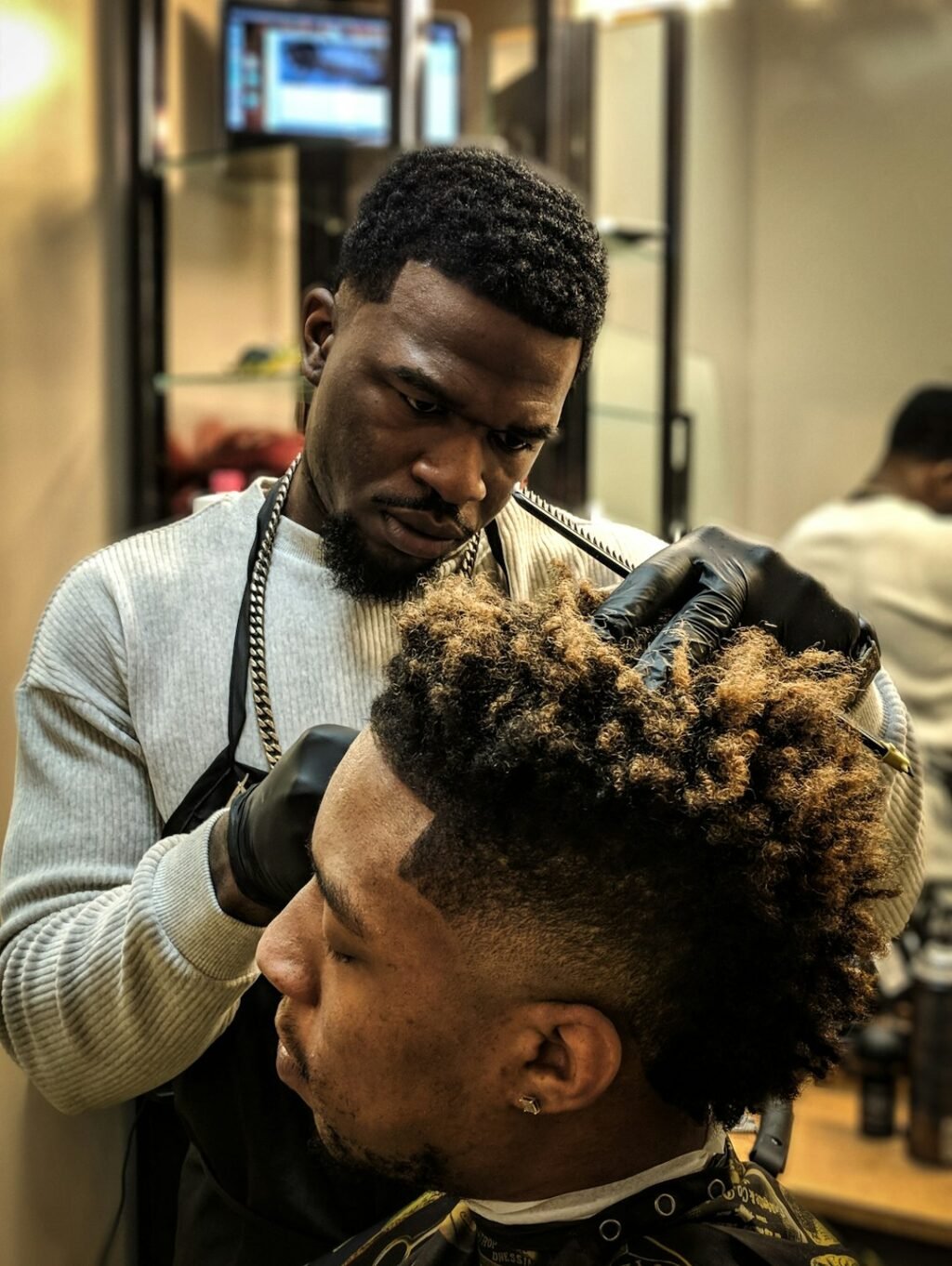
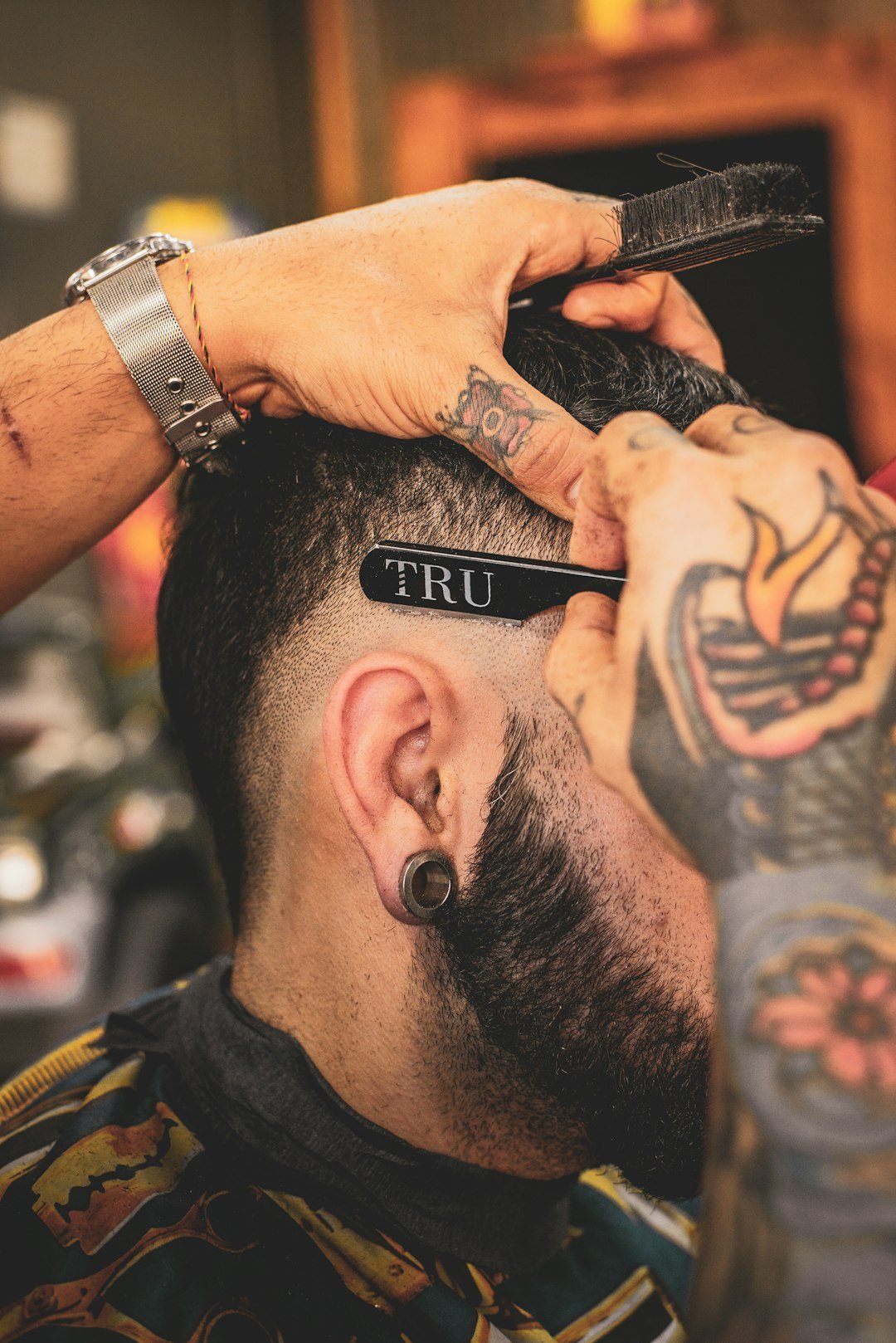
A burst fade is a fade that curves in a semicircle around the ear instead of running in a straight line around the head. The shortest point sits just above and behind the ear, and the hair gets longer as it radiates outward, like rays of a sun. Because the back is left longer, a burst fade gives a rounded, mohawk-style silhouette that looks bold from the side but still tidy from the front.
Below you will find how a burst fade differs from similar cuts, the best styles to pair with it, which hair types and hairlines it suits, how barbers cut it, and how to ask for one so you get the exact shape you want.
Burst Fade at a Glance
| Shape | Semicircle fade around the ear, longer hair at the back |
| Also called | Gentleman’s mohawk, South of France haircut |
| Best with | Mohawks, faux hawks, curly tops, Afros, mullets |
| Lowest point | Skin, or a 0 to 1 guard |
| Looks sharp for | About 2 weeks |
| Touch-ups | Every 2 to 3 weeks |
What Is a Burst Fade?
Most fades follow a horizontal band around the head. A burst fade instead follows an arc that starts near the temple, dips around the back of the ear, and comes back up toward the crown. Hair in front of and behind the arc is left longer, which is what creates the distinctive “sunburst” outline. The cut was made famous by Usher and his longtime barber, and it has since become a barbershop classic for men and boys.
Burst Fade vs Taper vs Drop vs Temple Fade
| Cut | Shape of the fade | Back of the head | Best for |
| Burst fade | Semicircle around the ear | Left long | Mohawks, curly tops, mullets |
| Taper fade | Only sideburns and neckline | Tapered neatly | Office-friendly, low-key looks |
| Drop fade | Drops lower behind the ear and follows the neckline | Faded | Longer tops, more shape at the back |
| Temple fade | Only at the temples and sideburns | Untouched | Line-ups and very subtle fades |
The key difference: a burst fade leaves length at the back of the neck. If you want the back faded too, ask for a drop fade instead. For the subtle version, see our taper fade guide on the blog.
Types of Burst Fade
- Low burst fade: the arc sits close to the ear. Subtle and the easiest to grow out.
- Mid burst fade: a wider arc that shows more contrast. The most popular version.
- High burst fade: the arc reaches toward the temples for a dramatic, mohawk-heavy look.
- Skin burst fade: the lowest point is shaved to the skin for maximum contrast.
- Burst taper: a softer burst that keeps a little more length at the lowest point.
10 Best Burst Fade Styles
- Burst fade mohawk: the classic pairing. The arc leads the eye up to a strip of longer hair on top.
- Burst fade faux hawk: a softer mohawk with the top styled toward the centre.
- Burst fade with curly top: removes bulk at the sides and lets curls stand out.
- Burst fade Afro: frames a round Afro shape with clean edges.
- Burst fade mullet: the curve transitions from short sides to a long back.
- Burst fade buzz cut: a short buzz on top with a curved fade for shape without length.
- Burst fade with twists or locs: keeps the scalp around the ears clean while the top stays long.
- Burst fade with design: a shaved line or pattern inside the arc for extra detail.
- Burst fade on straight hair: works best with a textured crop or messy fringe on top.
- Burst fade for boys: a low burst with a short textured top is a popular, easy kids’ cut.
Who Should Get a Burst Fade?
| You have | Will a burst fade suit you? |
| Curly or coily hair | Yes, one of the best matches; the arc complements round shapes |
| Thick hair | Yes, the contrast and curve stand out clearly |
| Straight hair | Yes, with a textured top so it does not look flat |
| Fine or thin hair | Possible, but keep it low so the sides do not look sparse |
| Receding hairline | Choose a low burst; a high arc draws attention to the temples |
| Round face | Pair with height on top, such as a faux hawk |
How a Burst Fade Is Cut
- Consultation: the barber agrees the top length and how high the arc should go.
- Set the canvas: the sides are taken down with a longer guard, often a 2.
- Mark the arc: a trimmer sets the lowest point just behind the ear.
- Fade upward in a curve: guards are worked up in a circular motion so the fade follows the arc, not a straight band.
- Keep the back long: the fade line drops right behind the ear so the neck keeps its length.
- Check the shape: a good barber steps back to check both sides match from a distance.
How to Ask Your Barber for a Burst Fade
Point to the area behind your ear and cover these points:
- Low, mid or high burst
- Skin at the lowest point, or a 0 or 1
- How much length to keep at the back of the neck
- Top length and style (mohawk, curls, crop)
Example script: “Mid burst fade from skin, keep the length at the back, about 7 cm on top for a faux hawk.” Always bring a side-view photo, because the arc is easiest to understand from the side.
Burst Fade Maintenance
The lowest, shortest part of a burst fade shows regrowth first, usually after about two weeks. By weeks three to four the arc starts to blur. Book a touch-up every two to three weeks to keep the curve crisp. Between cuts, use matte clay for mohawks and crops, or curl cream and a light oil for textured hair, and wash with a gentle shampoo because the scalp around the ear is exposed.
Burst Fade FAQs
Is a burst fade the same as a mohawk?
No. A burst fade is the shape of the fade around the ear. It is often paired with a mohawk, but you can wear it with almost any top.
Is a burst fade professional?
A low burst fade with a neat top can work in most workplaces. High burst fades with a mohawk are bolder and more casual.
What is the difference between a burst fade and a drop fade?
A drop fade continues down and follows the neckline. A burst fade stops behind the ear and leaves the back long.
How long does a burst fade last?
It looks sharp for about two weeks and holds its shape for around three. After that, the arc softens and needs a touch-up.
Sources: Modern Barber: What is the burst fade; Cadmen Academy: The burst fade guide; Man of Many: Taper fade haircuts.